

Spectral domain simulation of SIS frequency multiplication
28th International Symposium on Space Terahertz Technology (ISSTT 2017) National Radio Astronomy Observatory (2017)
Abstract:
In this paper, we compare simulations to experimental results for a new SIS frequency multiplier. To simulate these devices, we developed software based on spectral-domain analysis, which is ideal for simulating higherorder harmonics such as those present in a multiplier. In addition, we included the embedding circuit and interpolated the experimental I-V curve to allow the simulation to capture the experimental system as closely as possible. For the experimental data, results were taken from a new SIS frequency multiplier that has recently been developed at the Chalmers University of Technology. Previously, these experimental results were compared to simulations based on Tucker theory. Here, we compare these results to spectraldomain simulations. Qualitatively, the inclusion of embedding impedances and the use of spectral-domain analysis improves the agreement between simulation and experiment. The software can now be used to design multipliers with high output power and high conversion efficiency.Optimizing sparse sampling for 2D electronic spectroscopy
The Journal of Chemical Physics American Institute of Physics 146:8 (2017) 084201-084201
Abstract:
The two-dimensional (2D) vibronic spectroscopy of molecular trimers is studied theoretically. The solution of the time-dependent Schrödinger equation is carried out with the multi-configurational time-dependent Hartree (MCTDH) method which allows for an efficient propagation of the multi-component wave functions. 2D-spectra are calculated for H- and J-type aggregates incorporating one or two vibrational modes for each monomer. In performing calculations for monomer, dimer, and trimer systems, it is documented how the vibronic structure of the 2D-spectrum changes upon aggregation. This is of importance for the characterization of aggregation behavior being influenced by experimental conditions such as temperature or concentrationA 230 GHz Finline SIS receiver with wide IF bandwidth
27th International Symposium on Space Terahertz Technology, ISSTT 2016 International Symposium on Space Terahertz Technology (2017)
Abstract:
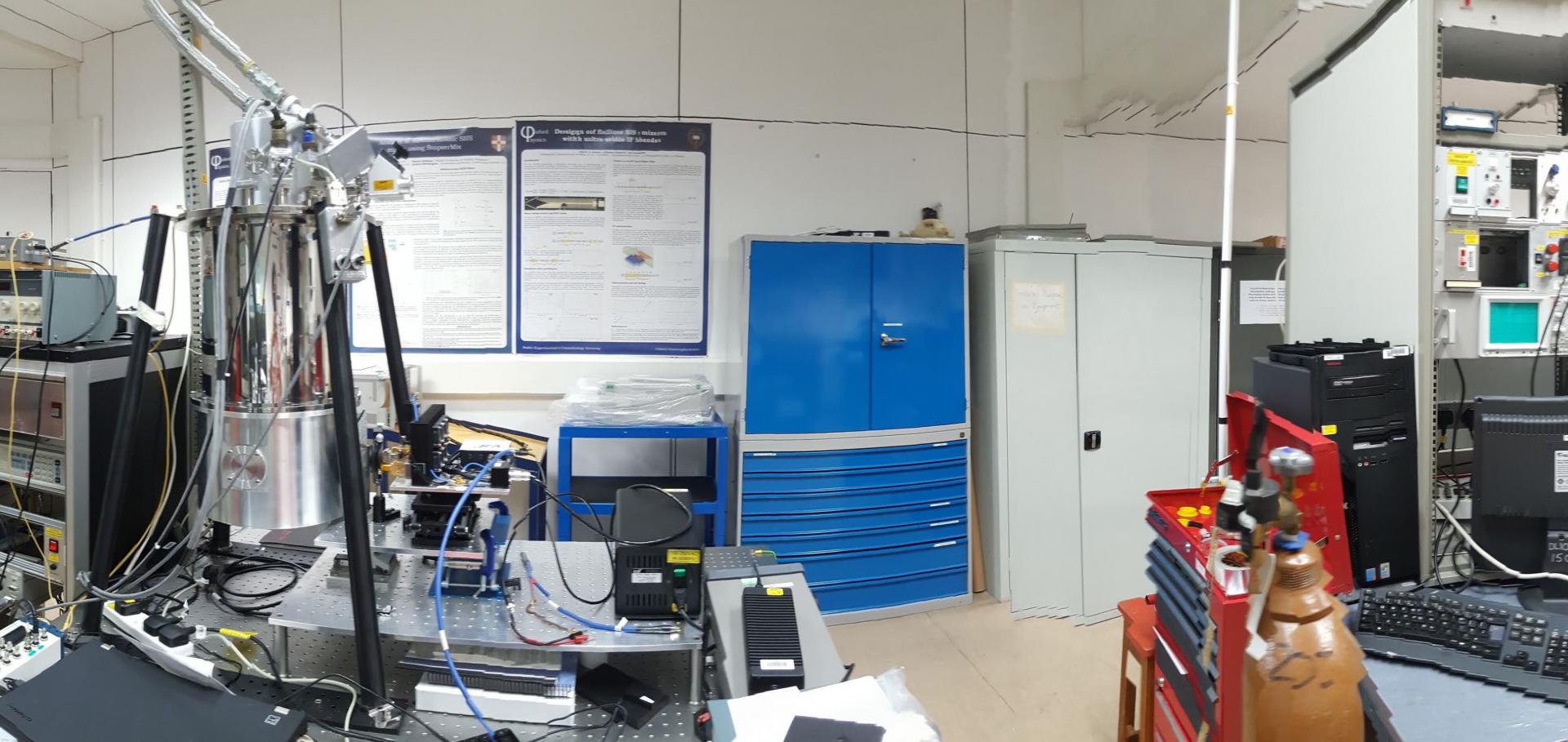
We have developed anSIS receiver with a wide intermediate-frequency (IF) bandwidth.This is important for reducing image integration time and simultaneously measuring multiple spectral lines. The receiver is a finline mixer-based design, which allows for ultra-wide radio-frequency (RF) bandwidth and has lower mechanical requirements compared to radial stub designs. Simulations of this receiver showed quantum limited noise in the RF frequency range of 140 to 260 GHzand from DC to 10GHz in the IF spectrum.We measured the noise temperature by comparing the receiver's response to hot and cold loads. The best noise temperature was 37.9 K at 231.0 GHz, and all of the results were below 100 K from 213 to 257 GHz (the bandwidth of our local-oscillator). We measured the IF bandwidth using a spectrum analyser, and found good results from around 3-10 GHz. The lower frequency was restricted by our IF amplifier's bandwidth but the higher frequency limit was lower than we expected from simulations. We believe that this discrepancywas due to the inductance of the bondwires that we used to connect the mixer chip to the IF board. We are currently investigating techniques to reduce and compensate for this inductance.A 230 GHz finline SIS receiver with wide if bandwidth
27th International Symposium on Space Terahertz Technology, ISSTT 2016 (2017)
Abstract:
We have developed anSIS receiver with a wide intermediate-frequency (IF) bandwidth.This is important for reducing image integration time and simultaneously measuring multiple spectral lines. The receiver is a finline mixer-based design, which allows for ultra-wide radio-frequency (RF) bandwidth and has lower mechanical requirements compared to radial stub designs. Simulations of this receiver showed quantum limited noise in the RF frequency range of 140 to 260 GHzand from DC to 10GHz in the IF spectrum.We measured the noise temperature by comparing the receiver's response to hot and cold loads. The best noise temperature was 37.9 K at 231.0 GHz, and all of the results were below 100 K from 213 to 257 GHz (the bandwidth of our local-oscillator). We measured the IF bandwidth using a spectrum analyser, and found good results from around 3-10 GHz. The lower frequency was restricted by our IF amplifier's bandwidth but the higher frequency limit was lower than we expected from simulations. We believe that this discrepancywas due to the inductance of the bondwires that we used to connect the mixer chip to the IF board. We are currently investigating techniques to reduce and compensate for this inductance.A smooth walled four pixel feed horn array operating at 1.4 THz
Isstt 2017 28th International Symposium on Space Terahertz Technology 2017-March (2017)