

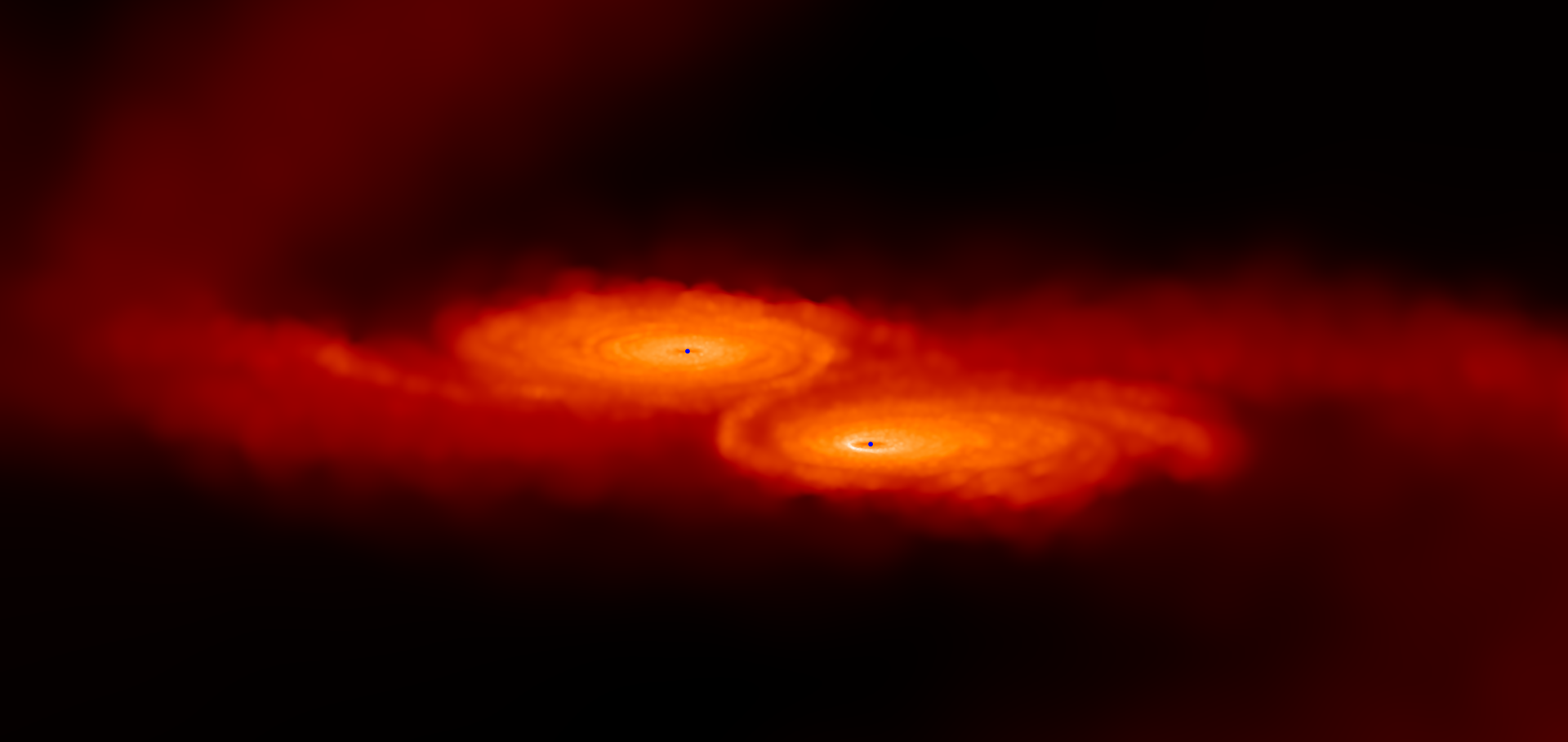
Constraining Stellar-mass Black Hole Mergers in AGN Disks Detectable with LIGO
ASTROPHYSICAL JOURNAL American Astronomical Society 866:1 (2018) ARTN 66
Abstract:
© 2018. The American Astronomical Society. All rights reserved.. Black hole (BH) mergers detectable with the Laser Interferometer Gravitational-wave Observatory (LIGO) can occur in active galactic nucleus (AGN) disks. Here we parameterize the merger rates, the mass spectrum, and the spin spectrum of BHs in AGN disks. The predicted merger rate spans ∼10-3-104 Gpc-1 yr-1, so upper limits from LIGO (<212 Gpc-1 yr-1) already constrain it. The predicted mass spectrum has the form of a broken power law, consisting of a pre-existing BH power-law mass spectrum and a harder power-law mass spectrum resulting from mergers. The predicted spin spectrum is multipeaked with the evolution of retrograde spin BHs in the gas disk playing a key role. We outline the large uncertainties in each of these LIGO observables for this channel and we discuss ways in which they can be constrained in the future.Action-based dynamical models of dwarf spheroidal galaxies: application to Fornax
Monthly Notices of the Royal Astronomical Society Oxford University Press (OUP) 480:1 (2018) 927-946
Conceptual design study for heat exhaust management in the ARC fusion pilot plant
Fusion Engineering and Design 137 (2018) 221-242
Abstract:
© 2018 Elsevier B.V. The ARC pilot plant conceptual design study has been extended beyond its initial scope [B. N. Sorbom et al., FED 100 (2015) 378] to explore options for managing ∼525 MW of fusion power generated in a compact, high field (B0 = 9.2 T) tokamak that is approximately the size of JET (R0 = 3.3 m). Taking advantage of ARC's novel design – demountable high temperature superconductor toroidal field (TF) magnets, poloidal magnetic field coils located inside the TF, and vacuum vessel (VV) immersed in molten salt FLiBe blanket – this follow-on study has identified innovative and potentially robust power exhaust management solutions. The superconducting poloidal field coil set has been reconfigured to produce double-null plasma equilibria with a long-leg X-point target divertor geometry. This design choice is motivated by recent modeling which indicates that such configurations enhance power handling and may attain a passively-stable detachment front that stays in the divertor leg over a wide power exhaust window. A modified VV accommodates the divertor legs while retaining the original core plasma volume and TF magnet size. The molten salt FLiBe blanket adequately shields all superconductors, functions as an efficient tritium breeder, and, with augmented forced flow loops, serves as an effective single-phase, low-pressure coolant for the divertor, VV, and breeding blanket. Advanced neutron transport calculations (MCNP) indicate a tritium breeding ratio of ∼1.08. The neutron damage rate (DPA/year) of the remote divertor targets is ∼3–30 times lower than that of the first wall. The entire VV (including divertor and first wall) can tolerate high damage rates since the demountable TF magnets allow the VV to be replaced every 1–2 years as a single unit, employing a vertical maintenance scheme. A tungsten swirl tube FLiBe coolant channel design, similar in geometry to that used by ITER, is considered for the divertor heat removal and shown capable of exhausting divertor heat flux levels of up to 12 MW/m2. Several novel, neutron tolerant diagnostics are explored for sensing power exhaust and for providing feedback control of divertor conditions over long time scales. These include measurement of Cherenkov radiation emitted in FLiBe to infer DT fusion reaction rate, measurement of divertor detachment front locations in the divertor legs with microwave interferometry, and monitoring “hotspots” on the divertor chamber walls via IR imaging through the FLiBe blanket.First-order mean motion resonances in two-planet systems: general analysis and observed systems
(2018)
Orbit-superposition models of discrete, incomplete stellar kinematics: application to the Galactic centre
(2018)