

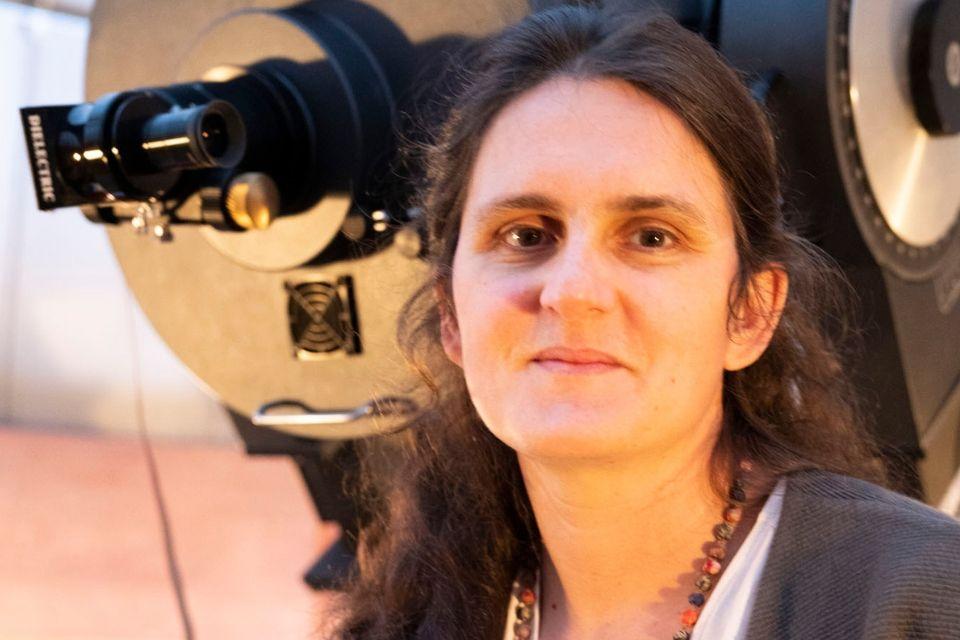
Professor Suzanne Aigrain has been awarded a European Research Council (ERC) Synergy Grant to co-lead an ambitious, far-reaching research project which aims to enable the discovery of Earth-like planets orbiting other stars. ERC Synergy Grants foster interdisciplinary and international collaboration between outstanding researchers and the project brings together researchers from the Department of Physics at the University of Oxford, Université de Genève and Georg-August-Universität Göttingen.
Astronomers can detect exoplanets by measuring the tiny changes in a star's motion caused by the gravitational pull of an orbiting planet. However, the signals from planets like Earth are so small that they are easily overwhelmed by variations in the stars themselves, as well as imperfections in the instruments used to observe them.
The project will combine advances in telescope instrumentation, observations of the Sun and cutting-edge data analysis to overcome these obstacles and reach the sensitivity required to detect rocky planets resembling Earth. The Oxford team, led by Professor Suzanne Aigrain, will develop new statistical and machine-learning techniques to disentangle the signatures of planets from the natural variability of their host stars, and to determine reliably which signals reveal genuine planets.
The last 30 years have seen very rapid technological progress in ultra-stable high-resolution spectrographs, yet the methods used to calibrate and extract the spectra have remained essentially unchanged. SpectralFidelity wants to unlock the full potential of existing, new, and next-generation spectrographs: the project aims to implement a fundamentally different, modern approach to the entire calibration, extraction and analysis procedure to enable a more detailed modelling of stellar variability. This, in turn, is what is needed to detect Earth-like planets.
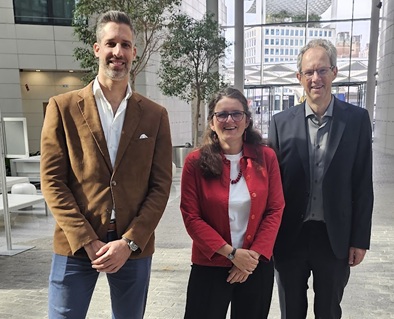
Professor Aigrain’s group will lead on the stellar variability modelling and planet detection aspects while Professor Reiners from the Georg-August-Universität Göttingen will lead on the calibration side and Professor Dumusque from the Université de Genève will lead on spectral extraction – although all three will work collaboratively across all of these topics. Professors Reiners and Dumusque are also principal investigators of solar telescopes that will provide crucial data to validate the project’s methods.
‘My collaborators and I believe the SpectralFidelity project will have a far-reaching impact,’ comments Professor Aigrain, ‘not just because it will allow us to push back the limits of detectability for exoplanets, but on astronomy more generally – high-dispersion spectroscopy is one of the most powerful tools available to astronomers to probe the Universe both near and far. SpectralFidelity will open up new discovery space from exoplanets to fundamental physics, and lead to the first true Earth analogues with measured masses.’