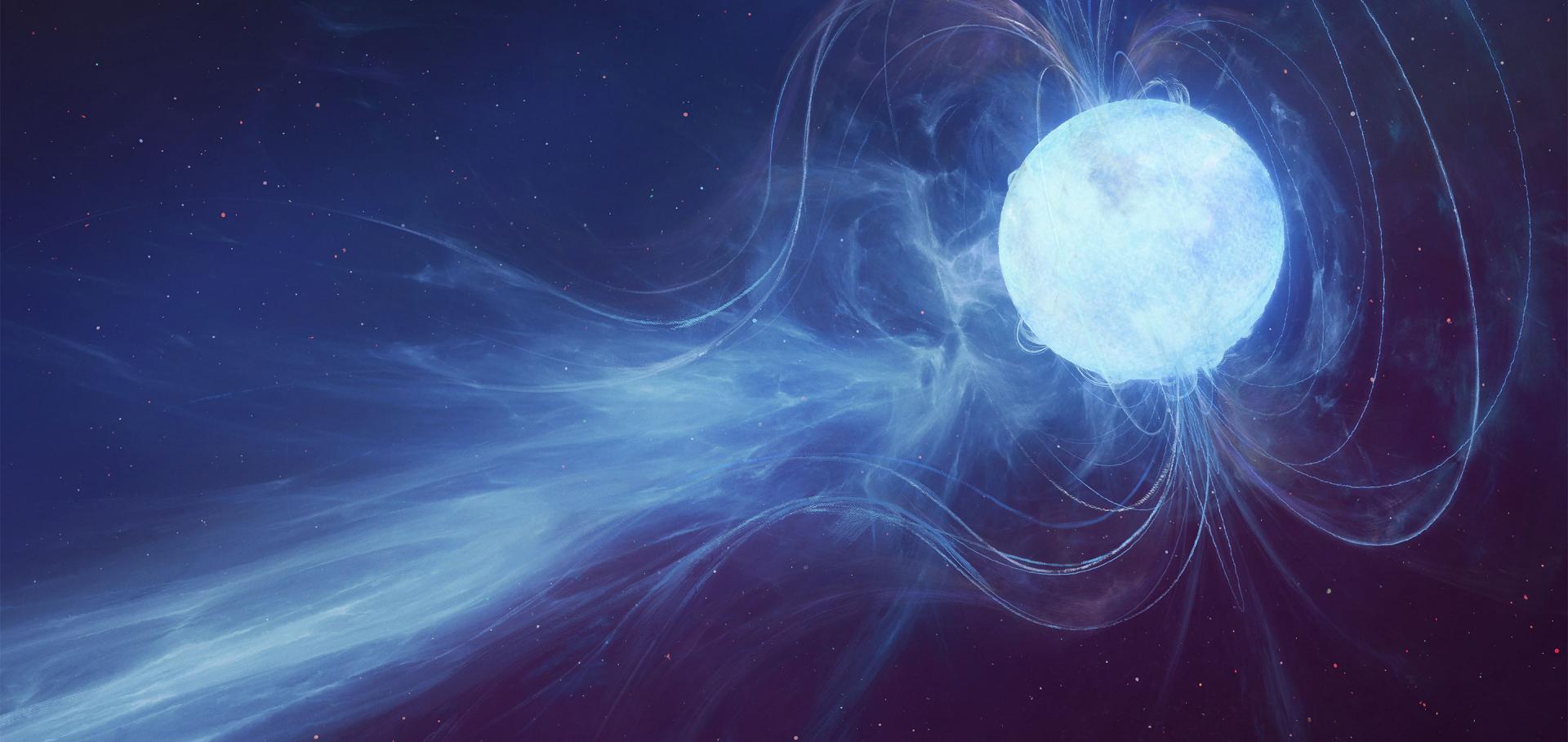
A persistent ultraviolet outflow from the accretion disc in a transient neutron star binary

Authors:

Noel Castro Segura, Christian Knigge, Knox Long, Diego Altamirano, Montserrat Armas Padilla, Charles Bailyn, David Buckley, Douglas Buisson, Jorge Casares, Phil Charles, Jorge Combi, Virginia A Cúneo, Nathalie Degenaar, Santiago del Palacio, Maria Diaz Trigo, Rob Fender, Poshak Gandhi, Claudia Gutíerrez, Juan Hernández Santisteban, Felipe Jiménez Ibarra, James Matthews, Mariano Mendez, Matthew Middleton, Teo Muñoz Darias, Mehtap Özbey Arabaci, Mayukh Pahari, Lauren Rhodes, Thomas Russell, Simone Scaringi, Jakob van den Eijden, Georgios Vasilopolulos, Federico Vincentelli, Phil Wiseman

A relativistic jet from a neutron star breaking out of its natal supernova remnant

Monthly Notices of the Royal Astronomical Society, Volume 541, Issue 4, August 2025, Pages 4011–4024

Authors:

K. V. S. Gasealahwe†; K. Savard†; I. M. Monageng; I. Heywood; R. P. Fender; P. A. Woudt; J. English; J. H. Matthews; H. Whitehead; F. J. Cowie; A. K. Hughes; P. Saikia; S. E. Motta.
† = co-first authors

Abstract:

The young neutron star X-ray binary, Cir X-1, resides within its natal supernova remnant and experiences ongoing outbursts every 16.5 d, likely due to periastron passage in an eccentric orbit. We present the deepest ever radio image of the field, which reveals relativistic jet-punched bubbles that are aligned with the mean axis of the smaller scale jets observed close to the X-ray binary core. We are able to measure the minimum energy for the bubble, which is around 10^45 erg. The nature and morphological structure of the source were investigated through spectral index mapping and numerical simulations. The spectral index map reveals a large fraction of the nebula’s radio continuum has a steep slope, associated with optically thin synchrotron emission, although there are distinct regions with flatter spectra. Our data are not sensitive enough to measure the spectral index of the protruding bubbles. We used the pluto code to run relativistic hydrodynamic simulations to try and qualitatively reproduce the observations with a combined supernova-plus-jet system. We are able to do so using a simplified model in which the asymmetrical bubbles are best represented by supernova explosion which is closely followed (within 100 yr) by a phase of very powerful jets lasting less than 1000 yr. These are the first observations revealing the initial breakout of neutron star jets from their natal supernova remnant, and further support the scenario in which Cir X-1 is a younger relation of the archetypal jet source SS433.

Are blazars above the blazar sequence a significant source of IceCube neutrinos?

Monthly Notices of the Royal Astronomical Society, Volume 509, Issue 3, pp.4620-4625

Authors:

Savard, Katherine ; Ruan, John J. ; Haggard, Daryl

Abstract:

The recent association of two flaring blazars (TXS 0506+056 and 3HSP J095507.9+355101) with IceCube neutrinos strongly suggests that blazars are at least one source of high-energy neutrinos. A peculiar characteristic of these two blazars is that they both appear to lie above the well-known blazar sequence, and they move further above the blazar sequence during the neutrino emission. Although the reason for this peculiarity is unclear, it may indicate a link between blazar SED properties and neutrino emission. Here, we test whether blazars lying above the blazar sequence are overrepresented in IceCube neutrino error regions. We spatially cross-match IceCube error regions with a sample of γ-ray blazars from the Fermi-LAT 4LAC catalogue, as a function of the blazars' distance in synchrotron peak frequency above the blazar sequence. We do not find a statistically significant excess of counterparts, and thus conclude that the current data cannot confirm that the sources above the blazar sequence are a significant source of IceCube neutrinos. However, we show that the inclusion of more recently detected IceCube events increases the likelihood of an excess of blazars above the blazar sequence, and suggest that this excess may reach statistical significance in the future as the sample of IceCube neutrino detections increases.

Detecting edges in the X-ray surface brightness of galaxy clusters

Monthly Notices of the Royal Astronomical Society Oxford University Press (OUP): Policy P - Oxford Open Option A

Authors:

JS Sanders, AC Fabian, HR Russell, SA Walker, KM Blundell

Abstract:

The effects of many physical processes in the intracluster medium of galaxy clusters imprint themselves in X-ray surface brightness images. It is therefore important to choose optimal methods for extracting information from and enhancing the interpretability of such images. We describe in detail a gradient filtering edge detection method that we previously applied to images of the Centaurus cluster of galaxies. The Gaussian gradient filter measures the gradient in the surface brightness distribution on particular spatial scales. We apply this filter on different scales to Chandra X-ray observatory images of two clusters with AGN feedback, the Perseus cluster and M87, and a merging system, A3667. By combining filtered images on different scales using radial filters spectacular images of the edges in a cluster are produced. We describe how to assess the significance of features in filtered images. We find the gradient filtering technique to have significant advantages for detecting many kinds of features compared to other analysis techniques, such as unsharp-masking. Filtering cluster images in this way in a hard energy band allows shocks to be detected.

Finding radio transients

Abstract:

Modern radio telescopes are data-intensive machines, producing many TB of data every night. Amongst this deluge of data are transient and variable phenomena, whose study can shed new light on processes as varied as stellar dynamos and the accretion discs in supermassive black holes. In this work I demonstrate the applicability of different methods to the discovery of these astrophysical transients and variables coming from telescopes such as MeerKAT.

I first consider a standard approach to discovering transients by characterising their variability. By making use of even modest sampling with the high sensitivity and wide field of view of MeerKAT, I demonstrate how we are now able to uncover new transients almost by accident - if we exclude the vast amount of time spent planning, building and operating excellent telescopes, efficient pipelines and well- crafted observing proposals. In this work I found a stellar flare from a nearby M dwarf, which was then followed up and complemented by optical and X-ray photometry and spectroscopy, providing new insights on the system.

Next I built a citizen science platform in order to perform such transient searches at scale, making use of a wide range of data available in the MeerKAT archive. I detail the process of review and beta-testing that resulted in the final design of the Bursts from Space: MeerKAT project. Over 1000 volunteers took part, demonstrating a healthy appetite for further Zooniverse data releases. Volunteers discovered or recovered a wide range of phenomena, from flare stars and pulsars to scintillating AGN and transient OH maser emission. I was also able to use the known transients in our fields to understand some reasons why interesting sources may be missed and will fold this learning through to future iterations of the project. This is the first demonstration of volunteers finding radio transients in images.

Finally, I show how anomaly detection, an unsupervised machine learning approach, is a suitable tool for finding these variable phenomena at scale, as is required for modern astronomical surveys. I use three feature sets as applied to two anomaly detection techniques in the Astronomaly package and analyse anomaly detection performance by comparison with citizen science labels. By using transients found by citizen scientists as a ground truth I demonstrate that anomaly detection techniques can recall over half of the radio transients within 10% of the sample dataset. I find that the choice of feature set is crucial, especially when considering available resources for human inspection and follow-up. I find that active learning on ∼2% of the data improves recall by up to 10%, depending on the feature-model pair. The best performing feature-model pairs result in a factor of 5 times fewer sources requiring vetting by humans. This is the first effort to apply anomaly detection techniques to finding radio transients and shows great promise for application to other datasets, a real-time transient detection system and upcoming large surveys.