Home
Department Of Physics text logo
  • Research
    • Our research
    • Our research groups
    • Our research in action
    • Research funding support
    • Summer internships for undergraduates
  • Study
    • Undergraduates
    • Postgraduates
  • Engage
    • For young people
    • For teachers
    • For the public
    • For alumni
    • For business
  • Support
Menu
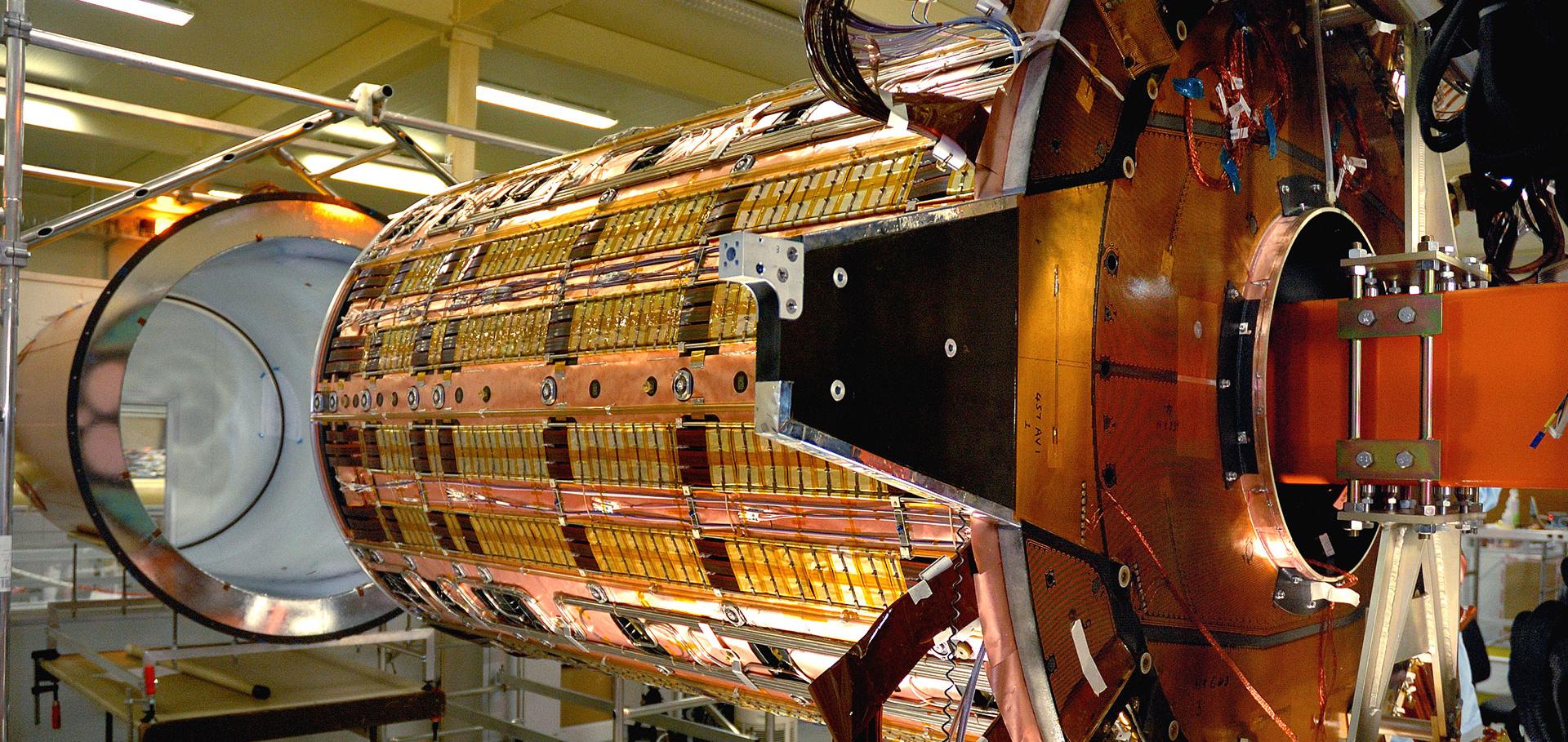
Insertion of STC into TRT at the Department of Physics, Oxford
Credit: CERN

Philip Burrows

Professor of Physics

Sub department

  • Particle Physics
Philip.Burrows@physics.ox.ac.uk
Telephone: 01865 (2)73451
Denys Wilkinson Building, room 615a
  • About
  • Publications

Controlled growth of the self-modulation of a relativistic proton bunch in plasma

Physical Review Letters American Physical Society 129 (2022) 024802

Abstract:

A long, narrow, relativistic charged particle bunch propagating in plasma is subject to the selfmodulation (SM) instability. We show that SM of a proton bunch can be seeded by the wakefields driven by a preceding electron bunch. SM timing reproducibility and control are at the level of a small fraction of the modulation period. With this seeding method, we independently control the amplitude of the seed wakefields with the charge of the electron bunch and the growth rate of SM with the charge of the proton bunch. Seeding leads to larger growth of the wakefields than in the instability case.
More details from the publisher
Details from ORA
More details
More details

Design of a very low energy beamline for NA61/SHINE

Proceedings of the 13th International Particle Accelerator Conference JACoW Publishing (2022) 1714-1744

Abstract:

A new, low-energy branch is being designed for the H2 beamline at the CERN North Experimental Area. This new low-energy branch would extend the capabilities of the current infrastructure enabling the study of particles in the low, 1–13 GeV/c, momentum range. The first experiment to profit from this new line will be NA61/SHINE (SPS Heavy Ion and Neutrino Experiment), a multi-purpose experiment studying hadron production in hadron-proton, hadron-nucleus and nucleus-nucleus collisions at the SPS. However, other future fixed target experiments or test-beam experiments installed in the downstream zones could also benefit from the lowenergy particles provided. The proposed layout and expected performance of this line, along with estimates of particle rates, and considerations on the technical implementation of the beamline are presented in this contribution. A description on the instrumentation, which will enable particle-byparticle tagging, crucial for the experiments scope, is also discussed.

More details from the publisher
Details from ORA

Challenge based innovation "accelerators for the environment"

Proceedings of the 13th International Particle Accelerator Conference JACoW Publishing (2022)

Abstract:

We present an initiative to foster new ideas about the applications of accelerators to the Environment. Called "Challenge Based Innovation" this initiative will gather four teams each of six master-level students each coming from different academic backgrounds. As part of the EU-funded I.FAST project (Innovation Fostering in Accelerator Science and Technology), they will gather during 10 days in Archamps near CERN to receive high level lectures on accelerators and the environment and to brainstorm on possible new applications of accelerators for the environment. At the end of the gathering, they will present their project at CERN to a jury made of experts.
More details from the publisher
Details from ORA

Generation of transversely uniform bunches from a Gaussian laser spot in a photoinjector for irradiation experiments

IPAC2022: Proceedings of the 13th International Particle Accelerator Conference JACoW Publishing (2022) 2483-2486

Authors:

LA Dyks, Philip Burrows, R Corsini, A Latina

Abstract:

Beams of uniform transverse beam profile are desirable for a variety of applications such as irradiation experiments. The generation of beams with such profiles has previously been investigated as a method of reducing emittance growth. These methods, however, often use complicated optics setups or short, femtosecond laser pulse lengths. In this paper, we demonstrate that if ultra low emittance is not the target of the photoinjector, it is possible to produce transversely uniform beam profiles using a simple Gaussian laser, with a bunch length of a few picoseconds, utilising space-charge effects only.
More details from the publisher
Details from ORA

Millisecond burst extractions from synchrotrons using RF phase displacement acceleration

Nuclear Instruments and Methods in Physics Research Section A: Accelerators, Spectrometers, Detectors, and Associated Equipment Elsevier 1039 (2022) 167007

Abstract:

FLASH radiation therapy calls for the delivery of fast bursted spills of particles with dose delivery times of the order of milliseconds. The requirements overlap with fundamental physics experimental requests that are being studied at CERN, albeit at very different energy scales. In this contribution, a scheme for extracting millisecond bursts from synchrotrons is explored by controlling a third-integer resonant and chromatic extraction with RF phase displacement acceleration. The scheme would be implementable in existing medical and experimental synchrotron facilities. Using a model of the CERN Proton Synchrotron, both single-burst and multi-burst extractions are simulated. Results show that 80 - 90 % of the total beam intensity is extracted in a single burst of 40 − 60 ms. This would correspond to a ∼10 ms burst in a typical medical synchrotron, namely the one outlined in the Proton Ion Medical Machine Study. A set of 3 consecutive bursts of 30 ms was simulated in the Proton Synchrotron with optimised machine parameters.
More details from the publisher
Details from ORA
More details

Pagination

  • First page First
  • Previous page Prev
  • …
  • Page 7
  • Page 8
  • Page 9
  • Page 10
  • Current page 11
  • Page 12
  • Page 13
  • Page 14
  • Page 15
  • …
  • Next page Next
  • Last page Last

Footer Menu

  • Contact us
  • Giving to the Dept of Physics
  • Work with us
  • Media

User account menu

  • Log in

Follow us

FIND US

Clarendon Laboratory,

Parks Road,

Oxford,

OX1 3PU

CONTACT US

Tel: +44(0)1865272200

University of Oxfrod logo Department Of Physics text logo
IOP Juno Champion logo Athena Swan Silver Award logo

© University of Oxford - Department of Physics

Cookies | Privacy policy | Accessibility statement

Built by: Versantus

  • Home
  • Research
  • Study
  • Engage
  • Our people
  • News & Comment
  • Events
  • Our facilities & services
  • About us
  • Giving to Physics
  • Current students
  • Staff intranet