Home
Department Of Physics text logo
  • Research
    • Our research
    • Our research groups
    • Our research in action
    • Research funding support
    • Summer internships for undergraduates
  • Study
    • Undergraduates
    • Postgraduates
  • Engage
    • For young people
    • For teachers
    • For the public
    • For alumni
    • For business
  • Support
Menu
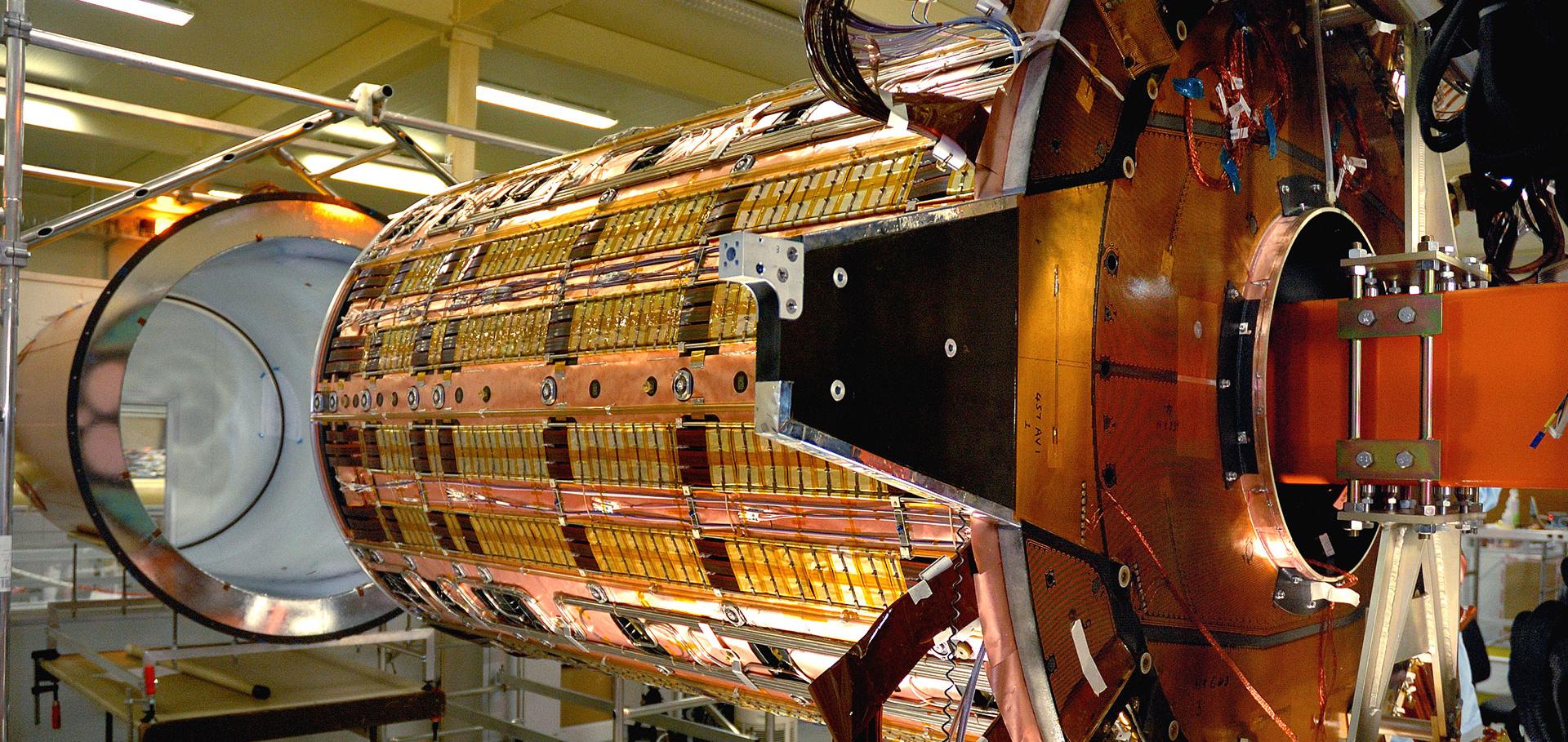
Insertion of STC into TRT at the Department of Physics, Oxford
Credit: CERN

Philip Burrows

Professor of Physics

Sub department

  • Particle Physics
Philip.Burrows@physics.ox.ac.uk
Telephone: 01865 (2)73451
Denys Wilkinson Building, room 615a
  • About
  • Publications

Recent AWAKE diagnostics development and operational results

Proceedings of the 13th International Particle Accelerator Conference JACoW Publishing (2022)

Abstract:

The Advanced Wakefield Experiment (AWAKE) at CERN investigates the plasma-wakefield acceleration of electrons driven by a relativistic proton bunch. After successfully demonstrating the acceleration process in Run 1, the experiment has now started Run 2. AWAKE Run 2 consists of several experimental periods that aim to demonstrate the feasibility of the AWAKE concept beyond the acceleration experiment, showing its feasibility as accelerator for particle physics applications. As part of these developments, a dramatic effort in improving the AWAKE instrumentation is sustained. This contribution reports on the current developments of the instrumentation pool upgrade, including the digital camera system for transverse beam profile measurement, the beam halo measurement and the spectrometer upgrade studies. Studies on the development of high-frequency beam position monitors are also described.

More details from the publisher
Details from ORA

Implementation of RF channeling at the CERN PS for spill quality improvements

Proceedings of the 13th International Particle Accelerator Conference JACoW Publishing (2022) 2114-2117

Abstract:

Resonant slow extraction from synchrotrons aims at providing constant intensity spills over timescales much longer than the revolution period of the machine. However, the extracted intensity is undesirably modulated by noise on the machine’s power converters with a frequency range of between 50 Hz and a few kHz. The impact of power converter noise can be suppressed by exploiting a Radio Frequency (RF) technique known as empty bucket channelling, which increases the speed at which particles cross the tune resonance boundary. In this contribution the implementation of empty bucket channelling in the CERN Proton Synchrotron (PS) is described via simulation and measurement. The technique was tested with both a resonant RF cavity and an inductive Finemet cavity, which can produce non-sinusoidal waveforms, to significantly reduce the low frequency noise observed on the extracted spill.
More details from the publisher
Details from ORA

Simulation studies of intra-train, bunch-by-bunch feedback systems at the International Linear Collider

Proceedings of the 13th International Particle Accelerator Conference JACoW Publishing (2022)

Abstract:

The International Linear Collider (ILC) is a proposed electron-positron collider targeting collision energies from 250 GeV to 1 TeV. With design luminosities of order 1034 cm2s⁻1 a beam-based, intra-train feedback system would be required near the Interaction Point (IP) to provide nanometre-level stabilisation of the beam overlap in the collisions. Here we present results from beam-tracking simulations of the 500 GeV ILC, including the impact of beam-trajectory imperfections on the luminosity, and the capability of the IP feedback system to compensate for them. Effects investigated include the position jitter introduced by the damping ring extraction kicker, short-range and long-range wakefields, and ground motion. The feedback system was shown to be able to correct for beam-beam offsets of up to 200 nm and stabilise the collision overlap to the nanometre level, within a few bunch crossings.

More details from the publisher
Details from ORA

The design of a second beamline for the CLEAR user facility at CERN

Proceedings of the 13th International Particle Accelerator Conference JACoW Publishing (2022) 2479-2482

Abstract:

The CERN Linear Electron Accelerator for Research (CLEAR) has been operating as a general user facility since 2017 providing beams for a wide range of user experiments. However, with its current optical layout, the beams available to users are not able to cover every request. To overcome this, a second experimental beamline has been proposed. In this paper we discuss the potential optics of the new line as well as detailing the hardware required for its construction. Branching from the current beamline, via a dogleg chicane that could be used for bunch compression, the new beamline would provide an additional in-air test stand to be available to users. The beamline before the test stand would utilise large aperture quadrupoles to allow the irradiation of large target areas or strong focussing of beams onto a target. In addition to this there would also be further in-vacuum space to install experiments.
More details from the publisher
Details from ORA

Beam optics study for a potential VHEE beam delivery system

Proceedings of the 13th International Particle Accelerator Conference JACoW Publishing (2022) 2992-2995

Abstract:

VHEE (Very High Energy Electron) therapy can be superior to conventional radiotherapy for the treatment of deep seated tumours, whilst not necessarily requiring the space and cost of proton or heavy ion facilities. Developments in high gradient RF technology have allowed electrons to be accelerated to VHEE energies in a compact space, meaning that treatment could be possible with a shorter linac. A crucial component of VHEE treatment is the transfer of the beam from accelerator to patient. This is required to magnify the beam to cover the transverse extent of the tumour, whilst ensuring a uniform beam distribution. Two principle methodologies for the design of a compact transfer line are presented. The first of these is based upon a quadrupole lattice and optical magnification of beam size. A minimisation algorithm is used to enforce certain criteria on the beam distribution at the patient, defining the lattice through an automated routine. Separately, a dual scattering-foil based system is also presented, which uses similar algorithms for the optimisation of the foil geometry in order to achieve the desired beam shape at the patient location.
More details from the publisher
Details from ORA

Pagination

  • First page First
  • Previous page Prev
  • …
  • Page 8
  • Page 9
  • Page 10
  • Page 11
  • Current page 12
  • Page 13
  • Page 14
  • Page 15
  • Page 16
  • …
  • Next page Next
  • Last page Last

Footer Menu

  • Contact us
  • Giving to the Dept of Physics
  • Work with us
  • Media

User account menu

  • Log in

Follow us

FIND US

Clarendon Laboratory,

Parks Road,

Oxford,

OX1 3PU

CONTACT US

Tel: +44(0)1865272200

University of Oxfrod logo Department Of Physics text logo
IOP Juno Champion logo Athena Swan Silver Award logo

© University of Oxford - Department of Physics

Cookies | Privacy policy | Accessibility statement

Built by: Versantus

  • Home
  • Research
  • Study
  • Engage
  • Our people
  • News & Comment
  • Events
  • Our facilities & services
  • About us
  • Giving to Physics
  • Current students
  • Staff intranet