Home
Department Of Physics text logo
  • Research
    • Our research
    • Our research groups
    • Our research in action
    • Research funding support
    • Summer internships for undergraduates
  • Study
    • Undergraduates
    • Postgraduates
  • Engage
    • For young people
    • For teachers
    • For the public
    • For alumni
    • For business
  • Support
Menu
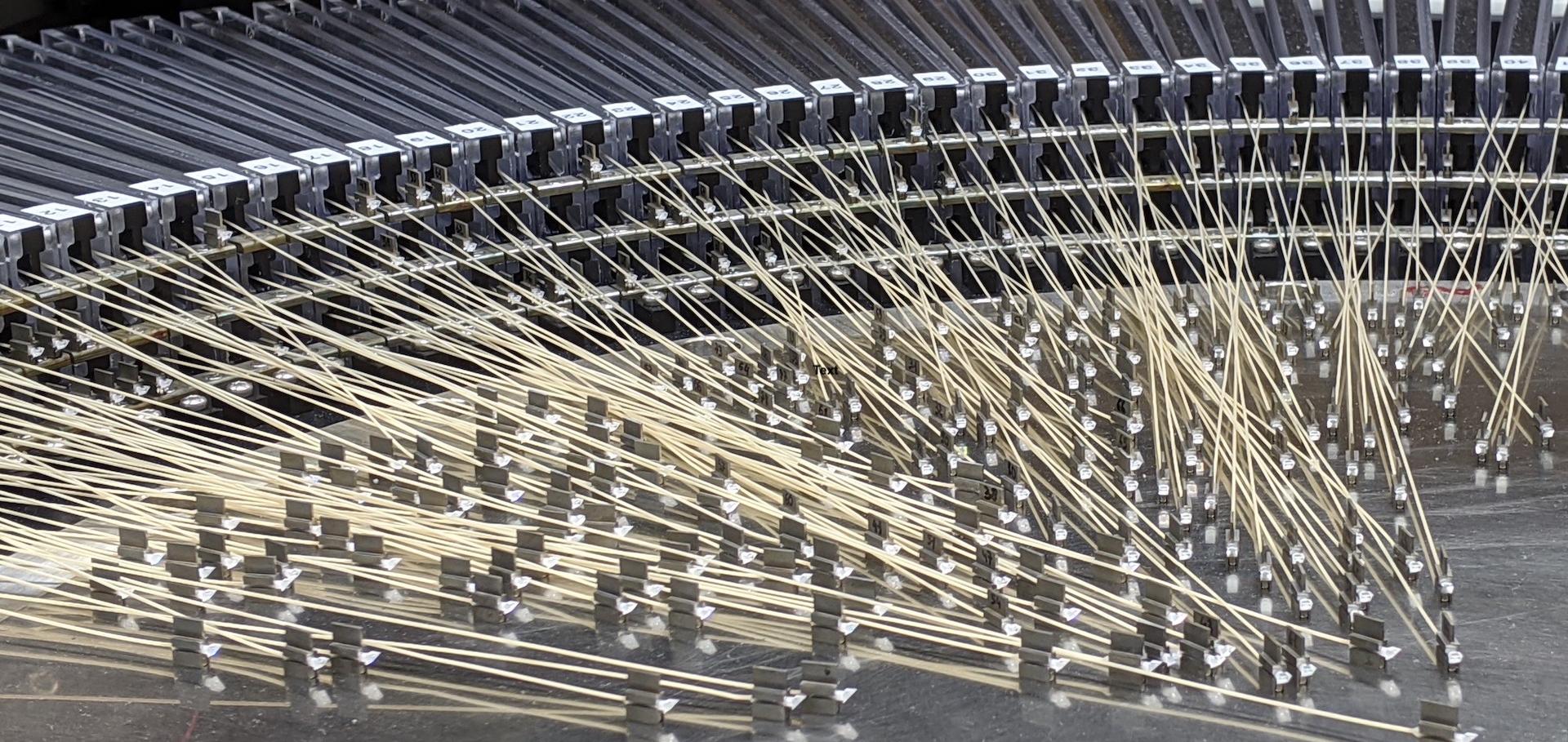
Part of a WEAVE fibre configuration

Part of the WEAVE focal plane showing optical fibres positioned on a set of targets in the telescope focal plane.

Prof Gavin Dalton

Professor of Astrophysics

Research theme

  • Astronomy and astrophysics

Sub department

  • Astrophysics

Research groups

  • Astronomical instrumentation
  • Extremely Large Telescope
Gavin.Dalton@physics.ox.ac.uk
  • About
  • Research
  • Publications

Subaru FMOS now and future

Society of Photo-Optical Instrumentation Engineers (SPIE) 8446 (2012) 0-0

Authors:

N Tamura, N Takato, F Iwamuro, M Akiyama, M Kimura, P Tait, GB Dalton, GJ Murray, S Smedley, T Maihara, K Ohta, Y Moritani, K Yabe, M Sumiyoshi, T Totani, H Sugai, H Karoji, S-Y Wang, Y Ohyama

Subaru FMOS now and Future

SPIE 8446 (2012) 84460M

Authors:

N Tamura, N Takato, F Iwamuro, M Akiyama, M Kimura, P Tait, GB Dalton, GJ Murray, S Smedley, T Maihara, K Ohta, Y Moritani, K Yabe, M Sumiyoshi, T Totani, H Sugai, H Karoji, S-Y Wang, Y Ohyama

Abstract:

Fiber Multi Object Spectrograph “FMOS” on Subaru Telescope is capable of configuring 400 fibers on the 30- arcmin diameter field of view at the prime focus for near-infrared (0.9–1.8 μm) spectroscopy, and this instrument has been open as a common-use instrument since May 2010. In this article, an overview of the instrument is given first, and then the typical operational sequence in science observation and a few notable features of the instrument are explained. In (see manuscript) 5, the instrument performance in terms of fiber positioning, auto guiding, and sensitivity to emission lines are highlighted. Recently (since March 2012) a Subaru Strategic Program (SSP) has started with FMOS to conduct a wide-field galaxy survey for a cosmological experiment. Upgrading fiber configuration by using a “metrology camera” has also been under discussion, which will enable to measure the positions of the 400 fibers quickly and shorten the fiber configuration time significantly. We will also report the status of these recent activities.
More details from the publisher
More details

VIRUS: production of a massively replicated 33k fiber integral field spectrograph for the upgraded Hobby-Eberly Telescope

SPIE 8446 (2012) 84660N

Authors:

GJ Hill, SE Tuttle, H Lee, BL Vattiat, ME Cornell, DL DePoy, N Drory, MH Fabricius, A Kelz, JL Marshall, JD Murphy, T Prochaska, RD Allen, R Bender, G Blanc, T Chonis, GB Dalton, K Gebhardt, J Good, D Haynes, T Jahn, PJ MacQueen, MD Rafal, MM Roth, RD Savage, J Snigula

Abstract:

The Visible Integral-field Replicable Unit Spectrograph (VIRUS) consists of a baseline build of 150 identical spectrographs (arrayed as 75 units, each with a pair of spectrographs) fed by 33,600 fibers, each 1.5 arcsec diameter, deployed over the 22 arcminute field of the upgraded 10 m Hobby-Eberly Telescope (HET). The goal is to deploy 82 units. VIRUS has a fixed bandpass of 350-550 nm and resolving power R~700. VIRUS is the first example of industrial-scale replication applied to optical astronomy and is capable of spectral surveys of large areas of sky. This approach, in which a relatively simple, inexpensive, unit spectrograph is copied in large numbers, offers significant savings of engineering effort, cost, and schedule when compared to traditional instruments. The main motivator for VIRUS is to map the evolution of dark energy for the Hobby-Eberly Telescope Dark Energy Experiment (HETDEX) using 0.8M Lyman-α emitting galaxies as tracers. The full VIRUS array is due to be deployed by early 2014 and will provide a powerful new facility instrument for the HET, well suited to the survey niche of the telescope. VIRUS and HET will open up wide-field surveys of the emission-line universe for the first time. We present the production design and current status of VIRUS.
More details from the publisher
More details

WEAVE: the next generation wide-field spectroscopy facility for the William Herschel Telescope

Society of Photo-Optical Instrumentation Engineers (SPIE) 8446 (2012) 0-0

Authors:

G Dalton, SC Trager, DC Abrams, D Carter, P Bonifacio, JAL Aguerri, M MacIntosh, C Evans, I Lewis, R Navarro, T Agocs, K Dee, S Rousset, I Tosh, K Middleton, J Pragt, D Terrett, M Brock, C Benn, M Verheijen, D Cano Infantes, C Bevil, I Steele, C Mottram, S Bates, FJ Gribbin, J Rey, LF Rodriguez, JM Delgado, I Guinouard, N Walton, MJ Irwin, P Jagourel, R Stuik, G Gerlofsma, R Roelfsma, I Skillen, A Ridings, M Balcells, J-B Daban, C Gouvret, L Venema, P Girard

A European vision for a “Polar Large Telescope” project

Proceedings of the International Astronomical Union Cambridge University Press (CUP) 8:S288 (2012) 243-250

Authors:

Lyu Abe, Nicolas Epchtein, Wolfgang Ansorge, Stefania Argentini, Ian Bryson, Marcel Carbillet, Gavin Dalton, Christine David, Igor Esau, Christophe Genthon, Maud Langlois, Thibault Le Bertre, Rachid Lemrani, Brice Le Roux, Gianpietro Marchiori, Djamel Mékarnia, Joachim Montnacher, Gil Moretto, Philippe Prugniel, Jean-Pierre Rivet, Eric Ruch, Charling Tao, André Tilquin, Isabelle Vauglin
More details from the publisher

Pagination

  • First page First
  • Previous page Prev
  • …
  • Page 33
  • Page 34
  • Page 35
  • Page 36
  • Current page 37
  • Page 38
  • Page 39
  • Page 40
  • Page 41
  • …
  • Next page Next
  • Last page Last

Footer Menu

  • Contact us
  • Giving to the Dept of Physics
  • Work with us
  • Media

User account menu

  • Log in

Follow us

FIND US

Clarendon Laboratory,

Parks Road,

Oxford,

OX1 3PU

CONTACT US

Tel: +44(0)1865272200

University of Oxfrod logo Department Of Physics text logo
IOP Juno Champion logo Athena Swan Silver Award logo

© University of Oxford - Department of Physics

Cookies | Privacy policy | Accessibility statement

Built by: Versantus

  • Home
  • Research
  • Study
  • Engage
  • Our people
  • News & Comment
  • Events
  • Our facilities & services
  • About us
  • Giving to Physics
  • Current students
  • Staff intranet