


Design drivers for a wide-field multi-object spectrograph for the William Herschel Telescope
Proceedings of SPIE the International Society for Optical Engineering 7735:PART 1 (2010)
Abstract:
Wide-field multi-object spectroscopy is a high priority for European astronomy over the next decade. Most 8-10m telescopes have a small field of view, making 4-m class telescopes a particularly attractive option for wide-field instruments. We present a science case and design drivers for a wide-field multi-object spectrograph (MOS) with integral field units for the 4.2-m William Herschel Telescope (WHT) on La Palma. The instrument intends to take advantage of a future prime-focus corrector and atmospheric-dispersion corrector (Agocs et al, this conf.) that will deliver a field of view 2 deg in diameter, with good throughput from 370 to 1,000 nm. The science programs cluster into three groups needing three different resolving powers R: (1) high-precision radial-velocities for Gaia-related Milky Way dynamics, cosmological redshift surveys, and galaxy evolution studies (R = 5,000), (2) galaxy disk velocity dispersions (R = 10,000) and (3) high-precision stellar element abundances for Milky Way archaeology (R = 20,000). The multiplex requirements of the different science cases range from a few hundred to a few thousand, and a range of fibre-positioner technologies are considered. Several options for the spectrograph are discussed, building in part on published design studies for E-ELT spectrographs. Indeed, a WHT MOS will not only efficiently deliver data for exploitation of important imaging surveys planned for the coming decade, but will also serve as a test-bed to optimize the design of MOS instruments for the future E-ELT. © 2010 Copyright SPIE - The International Society for Optical Engineering.FMOS the fibre multiple-object spectrograph, part VIII: Current performances and results of the engineering observations
Proceedings of SPIE the International Society for Optical Engineering 7735:PART 1 (2010)
Abstract:
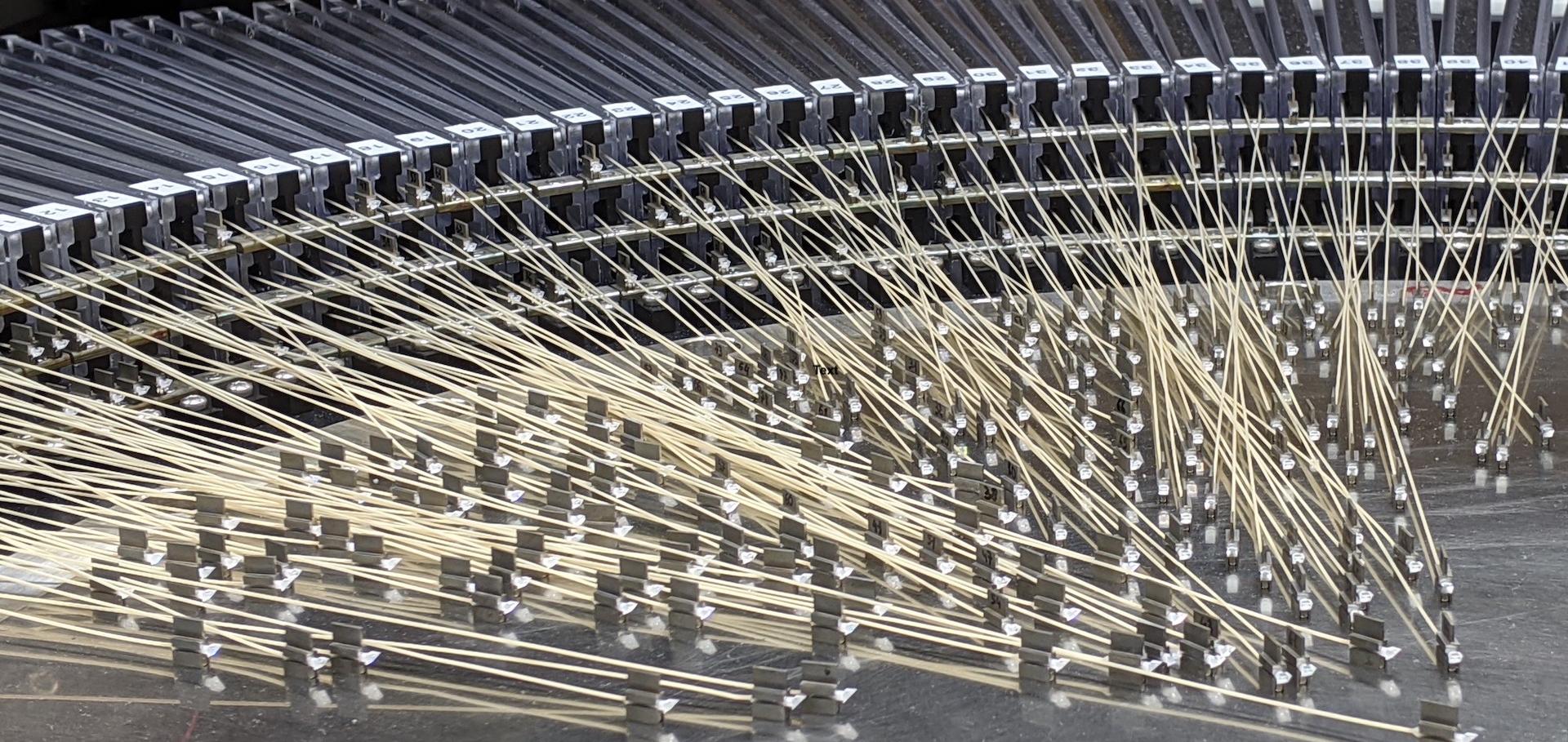
The Fibre Multi-Object Spectrograph for Subaru Telescope (FMOS) is a near-infrared instrument with 400 fibres in a 30' filed of view at F/2 prime focus. To observe 400 objects simultaneously, we have developed a fibre positioner called "Echidna" using a tube piezo actuator. We have also developed two OH-airglow suppressed and refrigerated spectrographs. Each spectrograph has two spectral resolution modes: the low-resolution mode and the high-resolution mode. The low-resolution mode covers the complete wavelength range of 0.9 - 1.8 μm with one exposure, while the high-resolution mode requires four exposures at different camera positions to cover the full wavelength range. The first light was accomplished in May 2008. The science observations and the open-use observations begin in May 2010. © 2010 Copyright SPIE - The International Society for Optical Engineering.OPTIMOS-EVE design trade-off analysis
Proceedings of SPIE the International Society for Optical Engineering 7735:PART 1 (2010)
Abstract:
OPTIMOS-EVE (OPTical Infrared Multi Object Spectrograph - Extreme Visual Explorer) is the fiber fed multi object spectrograph proposed for the E-ELT. It is designed to provide a spectral resolution ranging from 5000 to 30.000, at wavelengths from 0.37 μm to 1.70 μm, combined with a high multiplex (>200) and a large spectral coverage. The system consists of three main modules: a fiber positioning system, fibers and a spectrograph. The OPTIMOS-EVE Phase-A study, carried out within the framework of the ESO E-ELT instrumentation studies, has been performed by an international consortium consisting of institutes from France, Netherlands, United Kingdom, Italy and Denmark. This paper describes the design tradeoff study and the key issues determining the price and performance of the instrument. © 2010 Copyright SPIE - The International Society for Optical Engineering.Overview of the GYES instrument: A multifibre high-resolution spectrograph for the prime focus of the Canada-France-Hawaii Telescope
Proceedings of SPIE the International Society for Optical Engineering 7735:PART 1 (2010)
Abstract:
ESA's cornerstone mission Gaia will construct a billion-star catalogue down to magnitude 20 but will only provide detailed chemical information for the brighter stars and will be lacking radial velocity at the faint end due to insufficient Signal-to-Noise Ratios (SNR). This calls for the deployment of a ground spectrograph under time scales coherent with those of Gaia for a complementary survey. The GYES instrument is a high resolution (∼ 20,000) spectrometer proposed for installation on the Canada- France-Hawaii Telescope (CFHT) to perform this survey in the northern hemisphere. It exploits the large Field of View (FoV) available at the prime focus together with a high multiplex (∼ 500 fibres) to achieve a SNR of 30 in two hours at magnitude 16 and render the survey possible on the order of 300 nights. The on-going feasibility study aims at jointly optimising all components of the system: the field corrector, the positioner, the fibres and the spectrograph. The key challenges consist in accommodating the components in the highly constrained environment of the primary focus, as well as in achieving maximum efficiency thanks to high transmission and minimum reconfiguration delays. Meanwhile, for GYES to have its first light at the time of Gaia's initial data release (2014-2015), it is mandatory to keep its complexity down by designing a predominantly passive instrument. © 2010 Copyright SPIE - The International Society for Optical Engineering.Project overview of OPTIMOS-EVE: The fibre-fed multi-object spectrograph for the E-ELT
Proceedings of SPIE the International Society for Optical Engineering 7735:PART 1 (2010)