Home
Department Of Physics text logo
  • Research
    • Our research
    • Our research groups
    • Our research in action
    • Research funding support
    • Summer internships for undergraduates
  • Study
    • Undergraduates
    • Postgraduates
  • Engage
    • For young people
    • For teachers
    • For the public
    • For alumni
    • For business
  • Support
Menu
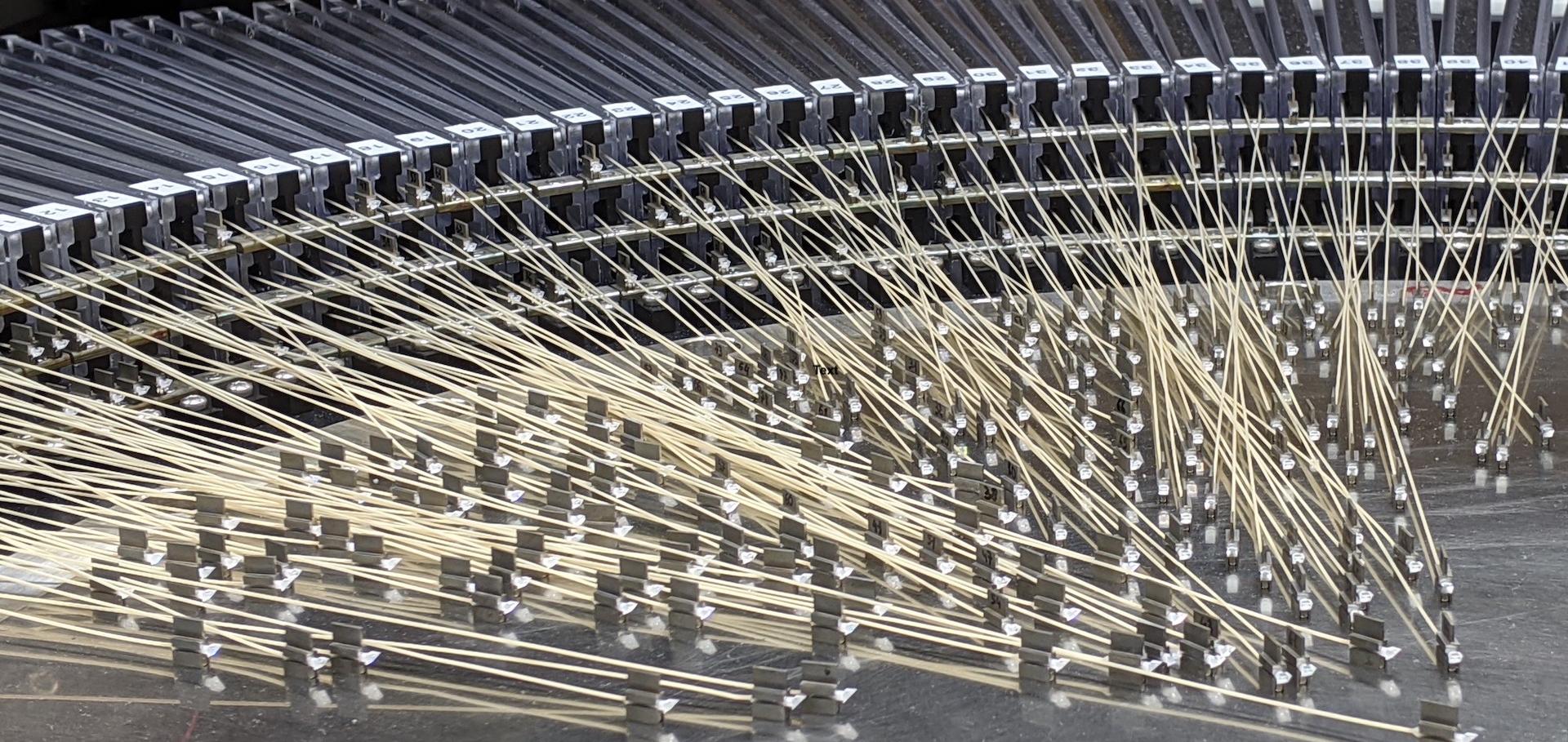
Part of a WEAVE fibre configuration

Part of the WEAVE focal plane showing optical fibres positioned on a set of targets in the telescope focal plane.

Prof Gavin Dalton

Professor of Astrophysics

Research theme

  • Astronomy and astrophysics

Sub department

  • Astrophysics

Research groups

  • Astronomical instrumentation
  • Extremely Large Telescope
Gavin.Dalton@physics.ox.ac.uk
  • About
  • Research
  • Publications

Fibre multi-object spectrograph (FMOS) for the Subaru Telescope

Publications of the Astronomical Society of Japan 62:5 (2010) 1135-1147

Authors:

M Kimura, T Maihara, F Iwamuro, M Akiyama, N Tamura, GB Dalton, N Takato, P Tait, K Ohta, S Eto, D Mochida, B Elms, K Kawate, T Kurakami, Y Moritani, J Noumaru, N Ohshima, M Sumiyoshi, K Yabe, J Brzeski, T Farrell, G Frost, PR Gillingham, R Haynes, AM Moore, R Muller, S Smedley, G Smith, DG Bonfield, CB Brooks, AR Holmes, E Curtis Lake, H Lee, IJ Lewis, TR Froud, IA Tosh, GF Woodhouse, C Blackburn, R Content, N Dipper, G Murray, R Sharples, DJ Robertson

Abstract:

Fibre Multi-Object Spectrograph (FMOS) is the first near-infrared instrument with a wide field of view capable of acquiring spectra simultaneously from up to 400 objects. It has been developed as a common-use instrument for the F=2 prime-focus of the Subaru Telescope. The field coverage of 300 diameter is achieved using a new 3-element corrector optimized in the near-infrared (0.9-1.8μm) wavelength range. Due to limited space at the prime-focus, we have had to develop a novel fibre positioner, called " Echidna" , together with two OH-airglow suppressed spectrographs. FMOS consists of three subsystems: the prime focus unit for IR, the fibre positioning system/connector units, and the two spectrographs. After full systems integration, FMOS was installed on the telescope in late 2007. Many aspects of the performance were checked through various test and engineering observations. In this paper, we present the optical and mechanical components of FMOS, and show the results of our on-sky engineering observations to date. © 2010. Astronomical Society of Japan.
More details from the publisher
More details
Details from ArXiV

Fibre positioning revisited: The use of an off-the-shelf assembly robot for OPTIMOS-EVE

Proceedings of SPIE the International Society for Optical Engineering 7739 (2010)

Authors:

GB Dalton, MS Whalley, O Mounissamy, EC Sawyer, IAJ Tosh, DL Terrett, IJ Lewis

Abstract:

The OPTIMOS-EVE instrument proposed for the E-ELT aims to use the maximum field of view available to the E-ELT in the limit of natural or ground-layer-corrected seeing for high multiplex fibre-fed multi-object spectroscopy in the visible and near-IR. At the bare nasmyth focus of the telescope, this field corresponds to a focal plane 2.3m in diameter, with a plate-scale of ∼3mm/arcsec. The required positioning accuracy that is implied by seeing limited performance at this plate-scale brings the system into the range of performances of commercial off-the-shelf robots that are commonly used in industrial manufacturing processes. The cost-benefits that may be realized through such an approach must be offset against the robot performance, and the ease with which a useful software system can be implemented. We therefore investigate whether the use of such a system is indeed feasible for OPTIMOS-EVE, and the possibilities of extending this approach to other instruments that are currently in the planning stage. © 2010 SPIE.
More details from the publisher
More details

GYES, a multifibre spectrograph for the CFHT

(2010)

Authors:

P Bonifacio, S Mignot, J-L Dournaux, P François, E Caffau, F Royer, C Babusiaux, F Arenou, C Balkowski, O Bienaymé, D Briot, R Carlberg, M Cohen, GB Dalton, B Famaey, G Fasola, Y Frémat, A Gómez, M Haywood, V Hill, J-M Huet, D Katz, D Horville, R Kudritzky, R Lallement, Ph Laporte, P de Laverny, B Lemasle, IJ Lewis, C Martayan, R Monier, D Mourard, N Nardetto, A Recio Blanco, N Robichon, AC Robin, M Rodrigues, C Soubiran, C Turon, K Venn, Y Viala
More details from the publisher

Fibre Positioning Revisited: The use an off-the-shelf assembly robot for OPTIMOS-EVE

(2010)

Authors:

Gavin Dalton, Martin Whalley, Oudayraj Mounissamy, Eric Sawyer, Ian Tosh, David Terrett, Ian Lewis
More details from the publisher
Details from ArXiV

Design drivers for a wide-field multi-object spectrograph for the William Herschel Telescope

(2010)

Authors:

Marc Balcells, Chris R Benn, David Carter, Gavin B Dalton, Scott C Trager, Sofia Feltzing, Marc AW Verheijen, Matt Jarvis, Will Percival, Don C Abrams, Tibor Agocs, Anthony GA Brown, Diego Cano, Chris Evans, Amina Helmi, Ian J Lewis, Ross McLure, Reynier F Peletier, Ismael Perez-Fournon, Ray M Sharples, Ian AJ Tosh, Ignacio Trujillo, Nic Walton, Kyle B Westfall
More details from the publisher

Pagination

  • First page First
  • Previous page Prev
  • …
  • Page 37
  • Page 38
  • Page 39
  • Page 40
  • Current page 41
  • Page 42
  • Page 43
  • Page 44
  • Page 45
  • …
  • Next page Next
  • Last page Last

Footer Menu

  • Contact us
  • Giving to the Dept of Physics
  • Work with us
  • Media

User account menu

  • Log in

Follow us

FIND US

Clarendon Laboratory,

Parks Road,

Oxford,

OX1 3PU

CONTACT US

Tel: +44(0)1865272200

University of Oxfrod logo Department Of Physics text logo
IOP Juno Champion logo Athena Swan Silver Award logo

© University of Oxford - Department of Physics

Cookies | Privacy policy | Accessibility statement

Built by: Versantus

  • Home
  • Research
  • Study
  • Engage
  • Our people
  • News & Comment
  • Events
  • Our facilities & services
  • About us
  • Giving to Physics
  • Current students
  • Staff intranet