Home
Department Of Physics text logo
  • Research
    • Our research
    • Our research groups
    • Our research in action
    • Research funding support
    • Summer internships for undergraduates
  • Study
    • Undergraduates
    • Postgraduates
  • Engage
    • For young people
    • For teachers
    • For the public
    • For alumni
    • For business
  • Support
Menu
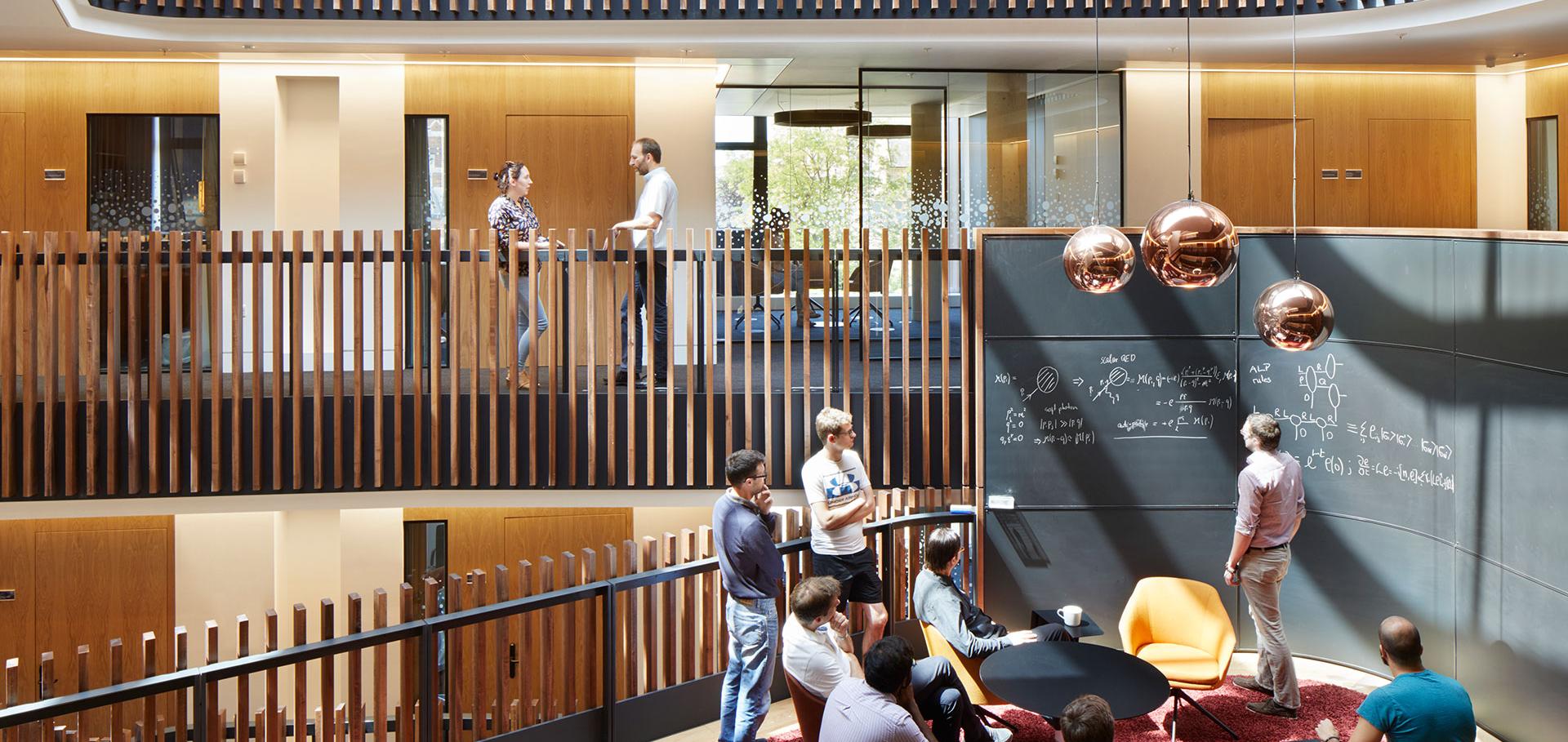
Theoretical physicists working at a blackboard collaboration pod in the Beecroft building.
Credit: Jack Hobhouse

Edward Hardy

Associate Professor

Research theme

  • Fundamental particles and interactions

Sub department

  • Rudolf Peierls Centre for Theoretical Physics

Research groups

  • Particle theory
edward.hardy@physics.ox.ac.uk
Telephone: 01865 273631
Rudolf Peierls Centre for Theoretical Physics, room 60.08
  • About
  • Publications

High-frequency Gravitational Waves from Superstring Phases in the Early Universe

(2025)

Authors:

Joseph P Conlon, Edmund J Copeland, Edward Hardy, Noelia Sánchez González
More details from the publisher
Details from ArXiV

Supernova bounds on new scalars from resonant and soft emission

(2025)

Authors:

Edward Hardy, Anton Sokolov, Henry Stubbs
More details from the publisher
Details from ArXiV

Dynamical Systems and Superstring Phases in the Early Universe

(2025)

Authors:

Noelia Sánchez González, Joseph P Conlon, Edmund J Copeland, Edward Hardy
More details from the publisher
Details from ArXiV

Stellar cooling limits on KK gravitons and dark dimensions

ArXiv 2510.18975 (2025)

Authors:

Edward Hardy, Anton Sokolov, Henry Stubbs
Details from ArXiV

QSHS: an axion dark matter resonant search apparatus

New Journal of Physics IOP Publishing 27:10 (2025) 105002

Authors:

A Alsulami, I Bailey, G Carosi, G Chapman, B Chakraborty, EJ Daw, N Du, S Durham, J Esmenda, J Gallop, T Gamble, T Godfrey, G Gregori, J Halliday, L Hao, E Hardy, EA Laird, P Leek, J March-Russell, PJ Meeson, CF Mostyn, Yu A Pashkin, SÓ Peatain, M Perry, M Piscitelli, M Reig, S Sarkar, A Sokolov, B-K Tan, S Withington

Abstract:

We describe a resonant cavity search apparatus for axion dark matter constructed by the quantum sensors for the hidden sector collaboration. The apparatus is configured to search for QCD axion dark matter, though also has the capability to detect axion-like particles, dark photons, and some other forms of wave-like dark matter. Initially, a tuneable cylindrical oxygen-free copper cavity is read out using a low noise microwave amplifier feeding a heterodyne receiver. The cavity is housed in a dilution refrigerator (DF) and threaded by a solenoidal magnetic field, nominally 8 T. The apparatus also houses a magnetic field shield for housing superconducting electronics, and several other fixed-frequency resonators for use in testing and commissioning various prototype quantum electronic devices sensitive at a range of axion masses in the range 2.0– 40μeVc−2. The apparatus as currently configured is intended as a test stand for electronics over the relatively wide frequency band attainable with the TM010 cavity mode used for axion searches. We present performance data for the resonator, DF, and magnet, and plans for the first science run.
More details from the publisher
Details from ORA
More details

Pagination

  • First page First
  • Previous page Prev
  • Page 1
  • Current page 2
  • Page 3
  • Page 4
  • Page 5
  • Page 6
  • Page 7
  • Page 8
  • Page 9
  • …
  • Next page Next
  • Last page Last

Footer Menu

  • Contact us
  • Giving to the Dept of Physics
  • Work with us
  • Media

User account menu

  • Log in

Follow us

FIND US

Clarendon Laboratory,

Parks Road,

Oxford,

OX1 3PU

CONTACT US

Tel: +44(0)1865272200

University of Oxfrod logo Department Of Physics text logo
IOP Juno Champion logo Athena Swan Silver Award logo

© University of Oxford - Department of Physics

Cookies | Privacy policy | Accessibility statement

Built by: Versantus

  • Home
  • Research
  • Study
  • Engage
  • Our people
  • News & Comment
  • Events
  • Our facilities & services
  • About us
  • Giving to Physics
  • Current students
  • Staff intranet