Home
Department Of Physics text logo
  • Research
    • Our research
    • Our research groups
    • Our research in action
    • Research funding support
    • Summer internships for undergraduates
  • Study
    • Undergraduates
    • Postgraduates
  • Engage
    • For young people
    • For teachers
    • For the public
    • For alumni
    • For business
  • Support
Menu
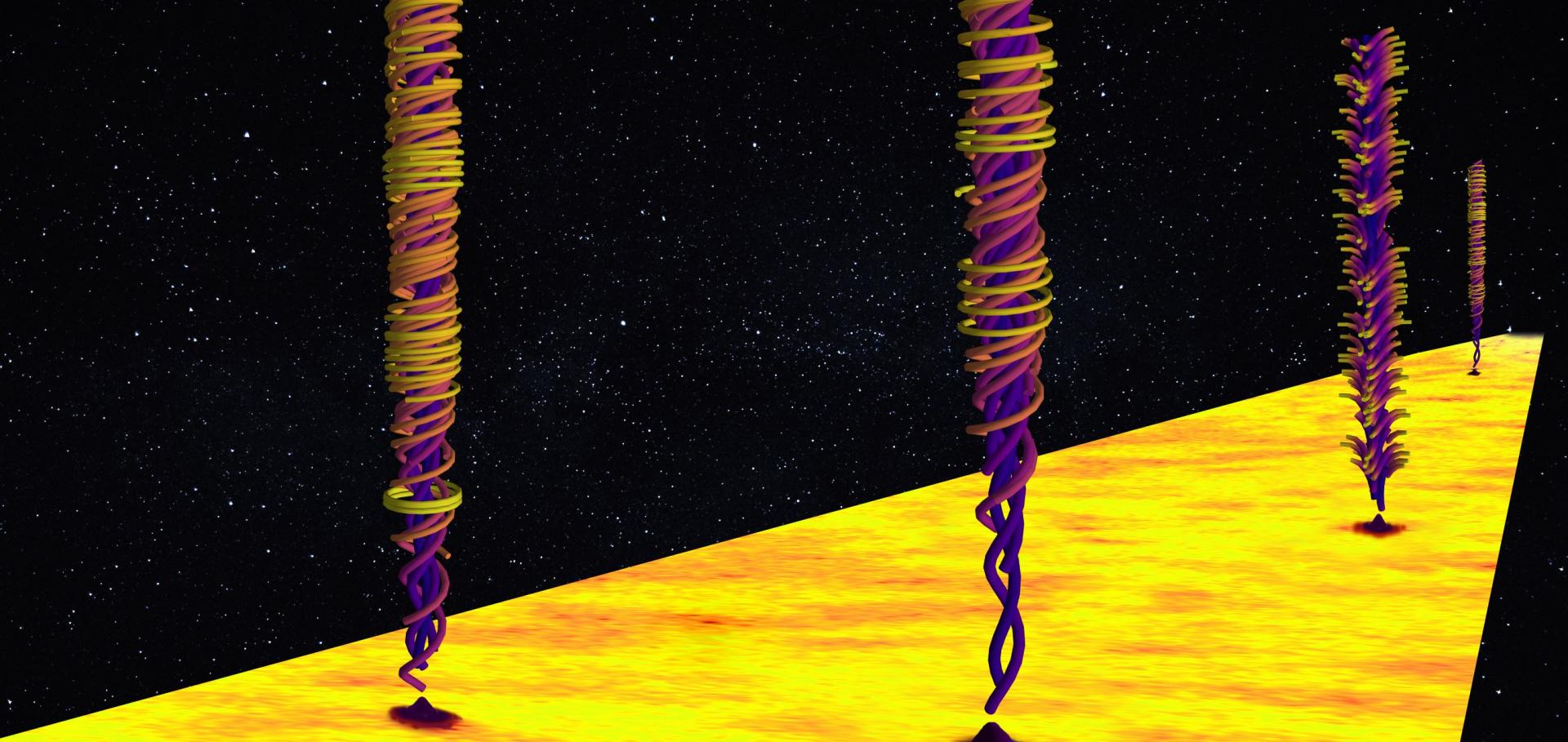
Cosmic whirls in rust
Credit: R Shetty, K Jani, H Jani

Prof Hariom Jani

Associate Professor of Materials

Research theme

  • Quantum materials

Sub department

  • Condensed Matter Physics

Research groups

  • Designer Quantum Materials for Devices
hariom.jani@physics.ox.ac.uk
Google Scholar
Youtube
  • About
  • Open PhD projects
  • Honors & Awards
  • Grants
  • Invited Talks & Lectures
  • Teaching & Outreach
  • Publications

Computing with rust

Harnessing whirls in iron-oxide

Where’s the very last place you would look if you wanted a new material to make computer memory? The compost heap or the scrap yard, probably. So who came up with the idea of using rust? Singapore’s Hariom Jani did. And he’s here to tell you it’s the futu

Cosmic strings in rust

The 2026 Skyrmionics Roadmap

(2026)

Authors:

Sabri Koraltan, Claas Abert, Manfred Albrecht, Maria Azhar, Christian Back, Helene Bea, Max T Birch, Stefan Bluegel, Olivier Boulle, Felix Buettner, Ping Che, Vincent Cros, Emily Darwin, Louise Desplat, Claire Donnelly, Haifeng Du, Karin Everschor-Sitte, Amalio Fernandez-Pacheco, Simone Finizio, Giovanni Finocchio, Markus Garst, Raphael Gruber, Dirk Grundler, Satoru Hayami, Thorsten Hesjedal, Axel Hoffmann, Alec Hrabec, Hans Josef Hug, Hariom Jani, Jagannath Jena, Wanjun Jiang, Javier Junquera, Kosuke Karube, Lisa-Marie Kern, Joo-Von Kim, Mathias Klaeui, Hidekazu Kurebayashi, Kai Litzius, Yizhou Liu, Martin Lonsky, Christopher H Marrows, Jan Masell, Stefan Mathias, Yuriy Mokrousov, Stuart SP Parkin, Bastian Pfau, Paolo G Radaelli, Florin Radu, Ramamoorthy Ramesh, Nicolas Reyren
More details from the publisher
Details from ORA
Details from ArXiV

Room Temperature Control of Axial and Basal Antiferromagnetic Anisotropies Using Strain

ACS Nano American Chemical Society 19:50 (2025) 42118-42127

Authors:

Jack Harrison, Junxiong Hu, Charles Godfrey, Jheng-Cyuan Lin, Tim A Butcher, Jörg Raabe, Simone Finizio, Hariom Jani, Paolo G Radaelli

Abstract:

Antiferromagnetic materials are promising platforms for the development of ultrafast spintronics and magnonics due to their robust magnetism, high-frequency relativistic dynamics, low-loss transport, and the ability to support topological textures. However, achieving deterministic control over antiferromagnetic order in thin films is a major challenge due to the formation of multidomain states stabilized by competing magnetic and destressing interactions. Thus, the successful implementation of antiferromagnetic materials necessitates careful engineering of their anisotropy. Here, we demonstrate strain-based, robust control over multiple antiferromagnetic anisotropies and nanoscale domains in the promising spintronic candidate α-Fe2O3 at room temperature. By applying isotropic and anisotropic in-plane strains across a broad temperature–strain phase space, we systematically tune the interplay between magneto-crystalline and magneto-elastic interactions. We observe that strain-driven control steers the system toward an aligned antiferromagnetic state, while preserving topological spin textures, such as merons, antimerons, and bimerons. We directly map the nanoscale antiferromagnetic order using linear dichroic scanning transmission X-ray microscopy integrated with in situ strain and temperature control. A Landau model and micromagnetic simulations reveal how strain reshapes the magnetic energy landscape. These findings suggest that strain could serve as a versatile control mechanism to reconfigure equilibrium or dynamic antiferromagnetic states on demand in α-Fe2O3 for implementation in next-generation spintronic and magnonic devices.
More details from the publisher
Details from ORA
More details
More details

Room temperature control of axial and basal antiferromagnetic anisotropies using strain

(2025)

Authors:

Jack Harrison, Junxiong Hu, Charles Godfrey, Jheng-Cyuan Lin, Tim A Butcher, JÃ rg Raabe, Simone Finizio, Hariom Jani, Paolo G Radaelli
Details from ArXiV

Electromechanically reconfigurable terahertz stereo metasurfaces

Advanced Materials Wiley (2024) 2402069

Authors:

Saurav Prakash, Prakash Pitchappa, Piyush Agrawal, Hariom Jani, Yunshan Zhao, Abhishek Kumar, John Thong, Jian Linke, Ariando Ariando, Ranjan Singh, Thirumalai Venkatesan

Abstract:

Dynamic terahertz devices are vital for the next generation of wireless communication, sensing, and non-destructive imaging technologies. Metasurfaces have emerged as a paradigm-shifting platform, offering varied functionalities, miniaturization, and simplified fabrication compared to their 3D counterparts. However, the presence of in-plane mirror symmetry and reduced degree of freedom impose fundamental limitations on achieving advanced chiral response, beamforming, and reconfiguration capabilities. In this work, a platform composed of electrically actuated resonators that can be colossally reconfigured between planar and 3D geometries is demonstrated. To illustrate the platform, metadevices with 3D Split Ring Resonators are fabricated, wherein two counteracting driving forces are combined: i) folding induced by stress mismatch, which enables non-volatile state design and ii) unfolding triggered by the strain associated with insulator-to-metal transition in VO2, which facilitates volatile structural reconfiguration. This large structural reconfiguration space allows for resonance mode switching, widely tunable magnetic and electric polarizabilities, and increased frequency agility. Moreover, the unique properties of VO2, such as the hysteretic nature of its phase transition is harnessed to demonstrate a multi-state memory. Therefore, these VO2 integrated metadevices are highly attractive for the realization of 6G communication devices such as reconfigurable intelligent surfaces, holographic beam formers, and spatial light modulators.
More details from the publisher
Details from ORA
More details
More details

Spatially reconfigurable antiferromagnetic states in topologically rich free-standing nanomembranes

Nature Materials Nature Research 23:5 (2024) 619-626

Authors:

Hariom Jani, Jack Harrison, Sonu Hooda, Saurav Prakash, Proloy Nandi, Junxiong Hu, Zhiyang Zeng, Jheng-Cyuan Lin, Charles Godfrey, Ganesh ji Omar, Tim A Butcher, Jörg Raabe, Simone Finizio, Aaron Voon-Yew Thean, A Ariando, Paolo G Radaelli

Abstract:

Antiferromagnets hosting real-space topological textures are promising platforms to model fundamental ultrafast phenomena and explore spintronics. However, they have only been epitaxially fabricated on specific symmetry-matched substrates, thereby preserving their intrinsic magneto-crystalline order. This curtails their integration with dissimilar supports, restricting the scope of fundamental and applied investigations. Here we circumvent this limitation by designing detachable crystalline antiferromagnetic nanomembranes of α-Fe2O3. First, we show—via transmission-based antiferromagnetic vector mapping—that flat nanomembranes host a spin-reorientation transition and rich topological phenomenology. Second, we exploit their extreme flexibility to demonstrate the reconfiguration of antiferromagnetic states across three-dimensional membrane folds resulting from flexure-induced strains. Finally, we combine these developments using a controlled manipulator to realize the strain-driven non-thermal generation of topological textures at room temperature. The integration of such free-standing antiferromagnetic layers with flat/curved nanostructures could enable spin texture designs via magnetoelastic/geometric effects in the quasi-static and dynamical regimes, opening new explorations into curvilinear antiferromagnetism and unconventional computing.
More details from the publisher
Details from ORA
More details
More details

Pagination

  • First page First
  • Previous page Prev
  • Page 1
  • Current page 2
  • Page 3
  • Page 4
  • Page 5
  • Page 6
  • Page 7
  • Page 8
  • Page 9
  • Next page Next
  • Last page Last

Footer Menu

  • Contact us
  • Giving to the Dept of Physics
  • Work with us
  • Media

User account menu

  • Log in

Follow us

FIND US

Clarendon Laboratory,

Parks Road,

Oxford,

OX1 3PU

CONTACT US

Tel: +44(0)1865272200

University of Oxfrod logo Department Of Physics text logo
IOP Juno Champion logo Athena Swan Silver Award logo

© University of Oxford - Department of Physics

Cookies | Privacy policy | Accessibility statement

Built by: Versantus

  • Home
  • Research
  • Study
  • Engage
  • Our people
  • News & Comment
  • Events
  • Our facilities & services
  • About us
  • Giving to Physics
  • Current students
  • Staff intranet