

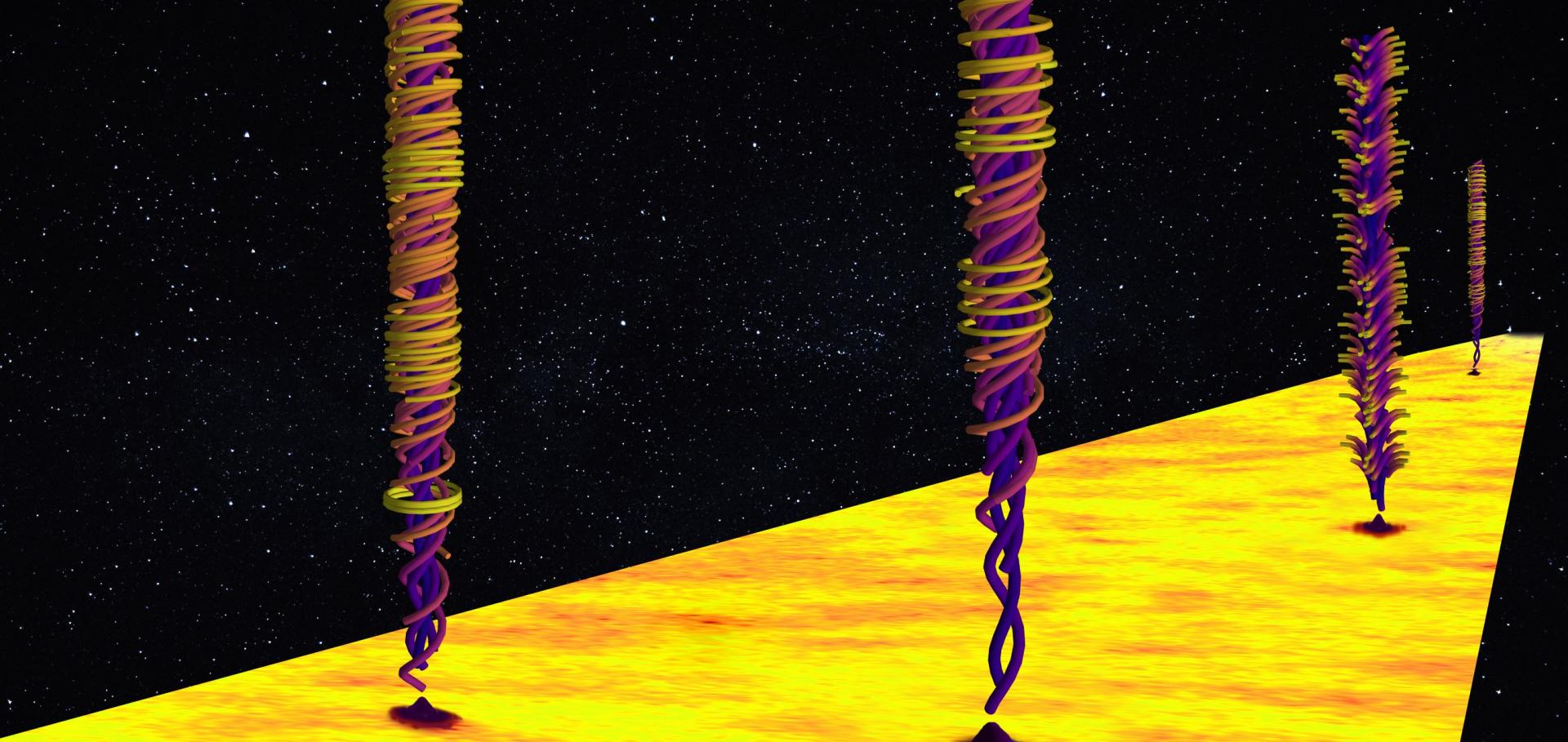


Antiferromagnetic half-skyrmions and bimerons at room temperature
Nature Springer Nature 590:7844 (2021) 74-79
Abstract:
In the quest for post-CMOS (complementary metal–oxide–semiconductor) technologies, driven by the need for improved efficiency and performance, topologically protected ferromagnetic ‘whirls’ such as skyrmions1,2,3,4,5,6,7,8 and their anti-particles have shown great promise as solitonic information carriers in racetrack memory-in-logic or neuromorphic devices1,9,10,11. However, the presence of dipolar fields in ferromagnets, which restricts the formation of ultrasmall topological textures3,6,8,9,12, and the deleterious skyrmion Hall effect, when skyrmions are driven by spin torques9,10,12, have thus far inhibited their practical implementation. Antiferromagnetic analogues, which are predicted to demonstrate relativistic dynamics, fast deflection-free motion and size scaling, have recently become the subject of intense focus9,13,14,15,16,17,18,19, but they have yet to be experimentally demonstrated in natural antiferromagnetic systems. Here we realize a family of topological antiferromagnetic spin textures in α-Fe2O3—an Earth-abundant oxide insulator—capped with a platinum overlayer. By exploiting a first-order analogue of the Kibble–Zurek mechanism20,21, we stabilize exotic merons and antimerons (half-skyrmions)8 and their pairs (bimerons)16,22, which can be erased by magnetic fields and regenerated by temperature cycling. These structures have characteristic sizes of the order of 100 nanometres and can be chemically controlled via precise tuning of the exchange and anisotropy, with pathways through which further scaling may be achieved. Driven by current-based spin torques from the heavy-metal overlayer, some of these antiferromagnetic textures could emerge as prime candidates for low-energy antiferromagnetic spintronics at room temperature1,9,10,11,23.Revealing emergent magnetic charge in an antiferromagnet with diamond quantum magnetometry
Nature Materials Springer Nature 23:2 (2023) 205-211
Abstract:
Whirling topological textures play a key role in exotic phases of magnetic materials and are promising for logic and memory applications. In antiferromagnets, these textures exhibit enhanced stability and faster dynamics with respect to their ferromagnetic counterparts, but they are also difficult to study due to their vanishing net magnetic moment. One technique that meets the demand of highly sensitive vectorial magnetic field sensing with negligible backaction is diamond quantum magnetometry. Here we show that an archetypal antiferromagnet—haematite—hosts a rich tapestry of monopolar, dipolar and quadrupolar emergent magnetic charge distributions. The direct read-out of the previously inaccessible vorticity of an antiferromagnetic spin texture provides the crucial connection to its magnetic charge through a duality relation. Our work defines a paradigmatic class of magnetic systems to explore two-dimensional monopolar physics, and highlights the transformative role that diamond quantum magnetometry could play in exploring emergent phenomena in quantum materials.Route towards stable homochiral topological textures in
A
Physical Review B American Physical Society (APS) 105:22 (2022) 224424
Roadmap on Freestanding Oxide Membranes (FOMs)
Journal of Physics Materials IOP Publishing (2026)
Abstract:
Abstract The ability to rationally design materials with specific properties is a major motivator in materials science and condensed matter physics. Driven by this motivation and the potential of opening up for unprecedented technological avenues, researchers are relentlessly pushing the limits to elevate established materials while concurrently pioneering novel materials. This push has led to newly developed techniques for fabricating, handling, and transferring quasi-twodimensional complex oxide membranes providing a new avenue to overcome traditional oxide epitaxial growth limitations, which relies on specific substrates and synthesis conditions. These advances enable the design and creation of novel materials with previously inaccessible interface symmetries, stacking configurations, and atomic reconstructions, opening exciting possibilities for exploring new physics and developing innovative device architectures using atomically engineered complex oxides. At the same time, these advancements present new challenges in the synthesis, membrane transfer, characterization, and final functionalization of freestanding oxide membranes. The field is still in its early stages and necessitates further scientific and technological progress. This roadmap offers an overview of the current state of the field and perspectives on its future, highlighting opportunities, challenges, and guiding principles for the research community.Revealing the origin of XMCD in an altermagnet via three-dimensional control of spins
(2026)