Home
Department Of Physics text logo
  • Research
    • Our research
    • Our research groups
    • Our research in action
    • Research funding support
    • Summer internships for undergraduates
  • Study
    • Undergraduates
    • Postgraduates
  • Engage
    • For young people
    • For teachers
    • For the public
    • For alumni
    • For business
  • Support
Menu
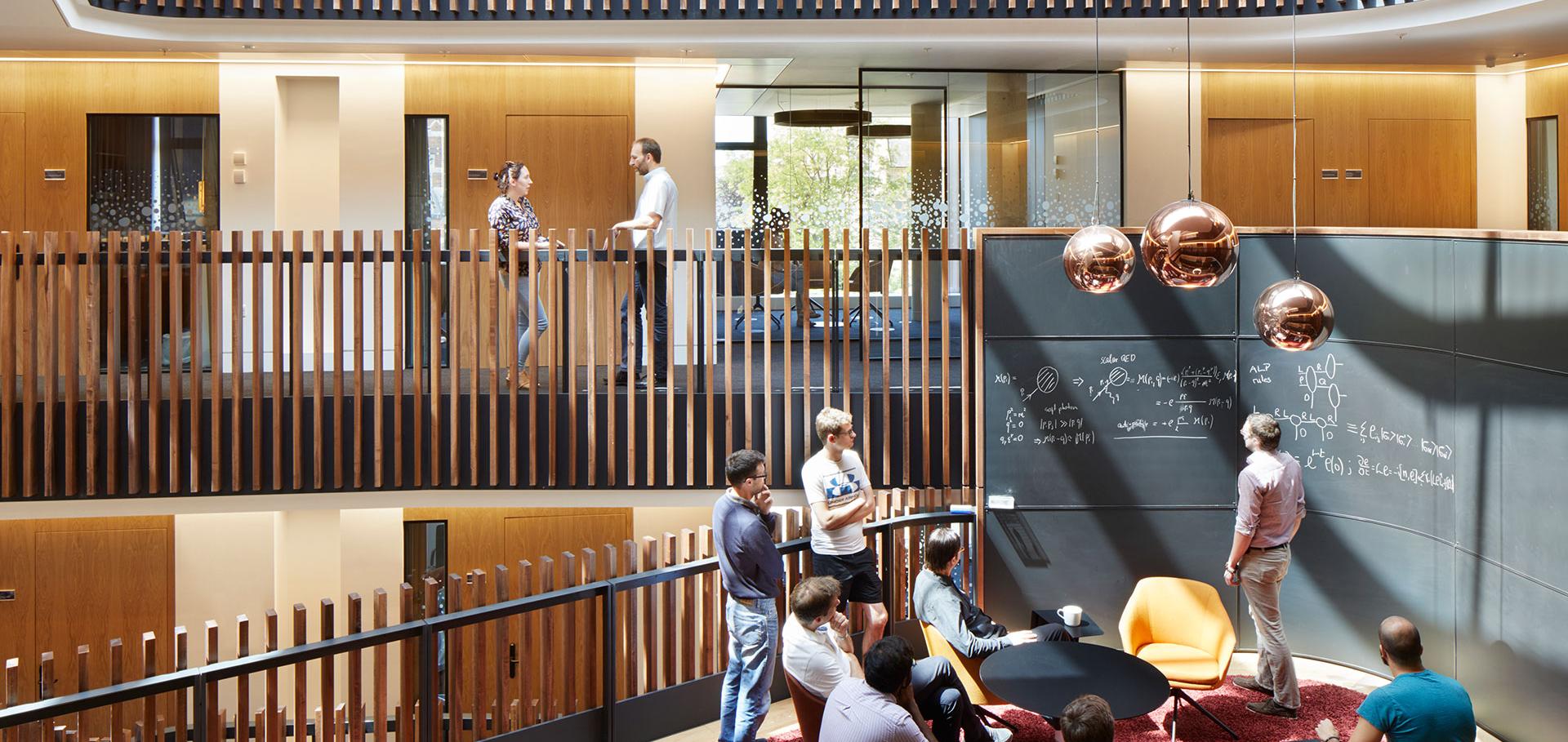
Theoretical physicists working at a blackboard collaboration pod in the Beecroft building.
Credit: Jack Hobhouse

Bence Kocsis

Associate Professor of Theoretical Astrophysics

Research theme

  • Astronomy and astrophysics

Sub department

  • Rudolf Peierls Centre for Theoretical Physics

Research groups

  • Galaxy formation and evolution
  • Pulsars, transients and relativistic astrophysics
  • Theoretical astrophysics and plasma physics at RPC
bence.kocsis@physics.ox.ac.uk
Telephone: 01865 273959
Rudolf Peierls Centre for Theoretical Physics, room 50.08
  • About
  • Publications

A numerical study of stellar discs in galactic nuclei

Monthly Notices of the Royal Astronomical Society Oxford University Press (OUP) (2022)

Authors:

Taras Panamarev, Bence Kocsis

Abstract:

Abstract We explore the dynamics of stellar discs in the close vicinity of a supermassive black hole (SMBH) by means of direct N-body simulations. We show that an isolated nuclear stellar disc exhibits anisotropic mass segregation meaning that massive stars settle to lower orbital inclinations and more circular orbits than the light stars. However, in systems in which the stellar disc is embedded in a much more massive isotropic stellar cluster, anisotropic mass segregation tends to be suppressed. In both cases, an initially thin stellar disc becomes thicker, especially in the inner parts due to the fluctuating anisotropy in the spherical component. We find that vector resonant relaxation is quenched in the disc by nodal precession, but it is still the most efficient relaxation process around SMBHs of mass 106 M⊙ and above. Two body relaxation may dominate for less massive SMBHs found in dwarf galaxies. Stellar discs embedded in massive isotropic stellar clusters ultimately tend to become isotropic on the local two-body relaxation time-scale. Our simulations show that the dynamics of young stars at the centre of the Milky Way is mostly driven by vector resonant relaxation leading to an anticorrelation between the scatter of orbital inclinations and distance from the SMBH. If the S-stars formed in a disc less than 10 Myr ago, they may coexist with a cusp of stellar mass black holes or an intermediate mass black hole with mass up to 1000 M⊙ to reproduce the observed scatter of angular momenta.
More details from the publisher
Details from ORA
More details
More details

The Population of Viscosity- and Gravitational Wave-driven Supermassive Black Hole Binaries among Luminous Active Galactic Nuclei (vol 700, 1952, 2009)

ASTROPHYSICAL JOURNAL American Astronomical Society 937:2 (2022) ARTN 129

Authors:

Zoltan Haiman, Bence Kocsis, Kristen Menou

Abstract:

The following minor errors have been found in the published article. (Equation presented). These errors do not affect any of the figures, results, or conclusions of the paper.
More details from the publisher
More details

Astrophysical gravitational-wave echoes from galactic nuclei

MONTHLY NOTICES OF THE ROYAL ASTRONOMICAL SOCIETY 515:3 (2022) 3299-3318

Authors:

Laszlo Gondan, Bence Kocsis
More details from the publisher
Details from ORA
More details
More details

A numerical study of stellar discs in galactic nuclei

(2022)

Authors:

Taras Panamarev, Bence Kocsis
More details from the publisher
Details from ArXiV

Merger Rates of Intermediate-mass Black Hole Binaries in Nuclear Star Clusters

ASTROPHYSICAL JOURNAL 933:2 (2022) ARTN 170

Authors:

Giacomo Fragione, Abraham Loeb, Bence Kocsis, Frederic A Rasio
More details from the publisher
Details from ORA
More details

Pagination

  • First page First
  • Previous page Prev
  • …
  • Page 7
  • Page 8
  • Page 9
  • Page 10
  • Current page 11
  • Page 12
  • Page 13
  • Page 14
  • Page 15
  • …
  • Next page Next
  • Last page Last

Footer Menu

  • Contact us
  • Giving to the Dept of Physics
  • Work with us
  • Media

User account menu

  • Log in

Follow us

FIND US

Clarendon Laboratory,

Parks Road,

Oxford,

OX1 3PU

CONTACT US

Tel: +44(0)1865272200

University of Oxfrod logo Department Of Physics text logo
IOP Juno Champion logo Athena Swan Silver Award logo

© University of Oxford - Department of Physics

Cookies | Privacy policy | Accessibility statement

Built by: Versantus

  • Home
  • Research
  • Study
  • Engage
  • Our people
  • News & Comment
  • Events
  • Our facilities & services
  • About us
  • Giving to Physics
  • Current students
  • Staff intranet