Home
Department Of Physics text logo
  • Research
    • Our research
    • Our research groups
    • Our research in action
    • Research funding support
    • Summer internships for undergraduates
  • Study
    • Undergraduates
    • Postgraduates
  • Engage
    • For young people
    • For teachers
    • For the public
    • For alumni
    • For business
  • Support
Menu
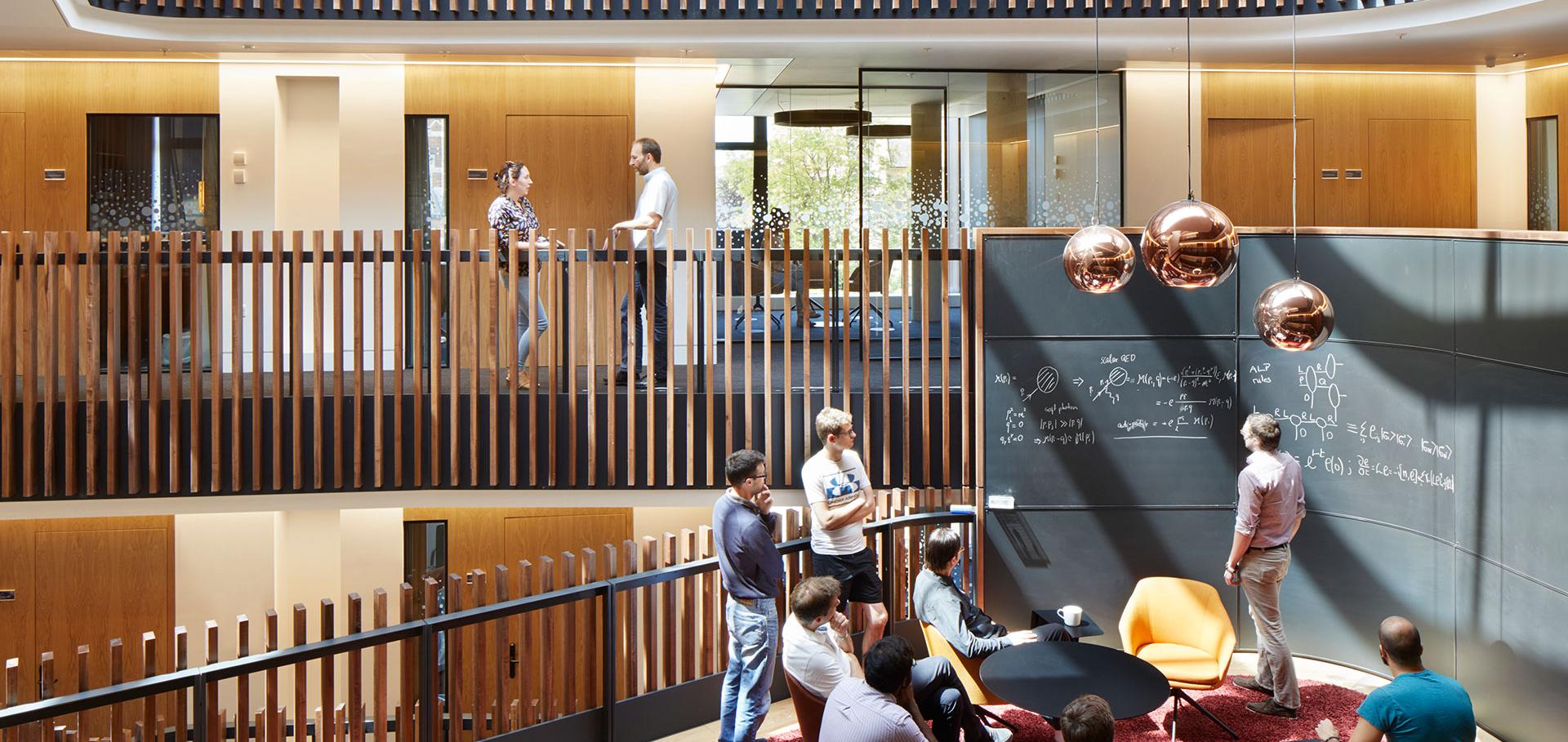
Theoretical physicists working at a blackboard collaboration pod in the Beecroft building.
Credit: Jack Hobhouse

Anders Sandberg

Visitor

Sub department

  • Rudolf Peierls Centre for Theoretical Physics
anders.sandberg@physics.ox.ac.uk
  • About
  • Publications

Happiness and industry 4.0

Future of Humanity Institute (2022)

Authors:

Anders Sandberg, Krisztina Jedlovszky

Abstract:

There is talk about a “fourth industrial revolution” that will change how goods are produced, itself a result of the underlying digital transformation and global economic shifts. Much of this has been a discussion of what manufacturing will be like, and how this influences economic and social progress. However, an understudied question is how this transformation can affect human well-being. Clearly past shifts in human modes of production and societal organization have changed both the opportunities for living a good life, and how they can be expressed. This paper aims to analyze how Industry 4.0 affects these factors, and in particular note where research, technical or policy work is needed to ensure that it enhances well-being rather than impairs it.
Details from ORA

Long term cost-effectiveness of resilient foods for global catastrophes compared to artificial general intelligence safety

International Journal of Disaster Risk Reduction Elsevier 73 (2022) ARTN 102798

Authors:

David Denkenberger, Anders Sandberg, Ross John Tieman, Joshua M Pearce
More details from the publisher
Details from ORA
More details

A safe governance space for humanity: necessary conditions for the governance of Global Catastrophic Risks

Journal and Proceedings of the Royal Society of New South Wales 155 (2022) 48-71

Authors:

L Fisher, A Sandberg

Abstract:

Cited as a CC-BY-NC-ND reprint of https://doi.org/10.1111/1758-5899.13030
More details from the publisher

Long-term cost-effectiveness of interventions for loss of electricity/industry compared to artificial general intelligence safety

EUROPEAN JOURNAL OF FUTURES RESEARCH 9:1 (2021) ARTN 11

Authors:

David Denkenberger, Anders Sandberg, Ross John Tieman, Joshua M Pearce
More details from the publisher
Details from ORA
More details

The timing of evolutionary transitions suggests intelligent life is rare

Astrobiology Mary Ann Liebert 21:3 (2020) 265-278

Authors:

A Snyder-Beattie, A Sandberg, Kim Drexler, Michael Bonsall

Abstract:

It is unknown how abundant extraterrestrial life is, or whether such life might be complex or intelligent. On Earth, the emergence of complex intelligent life required a preceding series of evolutionary transitions such as abiogenesis, eukaryogenesis, and the evolution of sexual reproduction, multicellularity, and intelligence itself. Some of these transitions could have been extraordinarily improbable, even in conducive environments. The emergence of intelligent life late in Earth's lifetime is thought to be evidence for a handful of rare evolutionary transitions, but the timing of other evolutionary transitions in the fossil record is yet to be analyzed in a similar framework. Using a simplified Bayesian model that combines uninformative priors and the timing of evolutionary transitions, we demonstrate that expected evolutionary transition times likely exceed the lifetime of Earth, perhaps by many orders of magnitude. Our results corroborate the original argument suggested by Brandon Carter that intelligent life in the Universe is exceptionally rare, assuming that intelligent life elsewhere requires analogous evolutionary transitions. Arriving at the opposite conclusion would require exceptionally conservative priors, evidence for much earlier transitions, multiple instances of transitions, or an alternative model that can explain why evolutionary transitions took hundreds of millions of years without appealing to rare chance events. Although the model is simple, it provides an initial basis for evaluating how varying biological assumptions and fossil record data impact the probability of evolving intelligent life, and also provides a number of testable predictions, such as that some biological paradoxes will remain unresolved and that planets orbiting M dwarf stars are uninhabitable.
More details from the publisher
Details from ORA
More details
More details

Pagination

  • First page First
  • Previous page Prev
  • Page 1
  • Page 2
  • Page 3
  • Current page 4
  • Page 5
  • Page 6
  • Page 7
  • Page 8
  • Page 9
  • …
  • Next page Next
  • Last page Last

Footer Menu

  • Contact us
  • Giving to the Dept of Physics
  • Work with us
  • Media

User account menu

  • Log in

Follow us

FIND US

Clarendon Laboratory,

Parks Road,

Oxford,

OX1 3PU

CONTACT US

Tel: +44(0)1865272200

University of Oxfrod logo Department Of Physics text logo
IOP Juno Champion logo Athena Swan Silver Award logo

© University of Oxford - Department of Physics

Cookies | Privacy policy | Accessibility statement

Built by: Versantus

  • Home
  • Research
  • Study
  • Engage
  • Our people
  • News & Comment
  • Events
  • Our facilities & services
  • About us
  • Giving to Physics
  • Current students
  • Staff intranet