Home
Department Of Physics text logo
  • Research
    • Our research
    • Our research groups
    • Our research in action
    • Research funding support
    • Summer internships for undergraduates
  • Study
    • Undergraduates
    • Postgraduates
  • Engage
    • For young people
    • For teachers
    • For the public
    • For alumni
    • For business
  • Support
Menu
Atomic and Laser Physics
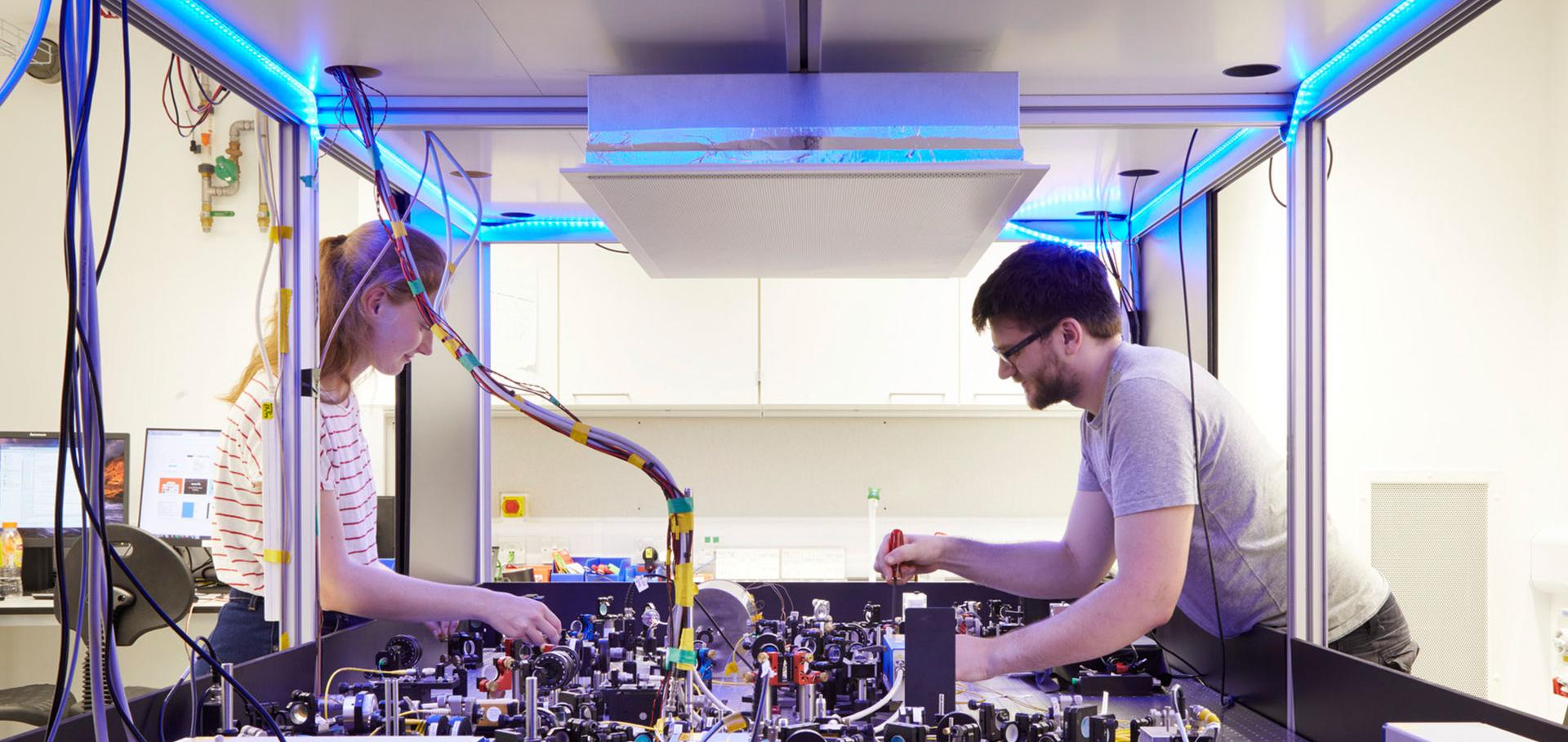
Credit: Jack Hobhouse

Jinzhao Sun

Schmidt AI in Science Fellow

Research theme

  • Quantum information and computation

Sub department

  • Atomic and Laser Physics

Research groups

  • Frontiers of quantum physics
jinzhao.sun@physics.ox.ac.uk
Clarendon Laboratory
Personal website
Google Scholar
  • About
  • Publications

Experimental quantum computational chemistry with optimized unitary coupled cluster ansatz

Nature Physics Springer Nature 20:8 (2024) 1240-1246

Authors:

Shaojun Guo, Jinzhao Sun, Haoran Qian, Ming Gong, Yukun Zhang, Fusheng Chen, Yangsen Ye, Yulin Wu, Sirui Cao, Kun Liu, Chen Zha, Chong Ying, Qingling Zhu, He-Liang Huang, Youwei Zhao, Shaowei Li, Shiyu Wang, Jiale Yu, Daojin Fan, Dachao Wu, Hong Su, Hui Deng, Hao Rong, Yuan Li, Kaili Zhang, Tung-Hsun Chung, Futian Liang, Jin Lin, Yu Xu, Lihua Sun, Cheng Guo, Na Li, Yong-Heng Huo, Cheng-Zhi Peng, Chao-Yang Lu, Xiao Yuan, Xiaobo Zhu, Jian-Wei Pan
More details from the publisher
More details

Purification and correction of quantum channels by commutation-derived quantum filters

(2024)

Authors:

Sowmitra Das, Jinzhao Sun, Michael Hanks, Bálint Koczor, MS Kim
More details from the publisher
Details from ArXiV

High-precision and low-depth quantum algorithm design for eigenstate problems

ArXiv 2406.04307 (2024)

Authors:

Jinzhao Sun, Pei Zeng, Tom Gur, MS Kim
Details from ArXiV

Weyl metallic state induced by helical magnetic order

npj Quantum Materials Springer Nature 9:1 (2024) 7

Authors:

Jian-Rui Soh, Irián Sánchez-Ramírez, Xupeng Yang, Jinzhao Sun, Ivica Zivkovic, Jose Alberto Rodríguez-Velamazán, Oscar Fabelo, Anne Stunault, Alessandro Bombardi, Christian Balz, Manh Duc Le, Helen C Walker, J Hugo Dil, Dharmalingam Prabhakaran, Henrik M Rønnow, Fernando de Juan, Maia G Vergniory, Andrew T Boothroyd

Abstract:

In the rapidly expanding field of topological materials there is growing interest in systems whose topological electronic band features can be induced or controlled by magnetism. Magnetic Weyl semimetals, which contain linear band crossings near the Fermi level, are of particular interest owing to their exotic charge and spin transport properties. Up to now, the majority of magnetic Weyl semimetals have been realized in ferro- or ferrimagnetically ordered compounds, but a disadvantage of these materials for practical use is their stray magnetic field which limits the minimum size of devices. Here we show that Weyl nodes can be induced by a helical spin configuration, in which the magnetization is fully compensated. Using a combination of neutron diffraction and resonant elastic x-ray scattering, we find that below TN = 14.5 K the Eu spins in EuCuAs develop a planar helical structure which induces two quadratic Weyl nodes with Chern numbers C = ±2 at the A point in the Brillouin zone.
More details from the publisher
Details from ORA
More details

Orbital expansion variational quantum eigensolver

Quantum Science and Technology IOP Publishing 8:4 (2023) 045030

Authors:

Yusen Wu, Zigeng Huang, Jinzhao Sun, Xiao Yuan, Jingbo B Wang, Dingshun Lv
More details from the publisher
More details

Pagination

  • First page First
  • Previous page Prev
  • Page 1
  • Page 2
  • Page 3
  • Page 4
  • Current page 5
  • Page 6
  • Page 7
  • Page 8
  • Page 9
  • …
  • Next page Next
  • Last page Last

Footer Menu

  • Contact us
  • Giving to the Dept of Physics
  • Work with us
  • Media

User account menu

  • Log in

Follow us

FIND US

Clarendon Laboratory,

Parks Road,

Oxford,

OX1 3PU

CONTACT US

Tel: +44(0)1865272200

University of Oxfrod logo Department Of Physics text logo
IOP Juno Champion logo Athena Swan Silver Award logo

© University of Oxford - Department of Physics

Cookies | Privacy policy | Accessibility statement

Built by: Versantus

  • Home
  • Research
  • Study
  • Engage
  • Our people
  • News & Comment
  • Events
  • Our facilities & services
  • About us
  • Giving to Physics
  • Current students
  • Staff intranet