Home
Department Of Physics text logo
  • Research
    • Our research
    • Our research groups
    • Our research in action
    • Research funding support
    • Summer internships for undergraduates
  • Study
    • Undergraduates
    • Postgraduates
  • Engage
    • For young people
    • For teachers
    • For the public
    • For alumni
    • For business
  • Support
Menu
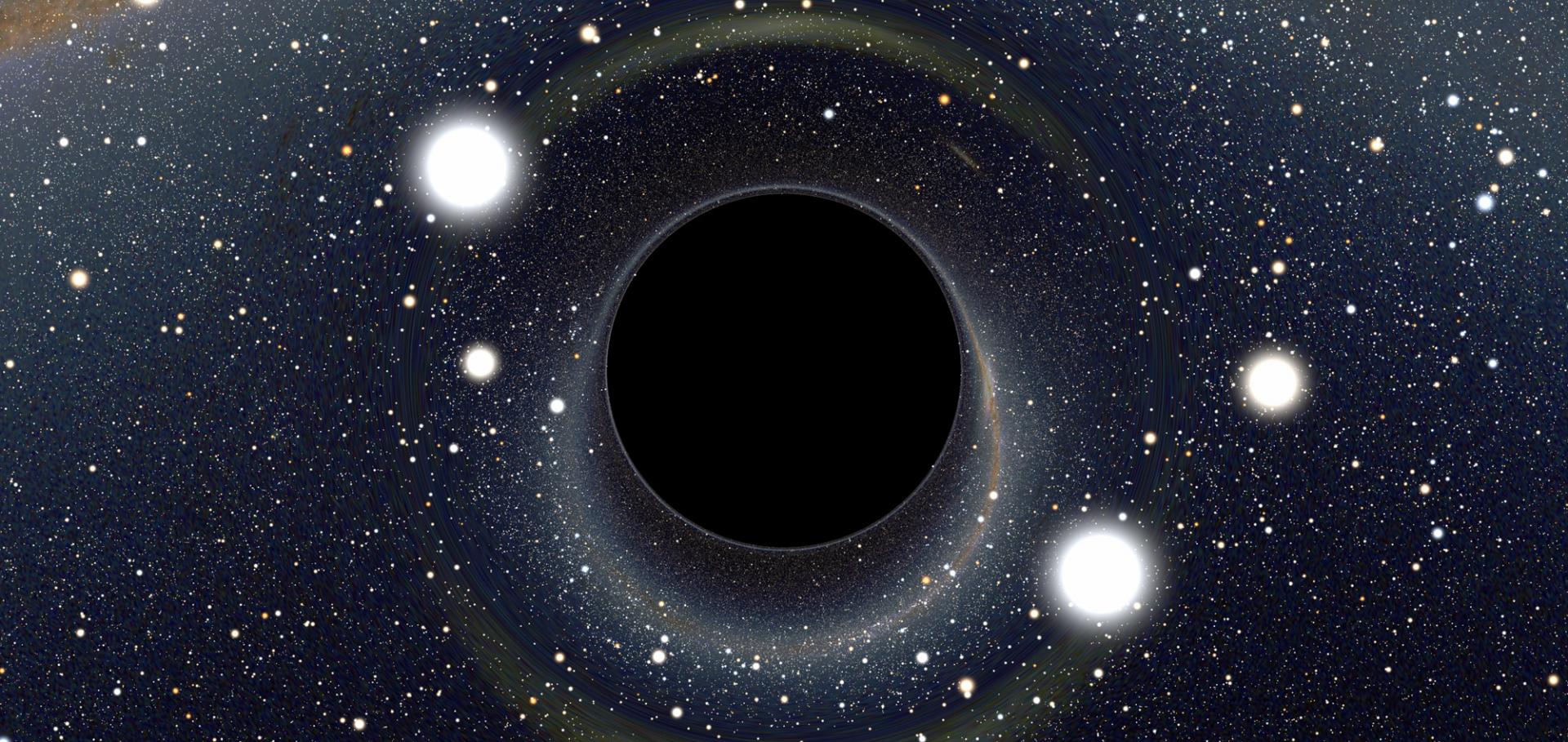
Black Hole

Lensing of space time around a black hole. At Oxford we study black holes observationally and theoretically on all size and time scales - it is some of our core work.

Credit: ALAIN RIAZUELO, IAP/UPMC/CNRS. CLICK HERE TO VIEW MORE IMAGES.

Angela Taylor

Professor of Experimental Astrophysics

Research theme

  • Astronomy and astrophysics
  • Particle astrophysics & cosmology
  • Instrumentation

Sub department

  • Astrophysics

Research groups

  • Experimental radio cosmology
  • C-BASS
  • The Square Kilometre Array (SKA)
Angela.Taylor@physics.ox.ac.uk
Telephone: 01865 (2)73297
Denys Wilkinson Building, room 753
  • About
  • Publications

Cosmological parameter estimation and Bayesian model comparison using VSA data

ArXiv astro-ph/0212497 (2002)

Authors:

Anze Slosar, Pedro Carreira, Kieran Cleary, Rod D Davies, Richard J Davis, Clive Dickinson, Ricardo Genova-Santos, Keith Grainge, Carlos M Gutierrez, Yaser A Hafez, Michael P Hobson, Michael E Jones, Rudiger Kneissl, Katy Lancaster, Anthony Lasenby, JP Leahy, Klaus Maisinger, Phil J Marshall, Guy G Pooley, Rafael Rebolo, Jose Alberto Rubino-Martin, Ben Rusholme, Richard DE Saunders, Richard Savage, Paul F Scott, Pedro J Sosa Molina, Angela C Taylor, David Titterington, Elizabeth Waldram, Robert A Watson, Althea Wilkinson

Abstract:

We constrain the basic comological parameters using the first observations by the Very Small Array (VSA) in its extended configuration, together with existing cosmic microwave background data and other cosmological observations. We estimate cosmological parameters for four different models of increasing complexity. In each case, careful consideration is given to implied priors and the Bayesian evidence is calculated in order to perform model selection. We find that the data are most convincingly explained by a simple flat Lambda-CDM cosmology without tensor modes. In this case, combining just the VSA and COBE data sets yields the 68 per cent confidence intervals Omega_b h^2=0.034 (+0.007, -0.007), Omega_dm h^2 = 0.18 (+0.06, -0.04), h=0.72 (+0.15,-0.13), n_s=1.07 (+0.06,-0.06) and sigma_8=1.17 (+0.25, -0.20). The most general model considered includes spatial curvature, tensor modes, massive neutrinos and a parameterised equation of state for the dark energy. In this case, by combining all recent cosmological data, we find, in particular, 95 percent limit on the tensor-to-scalar ratio R < 0.63 and on the fraction of massive neutrinos f_nu < 0.11; we also obtain the 68 per cent confidence interval w=-1.06 (+0.20, -0.25) on the equation of state of dark energy.
Details from ArXiV
More details from the publisher
More details

The CMB power spectrum out to l=1400 measured by the VSA

ArXiv astro-ph/0212495 (2002)

Authors:

Keith Grainge, Pedro Carreira, Kieran Cleary, Rod D Davies, Richard J Davis, Clive Dickinson, Ricardo Genova-Santos, Carlos M Gutierrez, Yaser A Hafez, Michael P Hobson, Michael E Jones, Rudiger Kneissl, Katy Lancaster, Anthony Lasenby, JP Leahy, Klaus Maisinger, Guy G Pooley, Rafael Rebolo, Jose Alberto Rubino-Martin, Pedro Sosa Molina, Carolina Odman, Ben Rusholme, Richard DE Saunders, Richard Savage, Paul F Scott, Anze Slosar, Angela C Taylor, David Titterington, Elizabeth Waldram, Robert A Watson, Althea Wilkinson

Abstract:

We have observed the cosmic microwave background (CMB) in three regions of sky using the Very Small Array (VSA) in an extended configuration with antennas of beamwidth 2 degrees at 34 GHz. Combined with data from previous VSA observations using a more compact array with larger beamwidth, we measure the power spectrum of the primordial CMB anisotropies between angular multipoles l = 160 - 1400. Such measurements at high l are vital for breaking degeneracies in parameter estimation from the CMB power spectrum and other cosmological data. The power spectrum clearly resolves the first three acoustic peaks, shows the expected fall off in power at high l and starts to constrain the position and height of a fourth peak.
Details from ArXiV
More details from the publisher
More details

First results from the Very Small Array -- I. Observational methods

ArXiv astro-ph/0205378 (2002)

Authors:

Robert A Watson, Pedro Carreira, Kieran Cleary, Rod D Davies, Richard J Davis, Clive Dickinson, Keith Grainge, Carlos M Gutierrez, Michael P Hobson, Michael E Jones, Rudiger Kneissl, Anthony Lasenby, Klaus Maisinger, Guy G Pooley, Rafael Rebolo, Jose Alberto Rubino-Martin, Ben Rusholme, Richard DE Saunders, Richard Savage, Paul F Scott, Anze Slosar, Pedro J Sosa Molina, Angela C Taylor, David Titterington, Elizabeth Waldram, Althea Wilkinson

Abstract:

The Very Small Array (VSA) is a synthesis telescope designed to image faint structures in the cosmic microwave background on degree and sub-degree angular scales. The VSA has key differences from other CMB interferometers with the result that different systematic errors are expected. We have tested the operation of the VSA with a variety of blank-field and calibrator observations and cross-checked its calibration scale against independent measurements. We find that systematic effects can be suppressed below the thermal noise level in long observations; the overall calibration accuracy of the flux density scale is 3.5 percent and is limited by the external absolute calibration scale.
Details from ArXiV
More details from the publisher
More details

First results from the Very Small Array -- II. Observations of the CMB

ArXiv astro-ph/0205381 (2002)

Authors:

Angela C Taylor, Pedro Carreira, Kieran Cleary, Rod D Davies, Richard J Davis, Clive Dickinson, Keith Grainge, Carlos M Gutierrez, Michael P Hobson, Michael E Jones, Rudiger Kneissl, Anthony Lasenby, JP Leahy, Klaus Maisinger, Guy G Pooley, Rafael Rebolo, Jose Alberto Rubino-Martin, Ben Rusholme, Richard DE Saunders, Richard Savage, Paul F Scott, Anze Slosar, Pedro J Sosa Molina, David Titterington, Elizabeth Waldram, Robert A Watson, Althea Wilkinson

Abstract:

We have observed the cosmic microwave background temperature fluctuations in eight fields covering three separated areas of sky with the Very Small Array at 34 GHz. A total area of 101 square degrees has been imaged, with sensitivity on angular scales 3.6 - 0.4 degrees (equivalent to angular multipoles l=150-900). We describe the field selection and observing strategy for these observations. In the full-resolution images (with synthesised beam of FWHM ~ 17 arcmin) the thermal noise is typically 45 microK and the CMB signal typically 55 microK. The noise levels in each field agree well with the expected thermal noise level of the telescope, and there is no evidence of any residual systematic features. The same CMB features are detected in separate, overlapping observations. Discrete radio sources have been detected using a separate 15 GHz survey and their effects removed using pointed follow-up observations at 34 GHz. We estimate that the residual confusion noise due to unsubtracted radio sources is less than 14 mJy/beam (15 microK in the full-resolution images), which added in quadrature to the thermal noise increases the noise level by 6 %. We estimate that the rms contribution to the images from diffuse Galactic emission is less than 6 microK. We also present images which are convolved to maximise the signal-to-noise of the CMB features and are co-added in overlapping areas, in which the signal-to-noise of some individual CMB features exceeds 8.
Details from ArXiV
More details from the publisher
More details

First results from the Very Small Array -- IV. Cosmological parameter estimation

ArXiv astro-ph/0205367 (2002)

Authors:

Jose Alberto Rubino-Martin, Rafael Rebolo, Pedro Carreira, Kieran Cleary, Rod D Davies, Richard J Davis, Clive Dickinson, Keith Grainge, Carlos M Gutierrez, Michael P Hobson, Michael E Jones, Rudiger Kneissl, Anthony Lasenby, Klaus Maisinger, Carolina Oedman, Guy G Pooley, Pedro J Sosa Molina, Ben Rusholme, Richard DE Saunders, Richard Savage, Paul F Scott, Anze Slosar, Angela C Taylor, David Titterington, Elizabeth Waldram, Robert A Watson, Althea Wilkinson

Abstract:

We investigate the constraints on basic cosmological parameters set by the first compact-configuration observations of the Very Small Array (VSA), and other cosmological data sets, in the standard inflationary LambdaCDM model. Using a weak prior 40 < H_0 < 90 km/s/Mpc and 0 < tau < 0.5 we find that the VSA and COBE_DMR data alone produce the constraints Omega_tot = 1.03^{+0.12}_{-0.12}, Omega_bh^2 = 0.029^{+0.009}_{-0.009}, Omega_cdm h^2 = 0.13^{+0.08}_{-0.05} and n_s = 1.04^{+0.11}_{-0.08} at the 68 per cent confidence level. Adding in the type Ia supernovae constraints, we additionally find Omega_m = 0.32^{+0.09}_{-0.06} and Omega_Lambda = 0.71^{+0.07}_{-0.07}. These constraints are consistent with those found by the BOOMERanG, DASI and MAXIMA experiments. We also find that, by combining all the recent CMB experiments and assuming the HST key project limits for H_0 (for which the X-ray plus Sunyaev--Zel'dovich route gives a similar result), we obtain the tight constraints Omega_m=0.28^{+0.14}_{-0.07} and Omega_Lambda= 0.72^{+0.07}_{-0.13}, which are consistent with, but independent of, those obtained using the supernovae data.
Details from ArXiV
More details from the publisher
More details

Pagination

  • First page First
  • Previous page Prev
  • …
  • Page 16
  • Page 17
  • Page 18
  • Page 19
  • Page 20
  • Page 21
  • Page 22
  • Current page 23
  • Page 24
  • Next page Next
  • Last page Last

Footer Menu

  • Contact us
  • Giving to the Dept of Physics
  • Work with us
  • Media

User account menu

  • Log in

Follow us

FIND US

Clarendon Laboratory,

Parks Road,

Oxford,

OX1 3PU

CONTACT US

Tel: +44(0)1865272200

University of Oxfrod logo Department Of Physics text logo
IOP Juno Champion logo Athena Swan Silver Award logo

© University of Oxford - Department of Physics

Cookies | Privacy policy | Accessibility statement

Built by: Versantus

  • Home
  • Research
  • Study
  • Engage
  • Our people
  • News & Comment
  • Events
  • Our facilities & services
  • About us
  • Giving to Physics
  • Current students
  • Staff intranet