

Twisted Tin‐Chloride Perovskite Single‐Crystal Heterostructures
Angewandte Chemie International Edition Wiley (2025) e20140
Abstract:
Self‐assembly affords simpler synthetic routes to heterostructures compared with manual layer‐by‐layer stacking, yet controlling interlayer twist angles in a bulk solid remains an outstanding challenge. We report two new single‐crystal heterostructures: (Sn2Cl2)(CYS)2SnCl4 (CYS = +NH3(CH2)2S–; Sn_CYS) and (Sn2Cl2)(SeCYS)2SnCl4 (SeCYS = +NH3(CH2)2Se–; Sn_SeCYS) synthesized in solution, with alternating perovskite and intergrowth layers. Notably, compared to the recently reported lead analog, (Pb2Cl2)(CYS)2PbCl4 (Pb_CYS), the tin heterostructures feature a twist between the perovskite and intergrowth layers. We trace this twist to local distortions at the Sn centers, which change the interfacial lattice‐matching requirements compared to those of the Pb analog. Electronic band structure calculations show that the striking differences in the relative energies of perovskite‐ and intergrowth‐derived bands in Sn_CYS and Pb_CYS arise from structural and not compositional differences. The structural anisotropy of Sn_CYS is also reflected in a large in‐plane photoluminescence linear anisotropy ratio. Interfacial strain further affords differential incorporation of Pb into the perovskite and intergrowth layers of the Sn heterostructures, resulting in redshifted optical absorption onsets. Thus, we posit that local structural distortions may be exploited to manipulate the twist angle and interfacial strain in bulk heterostructures, providing a new handle for tuning the band alignments of bulk quantum‐well electronic structures.Twisted Tin‐Chloride Perovskite Single‐Crystal Heterostructures
Angewandte Chemie (2025)
Abstract:
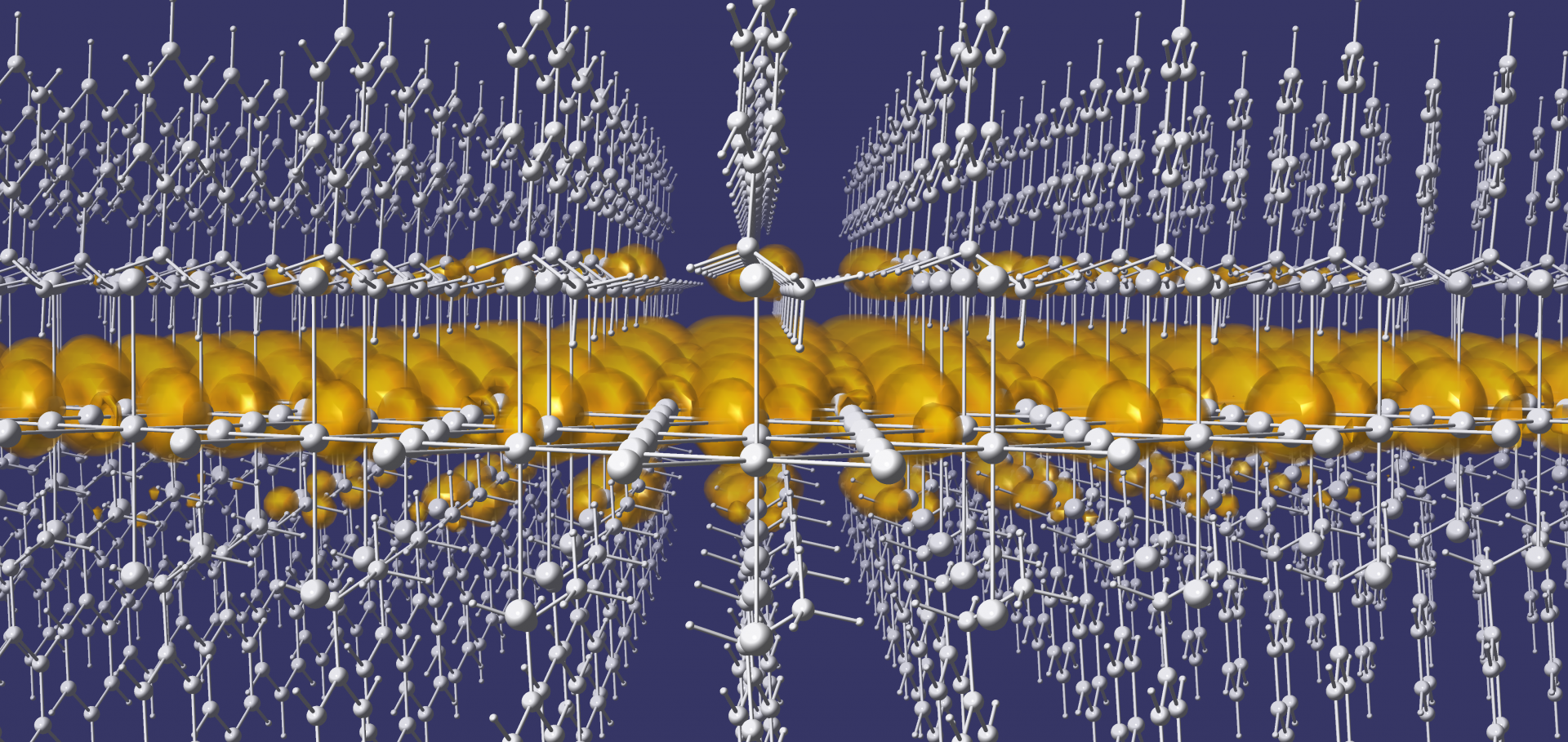
Self‐assembly affords simpler synthetic routes to heterostructures compared with manual layer‐by‐layer stacking, yet controlling interlayer twist angles in a bulk solid remains an outstanding challenge. We report two new single‐crystal heterostructures: (Sn2Cl2)(CYS)2SnCl4 (CYS = +NH3(CH2)2S–; Sn_CYS) and (Sn2Cl2)(SeCYS)2SnCl4 (SeCYS = +NH3(CH2)2Se–; Sn_SeCYS) synthesized in solution, with alternating perovskite and intergrowth layers. Notably, compared to the recently reported lead analog, (Pb2Cl2)(CYS)2PbCl4 (Pb_CYS), the tin heterostructures feature a twist between the perovskite and intergrowth layers. We trace this twist to local distortions at the Sn centers, which change the interfacial lattice‐matching requirements compared to those of the Pb analog. Electronic band structure calculations show that the striking differences in the relative energies of perovskite‐ and intergrowth‐derived bands in Sn_CYS and Pb_CYS arise from structural and not compositional differences. The structural anisotropy of Sn_CYS is also reflected in a large in‐plane photoluminescence linear anisotropy ratio. Interfacial strain further affords differential incorporation of Pb into the perovskite and intergrowth layers of the Sn heterostructures, resulting in redshifted optical absorption onsets. Thus, we posit that local structural distortions may be exploited to manipulate the twist angle and interfacial strain in bulk heterostructures, providing a new handle for tuning the band alignments of bulk quantum‐well electronic structures. Replacing lead with tin in a single‐crystal halide perovskite heterostructure drives a twist between the perovskite (gray) and intergrowth (blue) layers. The accompanying structural distortions and interfacial strain change the calculated orbital composition of the band edges and enable high in‐plane optical anisotropy in the Sn analog. (VBT = valence band top; CBB = conduction band bottom).Discovery of high-temperature charge order and time-reversal symmetry-breaking in the kagome superconductor YRu3Si2.
Nature communications 17:1 (2025) 1121
Abstract:
Identifying high-temperature unconventional charge order and superconductivity in kagome systems is crucial for understanding frustrated, correlated electrons and enabling future quantum technologies. Here, we report that the kagome superconductor YRu3Si2 hosts an exceptional interplay of charge order, magnetism, and superconductivity, revealed through a comprehensive suite of muon spin rotation (μSR), magnetotransport, X-ray diffraction, and density functional theory (DFT). We identify a high-temperature charge-ordered state with propagation vector (1/2,0,0) and a record onset temperature of 800 K, unprecedented in kagome systems and quantum materials more broadly. μSR measurements further reveal time-reversal symmetry-breaking below 25 K and field-induced magnetism near 90 K, features mirrored in the magnetoresistance, which reaches 45% at low temperatures. Band-structure calculations show two van Hove singularities near the Fermi level, including one within a flat band. At low temperatures, YRu3Si2 becomes superconducting below Tc = 3.4 K with either two full isotropic gaps or an anisotropic nodeless gap. These results establish YRu3Si2 as a prime platform for studying correlated kagome physics.Addition to “Tuning the Quantum-Well Structure of Single-Crystal Layered Perovskite Heterostructures”
Journal of the American Chemical Society American Chemical Society (ACS) 147:49 (2025) 45840-45840
Tailoring a lead-free organic–inorganic halobismuthate for large piezoelectric effect
Journal of the American Chemical Society American Chemical Society 147:49 (2025) 45366-45376