

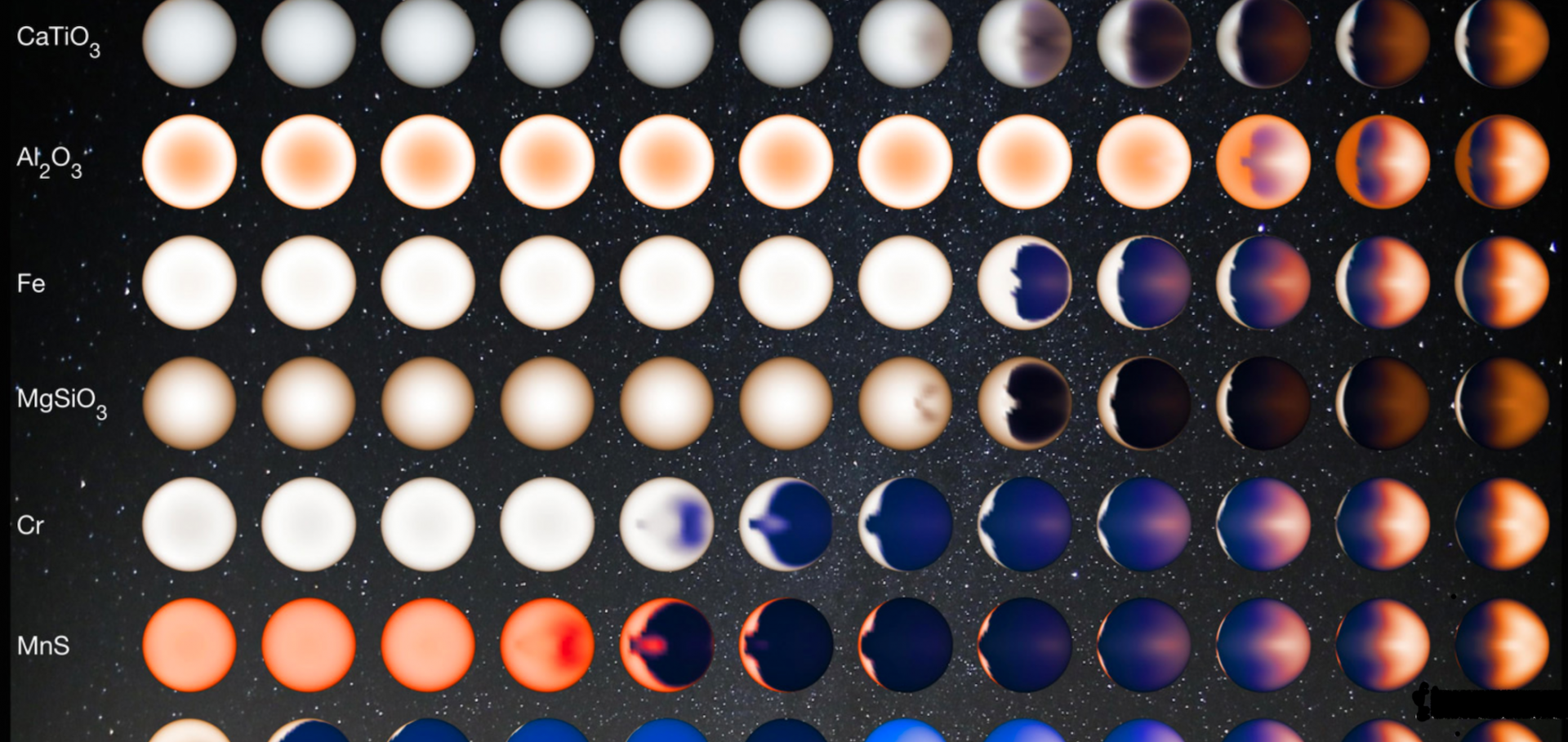
A Comprehensive Analysis of Spitzer 4.5 μm Phase Curves of Hot Jupiters
The Astronomical Journal American Astronomical Society 169:1 (2025) 32
CRIRES+ and ESPRESSO Reveal an Atmosphere Enriched in Volatiles Relative to Refractories on the Ultrahot Jupiter WASP-121b
The Astronomical Journal American Astronomical Society 169:1 (2025) 10
Challenges in the detection of gases in exoplanet atmospheres
Nature Astronomy (2025)
Abstract:
Claims of detections of gases in exoplanet atmospheres often rely on comparisons between models including and excluding specific chemical species. However, the space of molecular combinations available for model construction is vast and highly degenerate. Only a limited subset of these combinations is typically explored for any given detection. As a result, apparent detections of trace gases risk being artefacts of incomplete modelling rather than robust identification of atmospheric constituents, especially in the low-signal-to-noise regime. Here, using the sub-Neptune K2-18 b as a case study, we show that recent biosignature claims vanish when the model space is expanded, with numerous alternatives providing equally good or better fits. We demonstrate that the significance of a claimed detection relies on the choice of models being compared, and that model preference does not in itself imply the presence of a specific gas. We recommend treating model comparisons instead as relative adequacy tests, which should be supported by theoretical predictions and complementary metrics of statistical significance to attribute a signal to a particular gas.archNEMESIS: An Open-Source Python Package for Analysis of Planetary Atmospheric Spectra
Journal of Open Research Software Ubiquity Press 13:1 (2025) 10
Abstract:
ArchNEMESIS is an open-source Python package developed for the analysis of remote sensing spectroscopic observations of planetary atmospheres. It is based on the widely used NEMESIS radiative transfer and retrieval tool, which has been extensively used for the investigation of a wide variety of planetary environments. The main goal of archNEMESIS is to provide the capabilities of its Fortran-based predecessor, keeping or exceeding the efficiency in the calculations, and benefitting from the advantages Python tools provide in terms of usability and portability. ArchNEMESIS enables users to compute synthetic spectra for a wide variety of planetary atmospheres, supporting multiple spectral ranges, viewing geometries (e.g., nadir, limb, and solar occultation), and radiative transfer scenarios, including multiple scattering. Furthermore, it provides tools to fit observed spectra and retrieve atmospheric and surface parameters using both optimal estimation and nested sampling retrieval schemes. The code, stored in a public GitHub repository under a GPL-v3.0 license, is accompanied by detailed documentation available at https://archnemesis.readthedocs.io/.
Benchmarking Photolysis Rates: Species for Earth and Exoplanets
Geoscientific Model Development, 19, 5305 (2026)
Abstract:
Using the Socrates photolysis scheme, we present newly calculated photolysis rates under modern Earth atmospheric conditions for species directly relevant to Earth and species relevant to different atmospheric compositions. We compare to a previous photolysis comparison exercise, namely PhotoComp 2011. Overall, we find good agreement between our results and previous work, with discrepancies usually caused by the implementation of temperature or pressure dependent quantum yields and updated cross-section data. We provide a new set of benchmark photolysis rates for additional species both for Solar irradiance and when irradiated by an M dwarf host star. In general, the higher actinic flux at far-UV and shorter wavelengths of the M dwarf compared to the Sun drives increased photolysis rates for reactions with high threshold energies. This work provides an updated set of benchmark results for further studies of photolysis in the Earth's atmosphere and that of other planets.