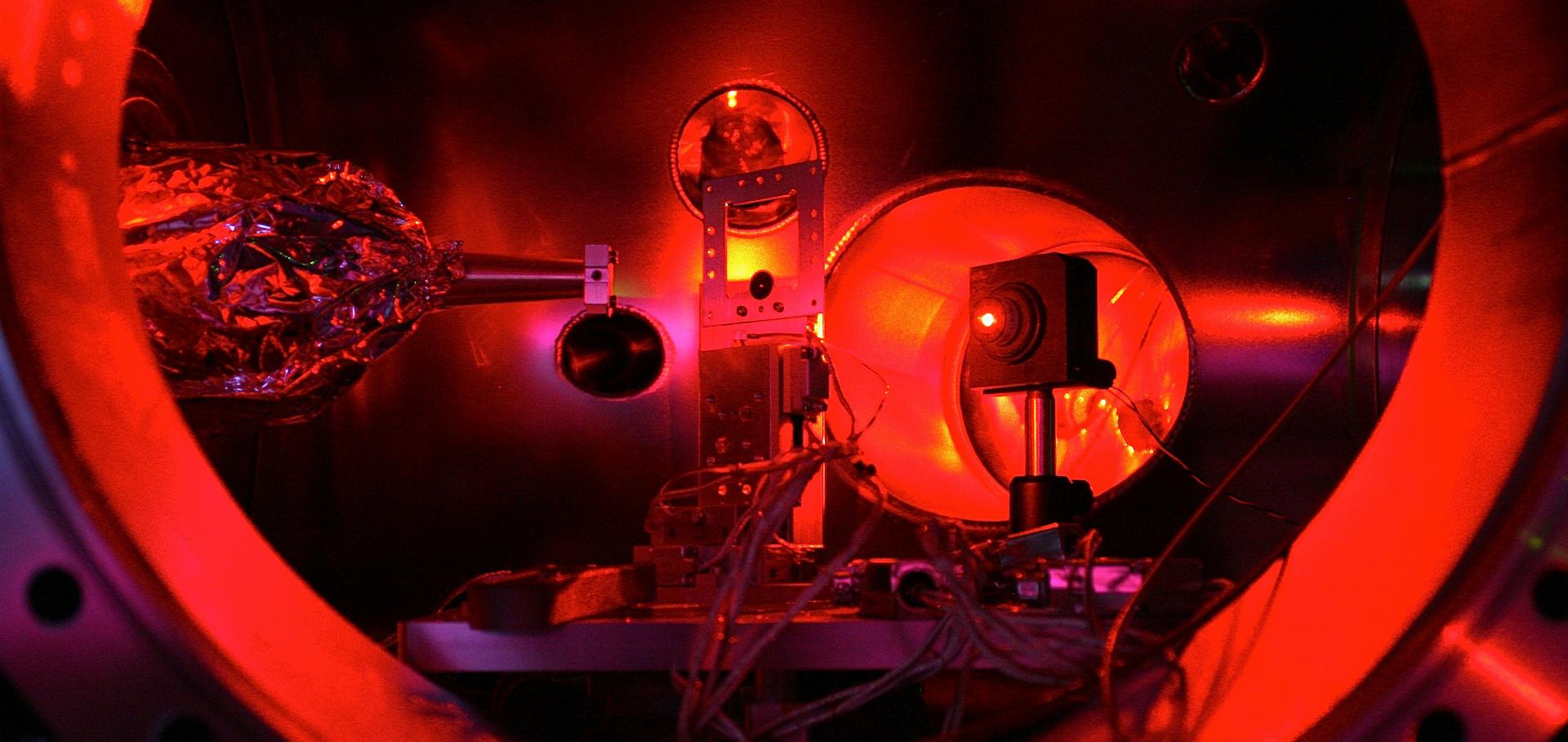
Laboratory realization of relativistic pair-plasma beams

(2024)

Authors:

Charles Arrowsmith, Pascal Simon, Pablo Bilbao, Archie Bott, Stephane Burger, Hui Chen, Filipe Cruz, Tristan Davenne, Ilias Efthymiopoulos, Dustin Froula, Alice Marie Goillot, Jon Tomas Gudmundsson, Dan Haberberger, Jonathan Halliday, Thomas Hodge, Brian Huffman, Sam Iaquinta, Francesco Miniati, Brian Reville, Subir Sarkar, Alexander Schekochihin, Luis Silva, Simpson, Vasiliki Stergiou, Raoul Trines, Thibault Vieu, Nikolaos Charitonidis, Robert Bingham, Gianluca Gregori

Control of autoresonant plasma beat-wave wakefield excitation

Physical Review Research 6:1 (2024)

Authors:

M Luo, C Riconda, I Pusztai, A Grassi, JS Wurtele, T Fülöp

Abstract:

Autoresonant phase locking of the plasma wakefield to the beat frequency of two driving lasers offers advantages over conventional wakefield acceleration methods, since it requires less demanding laser parameters and is robust to variations in the target plasma density. Here, we investigate the kinetic and nonlinear processes that come into play during autoresonant plasma beat-wave acceleration of electrons, their impact on the field amplitude of the accelerating structure, and on acceleration efficiency. Particle-in-cell simulations show that the process depends on the plasma density in a nontrivial way but can be reliably modeled under specific conditions. Beside recovering previous fluid results in the deeply underdense plasma limit, we demonstrate that robust field excitation can be achieved within a fully kinetic self-consistent modeling. By adjusting the laser properties, we can amplify the electric field to the desired level, up to wave breaking, and efficiently accelerate particles; we provide suggestions for optimized laser and plasma parameters. This versatile and efficient acceleration scheme, producing electrons from tens to hundreds of MeV energies, holds promise for a wide range of applications in research industry and medicine.

Efficient prediction of attosecond two-colour pulses from an X-ray free-electron laser with machine learning

ArXiv 2311.14751 (2023)

Authors:

Karim K Alaa El-Din, Oliver G Alexander, Leszek J Frasinski, Florian Mintert, Zhaoheng Guo, Joseph Duris, Zhen Zhang, David B Cesar, Paris Franz, Taran Driver, Peter Walter, James P Cryan, Agostino Marinelli, Jon P Marangos, Rick Mukherjee

Investigating mechanisms of state localization in highly ionized dense plasmas

Physical Review E American Physical Society 108:3 (2023) 35210

Authors:

Thomas Gawne, Thomas Campbell, Alessandro Forte, Patrick Hollebon, Gabriel Perez-Callejo, Oliver S Humphries, Oliver Karnbach, Muhammad F Kasim, Thomas R Preston, Hae Ja Lee, Alan Miscampbell, Quincy Y van den Berg, Bob Nagler, Shenyuan Ren, Ryan B Royle, Justin Wark, Sam M Vinko

Abstract:

We present experimental observations of Kβ emission from highly charged Mg ions at solid density, driven by intense x rays from a free electron laser. The presence of Kβ emission indicates the n = 3 atomic shell is relocalized for high charge states, providing an upper constraint on the depression of the ionization potential. We explore the process of state relocalization in dense plasmas from first principles using finite-temperature density functional theory alongside a wave-function localization metric, and find excellent agreement with experimental results.

Development of a new quantum trajectory molecular dynamics framework

Philosophical Transactions of the Royal Society A: Mathematical, Physical and Engineering Sciences Royal Society 381 (2023) 20220325

Authors:

Pontus Svensson, Thomas Campbell, Frank Graziani, Zhandos Moldabekov, Ningyi Lyu, Scott Richardson, Sam Vinko, Gianluca Gregori

Abstract:

An extension to the wave packet description of quantum plasmas is presented, where the wave packet can be elongated in arbitrary directions. A generalised Ewald summation is constructed for the wave packet models accounting for long-range Coulomb interactions and fermionic effects are approximated by purpose-built Pauli potentials, self-consistent with the wave packets used. We demonstrate its numerical implementation with good parallel support and close to linear scaling in particle number, used for comparisons with the more common wave packet employing isotropic states. Ground state and thermal properties are compared between the models with differences occurring primarily in the electronic subsystem. Especially, the electrical conductivity of dense hydrogen is investigated where a 15% increase in DC conductivity can be seen in our wave packet model compared to other models.