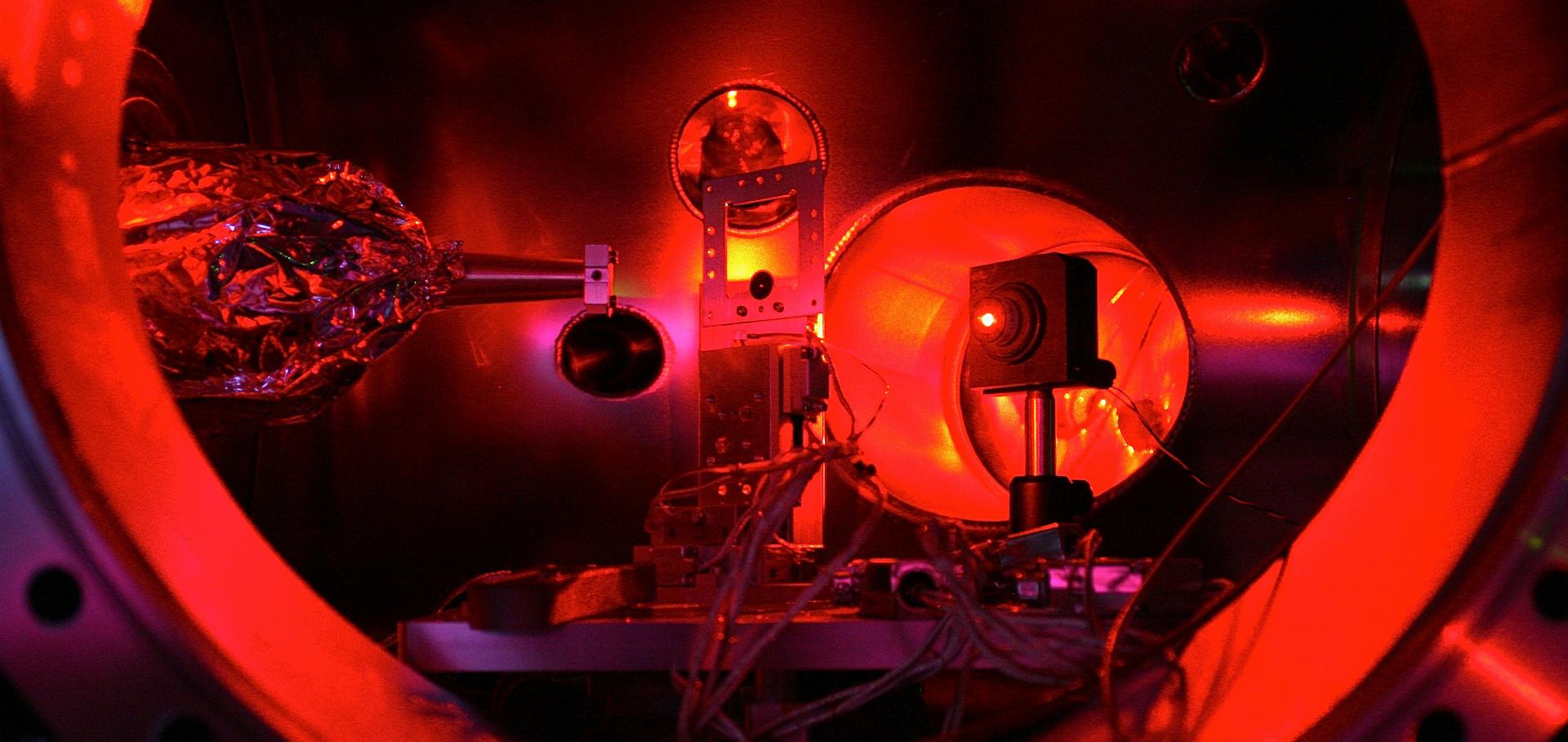
Evolution of autoresonant plasma wave excitation in two-dimensional particle-in-cell simulations
Journal of Plasma Physics Cambridge University Press (CUP) 91:1 (2025) e31
Shock-driven amorphization and melting in Fe2O3
Physical Review B American Physical Society 111:2 (2025) 024209
Abstract:
We present measurements on Fe2O3 amorphization and melt under laser-driven shock compression up to 209(10) GPa via time-resolved in situ x-ray diffraction. At 122(3) GPa, a diffuse signal is observed indicating the presence of a noncrystalline phase. Structure factors have been extracted up to 182(6) GPa showing the presence of two well-defined peaks. A rapid change in the intensity ratio of the two peaks is identified between 145(12) and 151(12) GPa, indicative of a phase change. The noncrystalline diffuse scattering is consistent with shock amorphization of Fe2O3 between 122(3) and 145(12) GPa, followed by an amorphous-to-liquid transition above 151(12) GPa. Upon release, a noncrystalline phase is observed alongside crystalline α-Fe2O3. The extracted structure factor and pair distribution function of this release phase resemble those reported for Fe2O3 melt at ambient pressure.Shock-driven amorphization and melting in
Physical Review B (condensed matter and materials physics) American Physical Society 111:2 (2025) 24209
Abstract:
<jats:p>We present measurements on <a:math xmlns:a="http://www.w3.org/1998/Math/MathML"><a:mrow><a:msub><a:mi>Fe</a:mi><a:mn>2</a:mn></a:msub><a:msub><a:mi mathvariant="normal">O</a:mi><a:mn>3</a:mn></a:msub></a:mrow></a:math> amorphization and melt under laser-driven shock compression up to 209(10) GPa via time-resolved x-ray diffraction. At 122(3) GPa, a diffuse signal is observed indicating the presence of a noncrystalline phase. Structure factors have been extracted up to 182(6) GPa showing the presence of two well-defined peaks. A rapid change in the intensity ratio of the two peaks is identified between 145(12) and 151(12) GPa, indicative of a phase change. The noncrystalline diffuse scattering is consistent with shock amorphization of <c:math xmlns:c="http://www.w3.org/1998/Math/MathML"><c:mrow><c:msub><c:mi>Fe</c:mi><c:mn>2</c:mn></c:msub><c:msub><c:mi mathvariant="normal">O</c:mi><c:mn>3</c:mn></c:msub></c:mrow></c:math> between 122(3) and 145(12) GPa, followed by an amorphous-to-liquid transition above 151(12) GPa. Upon release, a noncrystalline phase is observed alongside crystalline <e:math xmlns:e="http://www.w3.org/1998/Math/MathML"><e:mrow><e:mi>α</e:mi><e:mtext>−</e:mtext><e:msub><e:mi>Fe</e:mi><e:mn>2</e:mn></e:msub><e:msub><e:mi mathvariant="normal">O</e:mi><e:mn>3</e:mn></e:msub></e:mrow></e:math>. The extracted structure factor and pair distribution function of this release phase resemble those reported for <g:math xmlns:g="http://www.w3.org/1998/Math/MathML"><g:mrow><g:msub><g:mi>Fe</g:mi><g:mn>2</g:mn></g:msub><g:msub><g:mi mathvariant="normal">O</g:mi><g:mn>3</g:mn></g:msub></g:mrow></g:math> melt at ambient pressure.</jats:p> <jats:sec> <jats:title/> <jats:supplementary-material> <jats:permissions> <jats:copyright-statement>Published by the American Physical Society</jats:copyright-statement> <jats:copyright-year>2025</jats:copyright-year> </jats:permissions> </jats:supplementary-material> </jats:sec>Ionization calculations using classical molecular dynamics
Physical Review E: Statistical, Nonlinear, and Soft Matter Physics American Physical Society 111 (2025) 015204
Abstract:
By performing an ensemble of molecular dynamics simulations, the model-dependent ionization state is computed for strongly interacting systems self-consistently. This is accomplished through a free energy minimization framework based on the technique of thermodynamic integration. To illustrate the method, two simple models applicable to partially ionized hydrogen plasma are presented in which pair potentials are employed between ions and neutral particles. Within the models, electrons are either bound in the hydrogen ground state or distributed in a uniform charge-neutralizing background. Particular attention is given to the transition between atomic gas and ionized plasma, where the effect of neutral interactions is explored beyond commonly used models in the chemical picture. Furthermore, pressure ionization is observed when short-range repulsion effects are included between neutrals. The developed technique is general, and we discuss the applicability to a variety of molecular dynamics models for partially ionized warm dense matter.Ionization calculations using classical molecular dynamics
PHYSICAL REVIEW E 111:1 (2025)