

Modelling the seasonal cycle of Uranus’s colour and magnitude, and comparison with Neptune
Abstract:
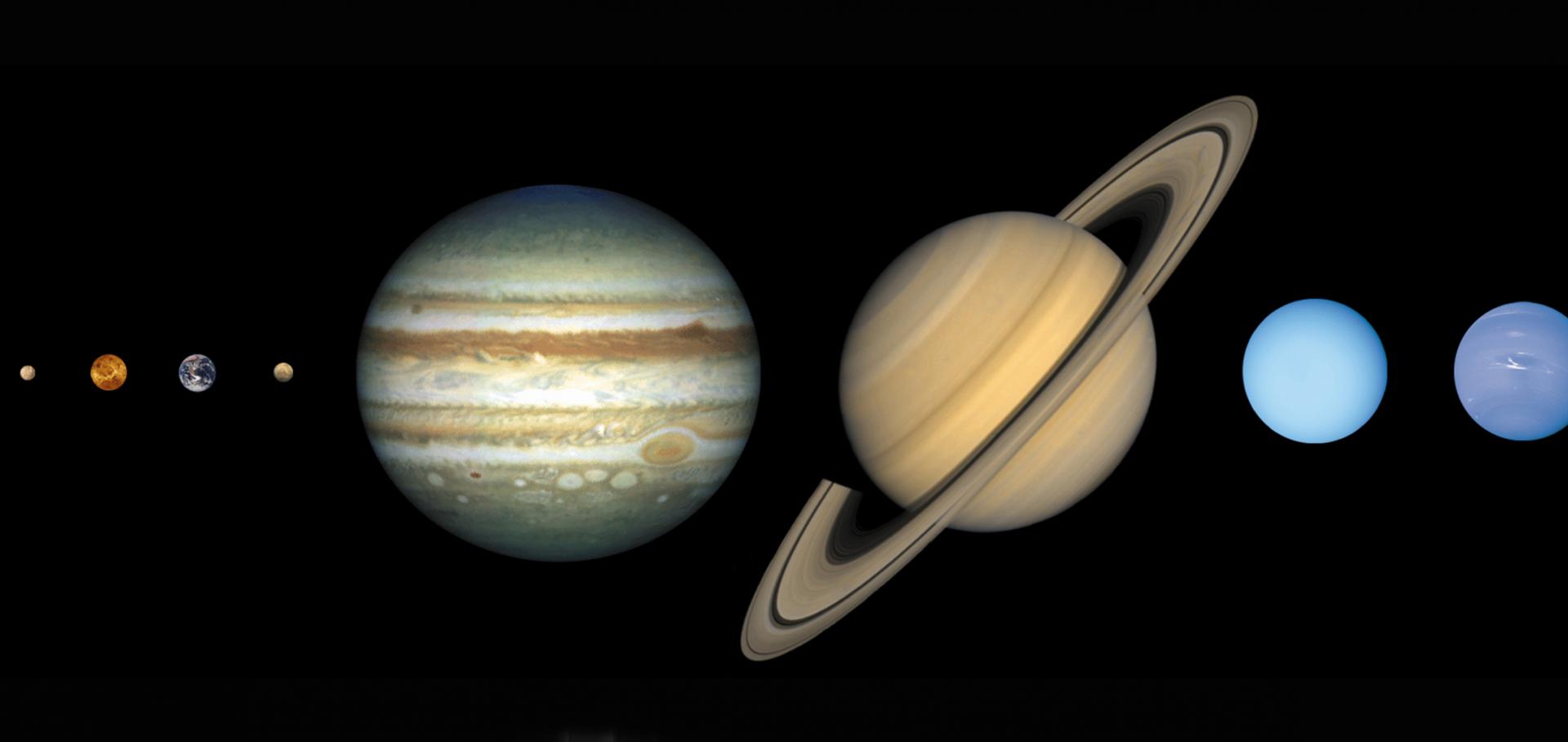
We present a quantitative analysis of the seasonal record of Uranus’s disc-averaged colour and photometric magnitude in Strömgren b and y filters (centred at 467 and 551 nm, respectively), recorded at the Lowell Observatory from 1950 to 2016, and supplemented with HST/WFC3 observations from 2016 to 2022. We find that the seasonal variations of magnitude can be explained by the lower abundance of methane at polar latitudes combined with a time-dependent increase of the reflectivity of the aerosol particles in layer near the methane condensation level at 1 – 2 bar. This increase in reflectivity is consistent with the addition of conservatively scattering particles to this layer, for which the modelled background haze particles are strongly absorbing at both blue and red wavelengths. We suggest that this additional component may come from a higher proportion of methane ice particles. We suggest that the increase in reflectivity of Uranus in both filters between the equinoxes in 1966 and 2007, noted by previous authors, might be related to Uranus’s distance from the Sun and the production rate of dark photochemical haze products. Finally, we find that although the visible colour of Uranus is less blue than Neptune, due to the increased aerosol thickness on Uranus, and this difference is greatest at Uranus’s solstices, it is much less significant than is commonly believed due to a long-standing misperception of Neptune’s ‘true’ colour. We describe how filter-imaging observations, such as those from Voyager-2/ISS and HST/WFC3, should be processed to yield accurate true colour representations.
LIRIS – Lunar Infrared Imaging System for High Resolution Volatile Mapping, a Small Satellite to Support Science and Exploration Missions
Relationships between HCl, H2 O, aerosols, and temperature in the Martian atmosphere Part II: quantitative correlations
Abstract:
NB: this dataset has now been SUPERSEDED by the version at https://ora.ox.ac.uk/objects/uuid:31ee4ec6-ad9c-4804-be86-da5aba057fd2.
Data generated for and supporting the Publication: Relationships between HCl, H2 O, aerosols, and temperature in the Martian atmosphere Part I: climatological outlook for the Journal of Geophysics Research.