Home
Department Of Physics text logo
  • Research
    • Our research
    • Our research groups
    • Our research in action
    • Research funding support
    • Summer internships for undergraduates
  • Study
    • Undergraduates
    • Postgraduates
  • Engage
    • For young people
    • For teachers
    • For the public
    • For alumni
    • For business
  • Support
Menu
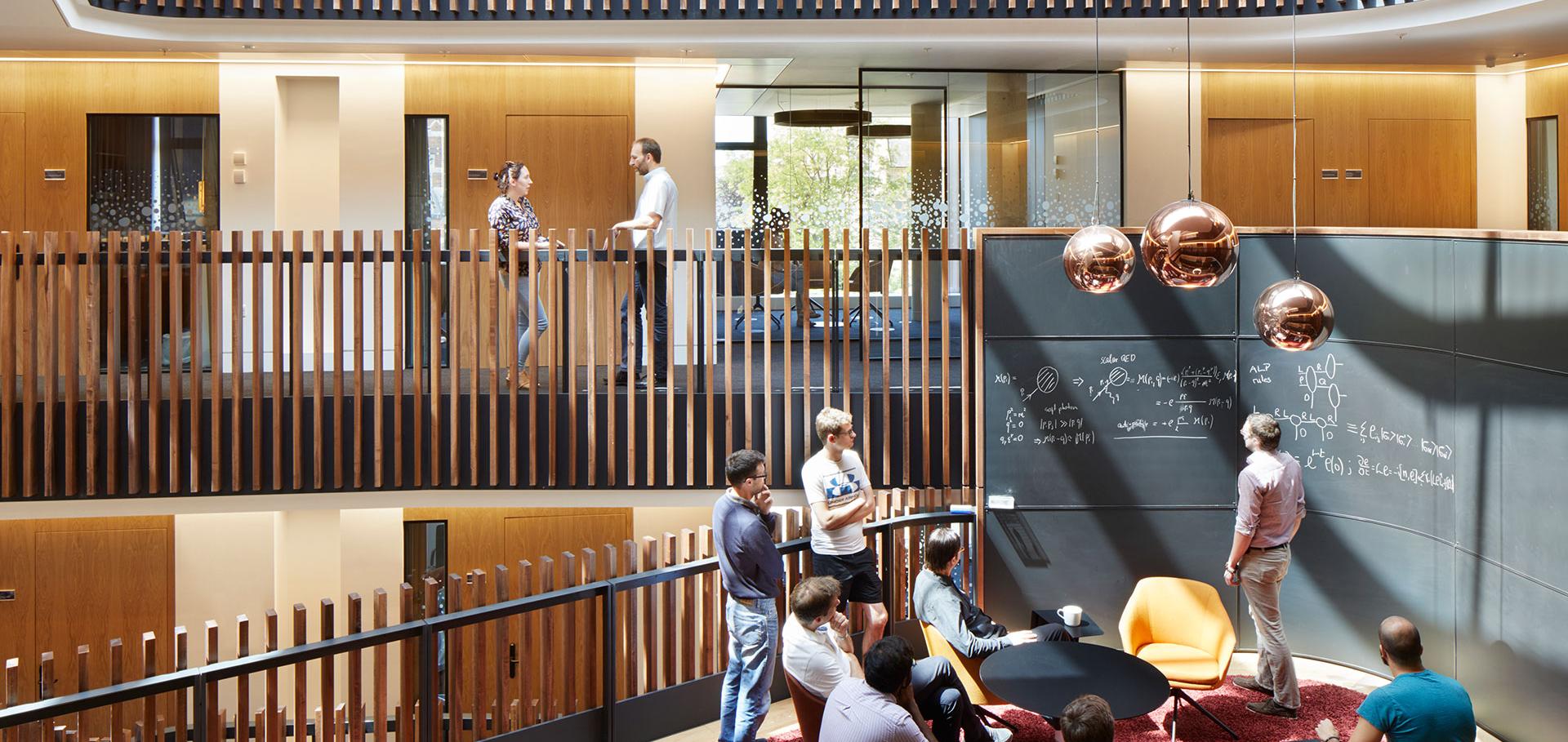
Theoretical physicists working at a blackboard collaboration pod in the Beecroft building.
Credit: Jack Hobhouse

Yonadav Barry Ginat

Royal Commission for the Exhibition 1851 and Branco Weiss Research Fellow

Research theme

  • Astronomy and astrophysics
  • Particle astrophysics & cosmology
  • Plasma physics

Sub department

  • Rudolf Peierls Centre for Theoretical Physics

Research groups

  • Cosmology
  • Theoretical astrophysics and plasma physics at RPC
yb.ginat@physics.ox.ac.uk
Telephone: 01865 273946
Rudolf Peierls Centre for Theoretical Physics, room 50.05
Personal website
  • About
  • Publications

Dynamical Evolution of Quasi-Hierarchical Triples

ArXiv 2509.02685 (2025)

Authors:

Yonadav Barry Ginat, Jakob Stegmann, Johan Samsing
Details from ArXiV

Angular-momentum pairs in spherical systems: applications to the Galactic centre

ArXiv 2507.10551 (2025)

Authors:

Taras Panamarev, Yonadav Barry Ginat, Bence Kocsis
Details from ArXiV

Large-Scale-Structure Observables in General Relativity Validated at Second Order

ArXiv 2506.1126 (2025)

Authors:

Antoine Villey, Yonadav Barry Ginat, Vincent Desjacques, Donghui Jeong, Fabian Schmidt
Details from ArXiV

Detection prospects for the GW background of galactic (sub)solar mass primordial black holes

Journal of Cosmology and Astroparticle Physics IOP Publishing 2025:05 (2025) 036

Authors:

Frans van Die, Ivan Rapoport, Yonadav Barry Ginat, Vincent Desjacques

Abstract:

In multi-component dark matter models, a fraction f pbh of the dark matter could be in the form of primordial black holes (PBHs) with (sub)solar masses. Some would have formed binaries that presently trace the Milky Way halo of particle dark matter. We explore the gravitational wave (GW) signal produced by such a hypothetical population of Galactic PBH binaries and assess its detectability by the LISA experiment. For this purpose, we model the formation and evolution of early-type PBH binaries accounting for GW hardening and binary disruption in the Milky Way. Our analysis reveals that the present-day Galactic population of PBH binaries is characterized by very high orbital eccentricities |1-e| ≪ 1. For a PBH mass M pbh ∼ 0.1 - 1M ⊙, this yields a GW background that peaks in the millihertz frequency range where the LISA instrumental noise is minimum. While this signal remains below the LISA detection threshold for viable f pbh ≲ 0.01, future GW observatories such as DECIGO and BBO could detect it if 0.01 ≲ M pbh ≲ 0.1M ⊙. Furthermore, we anticipate that, after 5 years of observations, LISA should be able to detect 𝒪(100) (resp. 𝒪(1)) loud Galactic PBH binaries of mass M pbh ≲ 0.1 - 1M ⊙ with a SNR ≥ 5 if f pbh = 0.01 (resp. f pbh = 0.001). Nonlinear effects not considered here such as mass accretion and dynamical capture could alter these predictions.
More details from the publisher
Details from ORA
More details
Details from ArXiV

Constraining Axion Dark Matter with Galactic-Centre Resonant Dynamics

(2025)

Authors:

Yonadav Barry Ginat, Bence Kocsis
More details from the publisher
Details from ArXiV

Pagination

  • First page First
  • Previous page Prev
  • Page 1
  • Page 2
  • Page 3
  • Current page 4
  • Page 5
  • Page 6
  • Page 7
  • Page 8
  • Next page Next
  • Last page Last

Footer Menu

  • Contact us
  • Giving to the Dept of Physics
  • Work with us
  • Media

User account menu

  • Log in

Follow us

FIND US

Clarendon Laboratory,

Parks Road,

Oxford,

OX1 3PU

CONTACT US

Tel: +44(0)1865272200

University of Oxfrod logo Department Of Physics text logo
IOP Juno Champion logo Athena Swan Silver Award logo

© University of Oxford - Department of Physics

Cookies | Privacy policy | Accessibility statement

Built by: Versantus

  • Home
  • Research
  • Study
  • Engage
  • Our people
  • News & Comment
  • Events
  • Our facilities & services
  • About us
  • Giving to Physics
  • Current students
  • Staff intranet