

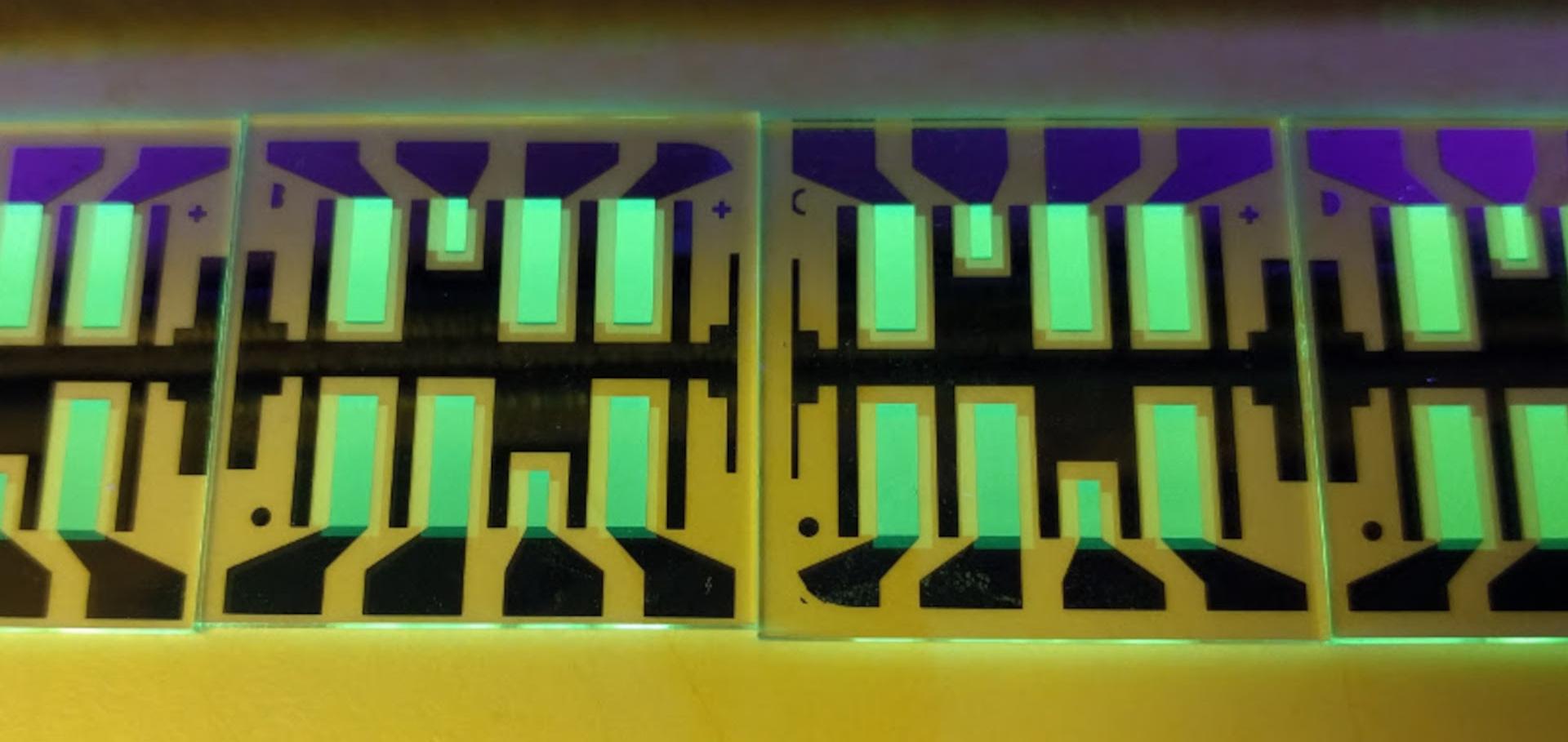

Electric potential mapping by thickness variation: A new method for model-free mobility determination in organic semiconductor thin films
Organic Electronics: physics, materials, applications 14 (2013) 3460-3471
Abstract:
Charge transport, with charge carrier mobility as main parameter, is one of the fundamental properties of semiconductors. In disordered systems like most organic semiconductors, the effective mobility is a function of the electric field, the charge carrier density, and temperature. Transport is often investigated in a space-charge limited current (SCLC) regime in thin film single carrier devices, where an electric current is driven in the direction perpendicular to the surface. Direct evaluation of the current-voltage characteristics, however, is problematic, because parasitic contributions from injection or extraction barriers can falsify results. Here, we present a novel measurement and evaluation technique for key transport parameters. First, it allows for the direct determination of the potential profile in single carrier devices. It is obtained from a series of steady-state current-voltage measurements from devices with varying thickness ("electric potential mapping by thickness variation", POEM). Second, the data can be evaluated to obtain the effective charge carrier mobility μ(F, n) as a function of the electric field F and the charge carrier density n. Single carrier transport is achieved by sandwiching the organic material under investigation between equally doped layers, i.e. p-i-p (resp. n-i-n) devices for hole (electron) transport investigations. The POEM concept is validated using drift-diffusion simulation data. It is furthermore experimentally applied to small molecular organic semiconductors, where the hole transport in a blend of zinc phthalocyanine (ZnPc) and C is characterized. In the measured range of F ≈ (1-5) × 10 V/cm and hole densities of approx. (1-5) × 10 cm, the hole mobility is found to be in the range of (10-10) cm/V s, comprising a pronounced field activation with an activation constant of 0.01 sqrt(cm / V). A dependence of the mobility on the charge carrier density in the given range is not observed. The POEM approach does not require a given mobility function as input, i.e. it constitutes a model-free determination of the effective mobility μ(F, n). It is especially suitable for semiconductors which require complex mobility models, like hopping or trap-dominated transport in disordered systems, and relatively low mobilities, like e.g. neat or mixed organic semiconductors. © 2013 The Authors.Correlation of open-circuit voltage and energy levels in zinc-phthalocyanine: C60 bulk heterojunction solar cells with varied mixing ratio
Physical Review B - Condensed Matter and Materials Physics 88:8 (2013)
Abstract:
The maximum open-circuit voltage V of bulk-heterojunction solar cells is limited by the effective HOMO(donor)-LUMO(acceptor) gap of the photoactive absorber blend. We investigate blend layers comprising zinc-phthalocyanine (ZnPc) and the buckminster fullerene C with ultraviolet, x-ray, and inverse photoelectron spectroscopy. By varying the volume mixing ratio ZnPc:C from 6:1 to 1:6, we observe a linear increase of the HOMO(ZnPc)-LUMO(C) gap by 0.25 eV. The trend in this gap correlates with the change in the charge transfer energy measured by Fourier-transform photocurrent spectroscopy as well as with the observed open-circuit voltage of solar cells containing ZnPc:C as the photoactive absorber layer. Furthermore, the morphology of different ZnPc:C blend layers is investigated by grazing-incidence x-ray diffraction. As physical origins for the changed energy levels, a suppressed crystallization of the C phase in the presence of donor molecules as well as concentration-dependent growth modes of the ZnPc phase are suggested. © 2013 American Physical Society.Molecular ordering and charge transport in a dicyanovinyl-substituted quaterthiophene thin film
RSC Advances 3:30 (2013) 12117-12123
Abstract:
By combining computer simulations, grazing incidence, and powder X-ray-diffraction measurements we reconstruct the crystal structure of a thin film of terminally dicyanovinyl-substituted quaterthiophene (DCV4T). The crystal structure differs from the known single crystal structure of the same compound, but resembles the molecular packing of a methylated DCV4T. Charge transport simulations on the molecular level show that the 2 dimensional thin-film charge-transport network is well suited for hole transport in solar cells. © The Royal Society of Chemistry 2013.Investigation of driving forces for charge extraction in organic solar cells: Transient photocurrent measurements on solar cells showing s-shaped current-voltage characteristics
Advanced Energy Materials 3:7 (2013) 873-880
Abstract:
The role of drift and diffusion as driving forces for charge carrier extraction in flat heterojunction organic solar cells is examined at the example of devices showing intentional S-shaped current-voltage ( J-V ) characteristics. Since these kinks are related to energy barriers causing a redistribution of the electric fi eld and charge carrier density gradients, they are suitable for studying the limits of charge extraction. The dynamics of this redistribution process are experimentally monitored via transient photocurrents, where the current response on square pulses of light is measured in the ? s to ms regime. In combination with drift-diffusion simulation data, we demonstrate a pile-up of charge carriers at extraction barriers and a high contribution of diffusion to photocurrent in the case of injection barriers. Both types of barrier lead to S-kinks in the J-V curve and can be distinguished from each other and from other reasons for S-kinks (e.g. imbalanced mobilities) by applying the presented approach. Furthermore, it is also helpful to investigate the driving forces for charge extraction in devices without S-shaped J-V curve close to open circuit to evaluate whether their electrodes are optimized. © 2013 WILEY-VCH Verlag GmbH & Co. KGaA, Weinheim.Two similar near-infrared (IR) absorbing benzannulated aza-BODIPY dyes as near-IR sensitizers for ternary solar cells.
ACS Appl Mater Interfaces 5:12 (2013) 5609-5616