Home
Department Of Physics text logo
  • Research
    • Our research
    • Our research groups
    • Our research in action
    • Research funding support
    • Summer internships for undergraduates
  • Study
    • Undergraduates
    • Postgraduates
  • Engage
    • For alumni
    • For business
    • For schools
    • For the public
  • Support
Menu
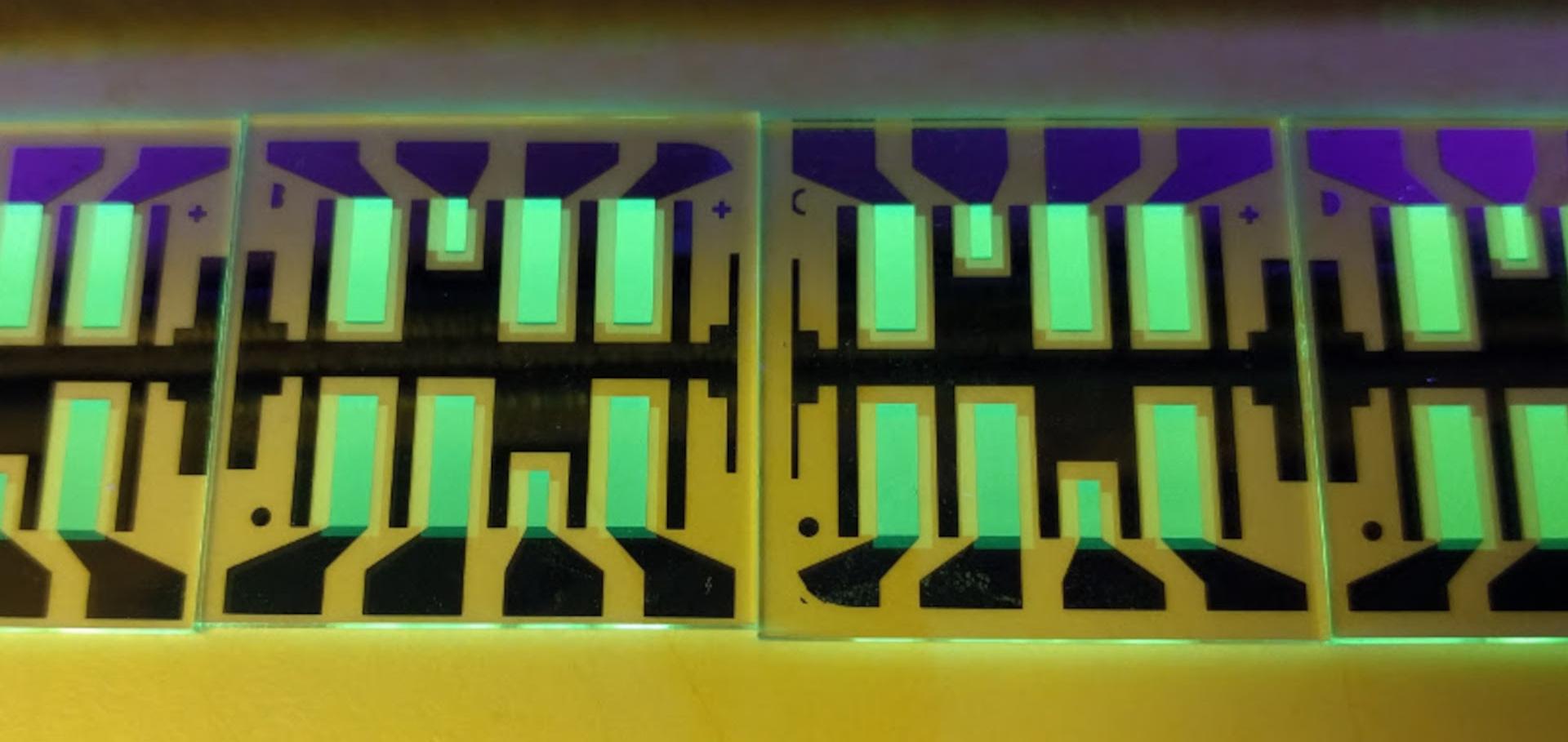
One of the substrate layouts for our organic solar cells
Credit: AFMD Group

Moritz Riede

Professor of Soft Functional Nanomaterials

Research theme

  • Photovoltaics and nanoscience

Sub department

  • Condensed Matter Physics

Research groups

  • Advanced Functional Materials and Devices (AFMD) Group
moritz.riede@physics.ox.ac.uk
  • About
  • Research
  • Teaching
  • Publications

Understanding the Role of Non-Fullerene Acceptors Crystallinity on the Charge Transport Properties and Performance of Organic Solar Cells

(2022)

Authors:

Pierluigi Mondelli, Pascal Kaienburg, Francesco Silvestri, Rebecca Scatena, Claire Welton, Martine Grandjean, Vincent Lemaur, Eduardo Solano, Mathias Nyman, Peter Horton, Simon Coles, Esther Barrena, Moritz Riede, Paolo Radaelli, David Beljonne, Manjunatha Reddy, Graham Morse
More details from the publisher
Details from ArXiV

Electronic and microstructure properties of all-small-molecule organic solar cells

SPIE, the international society for optics and photonics (2022) 31-31

Authors:

Pascal Kaienburg, Andreas Lauritzen, Irfan Habib, Olivia Gough, Subhrangsu Mukherjee, Harald Ade, Moritz Riede
More details from the publisher

The crystal packing of non-fullerene acceptors in organic solar cells

SPIE, the international society for optics and photonics (2022) 27-27

Authors:

Pierluigi Mondelli, Pascal Kaienburg, Francesco Silvestri, Eduardo Solano, Esther Barrena, Moritz Riede, Graham Morse
More details from the publisher

All-Small-Molecule Organic Solar Cells – Performance, Electronic & Microstructure Properties

Fundacio Scito (2022)

Authors:

Pascal Kaienburg, Moritz Riede
More details from the publisher
Details from ORA

Improving performance of fully scalable, flexible transparent conductive films made from carbon nanotubes and ethylene-vinyl acetate

Energy Reports Elsevier 8:S11 (2022) 48-60

Authors:

Bernd K Sturdza, Andreas E Lauritzen, Suer Zhou, Andre J Bennett, Joshua Form, M Greyson Christoforo, Robert M Dalgliesh, Henry J Snaith, Moritz K Riede, Robin J Nicholas

Abstract:

We report process improvements for the fabrication of single-walled carbon nanotube ethylene-vinyl acetate transparent conductive films. CNT:EVA films demonstrate high resilience against folding and can replace the external dopant in a spiro-OMeTAD based hole selective contact of n-i-p perovskite solar cells achieving a steady-state efficiency of 16.3%. The adapted process is fully scalable, and compared to previous reports (Mazzotta et al., 2018) lowers the material cost dramatically and improves DC to optical conductivity ratio by two orders of magnitude to σdc/σop = 3.6 for pristine and σdc/σop = 15 for chemically doped films. We analyse the microstructure of our films via small angle neutron scattering and find a positive correlation between the long range packing density of the CNT:EVA films and the σdc/σop performance. Increasing monomer ratio and chain length of the EVA polymer improves resilience against bending strain, whereas no significant effect on the CNT wrapping and electrical conductivity of resulting films is found.
More details from the publisher
Details from ORA
More details

Pagination

  • First page First
  • Previous page Prev
  • …
  • Page 2
  • Page 3
  • Page 4
  • Page 5
  • Current page 6
  • Page 7
  • Page 8
  • Page 9
  • Page 10
  • …
  • Next page Next
  • Last page Last

Footer Menu

  • Contact us
  • Giving to the Dept of Physics
  • Work with us
  • Media

User account menu

  • Log in

Follow us

FIND US

Clarendon Laboratory,

Parks Road,

Oxford,

OX1 3PU

CONTACT US

Tel: +44(0)1865272200

University of Oxfrod logo Department Of Physics text logo
IOP Juno Champion logo Athena Swan Silver Award logo

© University of Oxford - Department of Physics

Cookies | Privacy policy | Accessibility statement

Built by: Versantus

  • Home
  • Research
  • Study
  • Engage
  • Our people
  • News & Comment
  • Events
  • Our facilities & services
  • About us
  • Giving to Physics
  • Current students
  • Staff intranet