

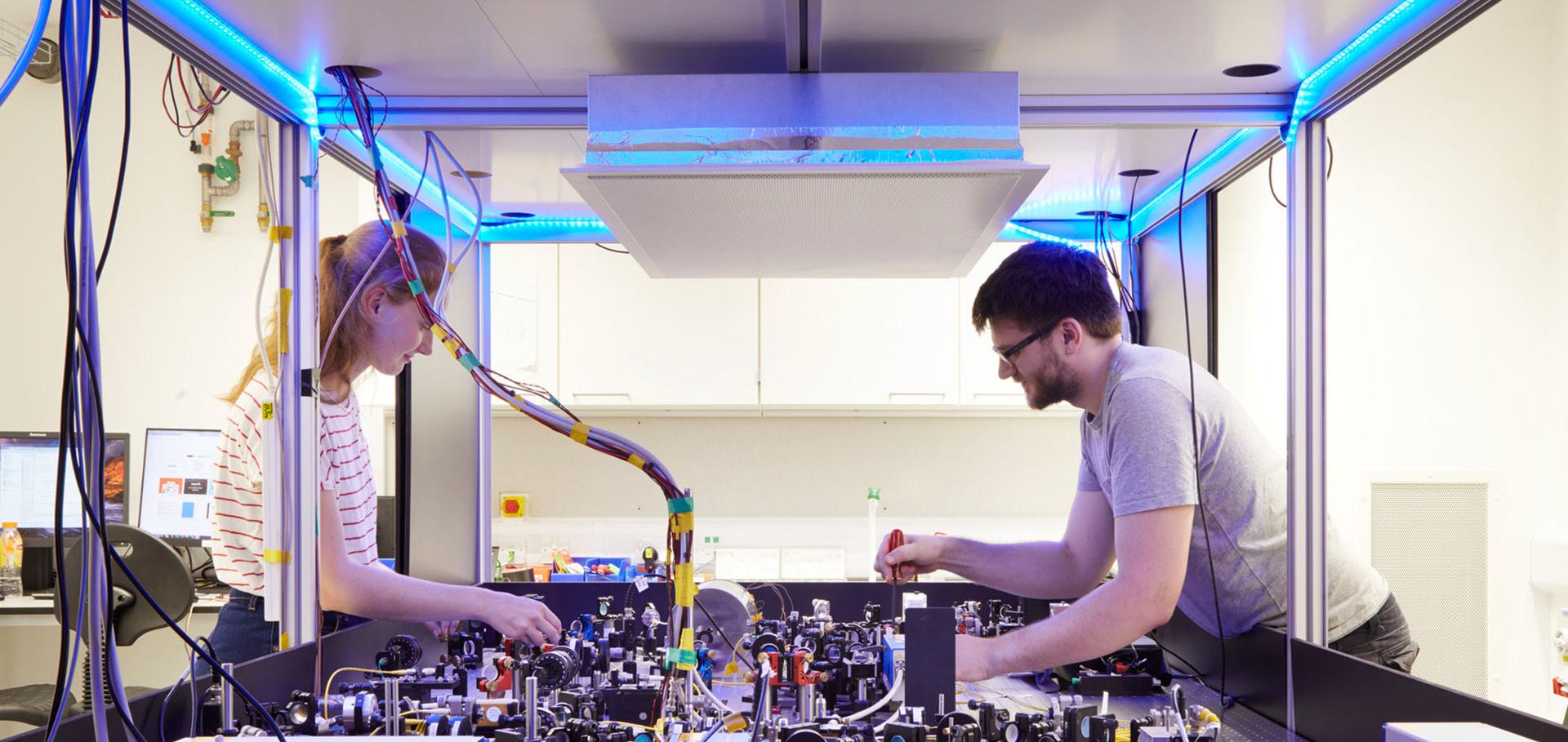

Interfacing ultrafast single-photon-level fields with an atomic ensemble.
Science advances 12:47 (2026) eaeh3804
Abstract:
Ultrafast photons-with pulse durations on the order of 100 femtoseconds-are typical of high-rate, high-purity, entangled photon-pair sources. Efficient, coherent mapping between these states and matter-based quantum systems is an important problem in quantum optics and could enable applications in quantum frequency conversion, bandwidth conversion, and local quantum information processing at gigahertz speeds. This coherent mapping is also the initial storage step in matter-based photonic quantum memory, which can enhance multiphoton rates and allow for synchronization in quantum repeaters. Here, we use a collisionally broadened neutral atomic barium ensemble to demonstrate a quantum-compatible light-matter interface with storage efficiency of 95.6 ± 0.3%, total internal efficiency of 31 ± 1%, and noise contributions of 10-4 photons per pulse. Using the simultaneous efficiency, bandwidth, and noise performance of this interface, we perform a full amplitude and phase reconstruction via spectral interferometry of single-photon-level fields retrieved from the interface.Applications of Spin-Dependent Generalized Squeezing in Hybrid Spin-Oscillator Quantum Processors
(2026)
Frequency-time multiplexing for near-deterministic generation of n-photon frequency-bin states
Physical Review A 114:4 (2026)
Abstract:
One of the primary challenges of photonic quantum information processing is the on-demand preparation of multiple single-photon-level quantum states from probabilistic photon-pair sources. Motivated by recent developments in frequency-bin-encoded photonic quantum information processing, here we consider active time multiplexing to generate n-photon states, where n single photons with n distinct frequencies occupy the same spatiotemporal mode. We devise an approach that uses optical quantum memories to manipulate the temporal mode of heralded single photons and an array of fiber Bragg grating reflectors to jointly manipulate the frequency and temporal modes of the photons, overlapping n photons in n separate frequency bins into a single spatiotemporal mode. We calculate multiphoton state generation rates that, accounting for loss, are realistically achievable with commercially available hardware. Using only a single free-space switchable delay loop for an optical quantum memory, this scheme could feasibly produce eight-photon states at an average rate of 1 kHz.Public quantum network: The first node
Applied Physics Letters 126:5 (2025)
Abstract:
We present a quantum network that distributes entangled photons between the University of Illinois Urbana-Champaign and a public library in Urbana. The network allows members of the public to perform measurements on the photons. We describe its design and implementation and outreach based on the network. Over 400 instances of public interaction have been logged with the system since it was launched in November 2023.High-efficiency, high-speed, and low-noise photonic quantum memory
ArXiv 2309.00969 (2023)