

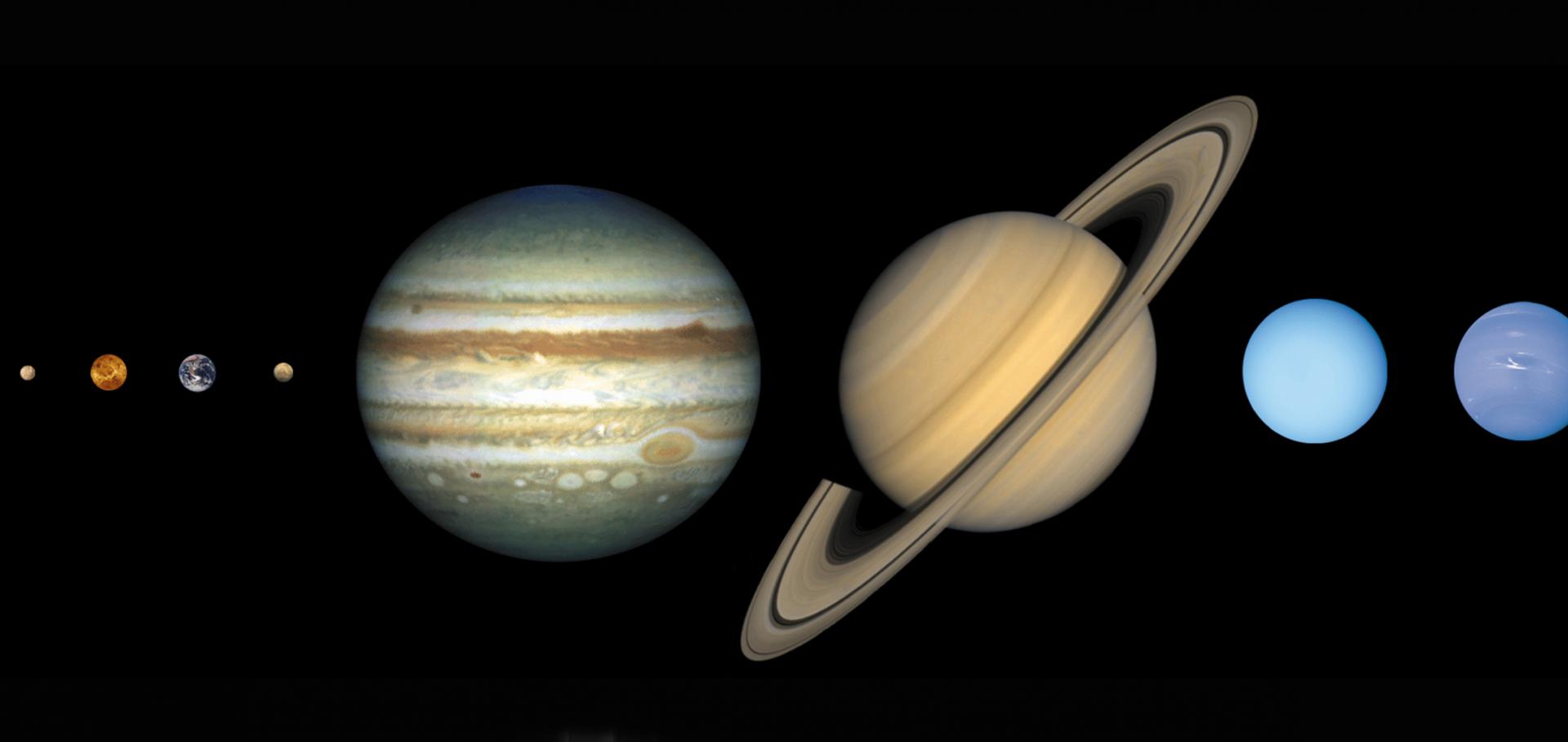
Colour changes of Jupiter’s Oval BA through microphysical modelling
Icarus Elsevier 459 (2026) 117239
Abstract:
Jupiter’s Oval BA undergoes recurrent colour changes whose physical origin remains uncertain. Radiative transfer retrievals indicate that these changes occur in the upper chromophore haze of the vortex annulus, around and above the 0.2–bar level, and are primarily associated with a decrease in optical depth, with no significant change in particle size or haze altitude. We apply a one-dimensional microphysical model to this haze layer, constrained by the retrieved aerosol properties of the red annulus in 2016 and the whiter annulus in 2020, and use it to reproduce the observed colour-change timescale of approximately 0.5 years. Our results indicate that this transition is best reproduced by changes in tropospheric vertical transport within a subsiding annulus, corresponding to preferred downwelling velocities of order 10−4–10−3 m s−1 at chromophore-bearing pressures. These small vertical velocities may help explain why no clear dynamical signature has yet been identified.The fast destruction of methane by heterogeneous electrochemistry induced by martian dust activity: An experimental approach
Earth and Planetary Science Letters Elsevier 693 (2026) 120263
Abstract:
Methane (CH4) on Mars is of high scientific importance, particularly for its generation and destruction mechanisms. With an estimated photochemical lifetime of approximately 300 years, sporadic methane plumes observed on Mars by orbital, landed missions, and Earth-based telescopes suggest the presence of unknown destruction processes. Here, we present an experiment to examine CH4 destruction through heterogeneous electrochemistry (HEC) triggered by Martian dust activities. We performed a series of mid-strength electrostatic discharge (ESD) experiments in mixtures of CO2 and CH4 under conditions relevant to the Martian near-surface atmosphere. We characterized (1) the free radicals produced from the breakdown of CH4 and CO2; (2) the gaseous and solid products of CH4 and CO2 decomposition; and (3) the half-life of CH4 in this experiment. Based on a newly reported mission observation of electric discharge during a dust devil (DD) on Mars, we extrapolated the experimentally derived half-life to an approximate dust-devil-effective half-life of CH4 on Mars, with uncertainties spanning orders of magnitude. The result demonstrates that dust-driven HEC can cause CH4 destruction at rates hundreds to thousands of times faster than photochemistry. In future missions to Mars, if the knowledge gaps in the E-properties of dust activity are filled through regular measurements, this experimental finding may imply that Martian dust activity could be the primary factor reducing methane's lifetime, thereby contributing to understanding methane loss in the Martian atmosphere.New determination of Jupiter’s vertical cloud and haze structure using dual viewing angle MUSE/VLT observations
Monthly Notices of the Royal Astronomical Society Oxford University Press (OUP) (2026) stag1936
Abstract:
A Highly Reflective Atmosphere on the Lava World TOI-561b Revealed by JWST/NIRSpec Phase Curves
The Astronomical Journal American Astronomical Society 172:4 (2026) 239-239
Abstract:
The safety-critical edge should be sparse
EWSN '26: Proceedings of the 2026 International Conference on Embedded Wireless Systems and Networks Association for Computing Machinery (2026) 237-242