Home
Department Of Physics text logo
  • Research
    • Our research
    • Our research groups
    • Our research in action
    • Research funding support
    • Summer internships for undergraduates
  • Study
    • Undergraduates
    • Postgraduates
  • Engage
    • For young people
    • For teachers
    • For the public
    • For alumni
    • For business
  • Support
Menu
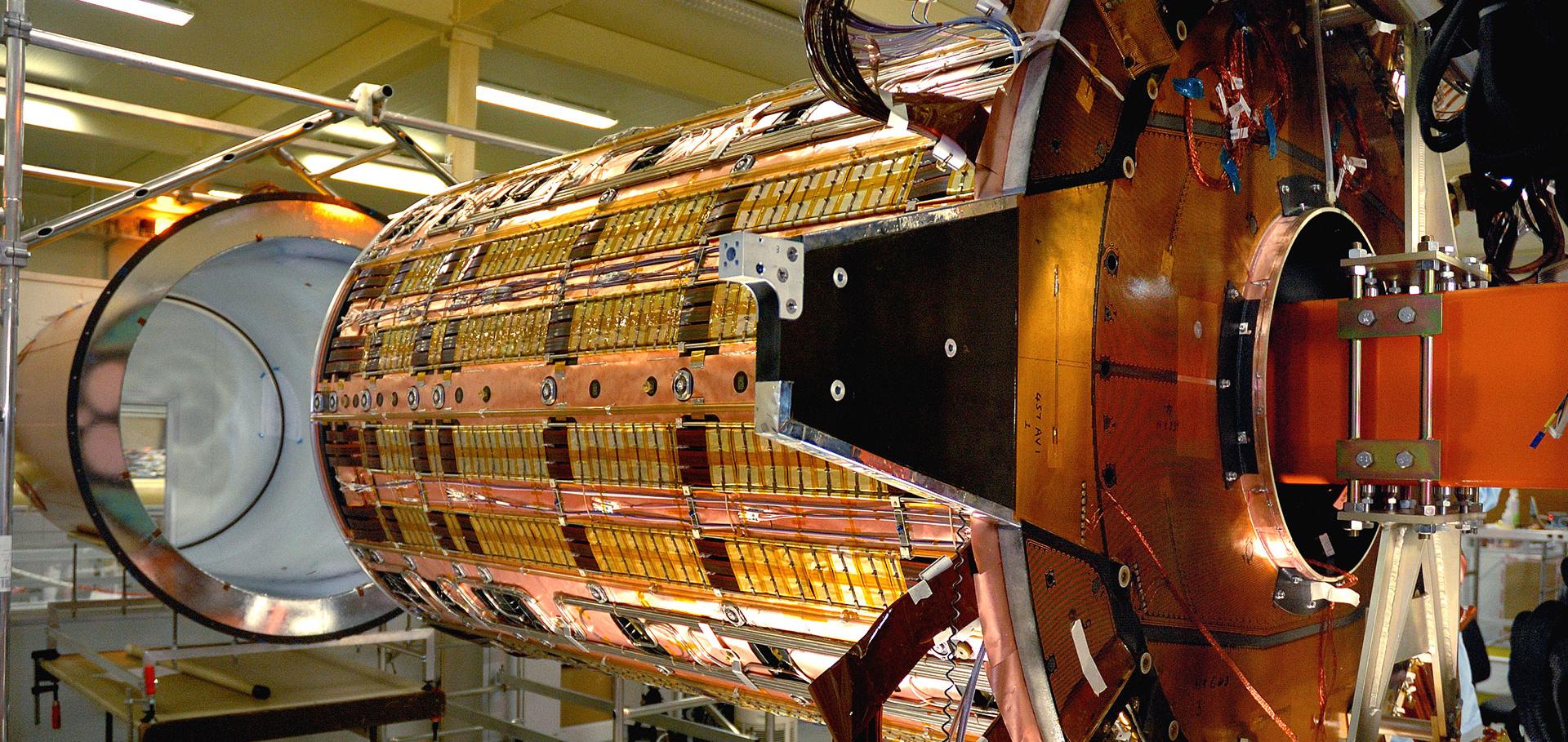
Insertion of STC into TRT at the Department of Physics, Oxford
Credit: CERN

Philip Burrows

Professor of Physics

Sub department

  • Particle Physics
Philip.Burrows@physics.ox.ac.uk
Telephone: 01865 (2)73451
Denys Wilkinson Building, room 615a
  • About
  • Publications

Simulation and experimental study of proton bunch self-modulation in plasma with linear density gradients

Physical Review Accelerators and Beams American Physical Society 24:10 (2021) 101301

Authors:

Pi Morales Guzmán, P Muggli, R Agnello, Philip Burrows

Abstract:

We present numerical simulations and experimental results of the self-modulation of a long proton bunch in a plasma with linear density gradients along the beam path. Simulation results agree with the experimental results reported [F. Braunmller, T. Nechaeva et al. (AWAKE Collaboration), Phys. Rev. Lett. 125, 264801 (2020)]: with negative gradients, the charge of the modulated bunch is lower than with positive gradients. In addition, the bunch modulation frequency varies with gradient. Simulation results show that dephasing of the wakefields with respect to the relativistic protons along the plasma is the main cause for the loss of charge. The study of the modulation frequency reveals details about the evolution of the self-modulation process along the plasma. In particular for negative gradients, the modulation frequency across time-resolved images of the bunch indicates the position along the plasma where protons leave the wakefields. Simulations and experimental results are in excellent agreement.
More details from the publisher
Details from ORA
More details

Analysis of Proton Bunch Parameters in the AWAKE Experiment

(2021)

Authors:

V Hafych, A Caldwell, R Agnello, CC Ahdida, M Aladi, MC Amoedo Goncalves, Y Andrebe, O Apsimon, R Apsimon, A-M Bachmann, MA Baistrukov, F Batsch, M Bergamaschi, P Blanchard, PN Burrows, B Buttenschön, J Chappell, E Chevallay, M Chung, DA Cooke, H Damerau, C Davut, G Demeter, A Dexter, S Doebert, J Farmer, A Fasoli, VN Fedosseev, R Fiorito, RA Fonseca, I Furno, S Gessner, AA Gorn, E Granados, M Granetzny, T Graubner, O Grulke, E Gschwendtner, ED Guran, JR Henderson, M Hüther, MÁ Kedves, V Khudyakov, S-Y Kim, F Kraus, M Krupa, T Lefevre, L Liang, N Lopes, KV Lotov, S Mazzoni, D Medina Godoy, JT Moody, K Moon, PI Morales Guzmán, M Moreira, T Nechaeva, E Nowak, C Pakuza, H Panuganti, A Pardons, A Perera, J Pucek, A Pukhov, B Ráczkevi, RL Ramjiawan, S Rey, O Schmitz, E Senes, LO Silva, C Stollberg, A Sublet, A Topaloudis, N Torrado, PV Tuev, M Turner, F Velotti, L Verra, J Vieira, H Vincke, CP Welsch, M Wendt, M Wing, J Wolfenden, B Woolley, G Xia, M Zepp, G Zevi Della Porta
More details from the publisher

Consolidation and future upgrades to the CLEAR user facility at CERN

JACoW Publishing, Geneva, Switzerland (2021) 2700-2703

Authors:

LA Dyks, Philip Burrows, P Korysko

Abstract:

The CERN Linear Electron Accelerator for Research (CLEAR) at CERN has been operating since 2017 as a dedicated user facility providing beams for a varied range of experiments. CLEAR consists of a 20 m long linear accelerator (linac), able to produce beams from a Cs₂Te photocathode and accelerate them to energies of between 60 MeV and 220 MeV. Following the linac, an experimental beamline is located, in which irradiation tests, wakefield and impedances tudies, plasma lens experiments, beam diagnostics development, and terahertz (THz) emission studies, are performed. In this paper, we present recent upgrades to the entire beamline, as well as the design of future upgrades, such as a dogleg section connecting to an additional proposed experimental beamline. The gain in performance due to these upgrades is presented with a full range of available beam properties documented.
More details from the publisher
Details from ORA

A high-resolution, low-latency, bunch-by-bunch feedback system for nano-beam stabilization

JACoW Publishing, Geneva, Switzerland (2021) 1378-1381

Authors:

Rebecca Ramjiawan, D Bett, Neven Blaskovic Kraljevic, T Bromwich, Philip Burrows, Glenn Christian, C Perry

Abstract:

A low-latency, bunch-by-bunch feedback system employing high-resolution cavity Beam Position Monitors (BPMs) has been developed and tested at the Accelerator Test Facility (ATF2) at the High Energy Accelerator Research Organization (KEK), Japan. The feedback system was designed to demonstrate nanometer-level vertical stabilization at the focal point of the ATF2 and can be operated using either a single BPM to provide local beam stabilization, or by using two BPMs to stabilize the beam at an intermediate location. The feedback correction is implemented using a stripline kicker and the feedback calculations are performed on a digital board constructed around a Field Programmable Gate Array (FPGA). The feedback performance was tested with trains of two bunches, separated by 280ns, at a charge of ~1nC, where the vertical offset of the first bunch was measured and used to calculate the correction to be applied to the second bunch. The BPMs have been demonstrated to achieve an operational resolution of ~20nm. With the application of single-BPM and two-BPM feedback, beam stabilization of below 50nm and 41nm respectively has been achieved with a latency of 232ns.
More details from the publisher
Details from ORA

A sub-micron resolution, bunch-by-bunch beam trajectory feedback system and its application to reducing wakefield effects in single-pass beamlines

JACoW Publishing, Geneva, Switzerland (2021) 1382-1385

Authors:

DR Bett, Philip Burrows, C Perry, Rebecca Ramjiawan

Abstract:

A high-precision intra-bunch-train beam orbit feedback correction system has been developed and tested at the KEK Accelerator Test Facility, ATF2. The system uses the vertical position of the bunch measured at two beam position monitors to calculate a pair of kicks which are applied to the next bunch using two upstream kickers, thereby correcting both the vertical position and trajectory angle. Using trains of two electron bunches separated in time by 187.6ns, the system was optimised so as to stabilize the beam offset at the feedback BPMs to better than 350nm, yielding a local trajectory angle correction to within 250nrad. The quality of the correction was verified using three downstream witness BPMs and the results were found to be in agreement with the predictions of a linear lattice model used to propagate the beam trajectory from the feedback region. This same model predicts a corrected be am jitter of c.1nm at the focal point of the accelerator. Measurements with a beam size monitor at this location demonstrate that reducing the trajectory jitter of the beam by a factor of 4 also reduces the increase in the measured beam size as a function of beam charge by a factor of ~1.6.
More details from the publisher
Details from ORA

Pagination

  • First page First
  • Previous page Prev
  • …
  • Page 12
  • Page 13
  • Page 14
  • Page 15
  • Current page 16
  • Page 17
  • Page 18
  • Page 19
  • Page 20
  • …
  • Next page Next
  • Last page Last

Footer Menu

  • Contact us
  • Giving to the Dept of Physics
  • Work with us
  • Media

User account menu

  • Log in

Follow us

FIND US

Clarendon Laboratory,

Parks Road,

Oxford,

OX1 3PU

CONTACT US

Tel: +44(0)1865272200

University of Oxfrod logo Department Of Physics text logo
IOP Juno Champion logo Athena Swan Silver Award logo

© University of Oxford - Department of Physics

Cookies | Privacy policy | Accessibility statement

Built by: Versantus

  • Home
  • Research
  • Study
  • Engage
  • Our people
  • News & Comment
  • Events
  • Our facilities & services
  • About us
  • Giving to Physics
  • Current students
  • Staff intranet