Home
Department Of Physics text logo
  • Research
    • Our research
    • Our research groups
    • Our research in action
    • Research funding support
    • Summer internships for undergraduates
  • Study
    • Undergraduates
    • Postgraduates
  • Engage
    • For alumni
    • For business
    • For schools
    • For the public
  • Support
Menu
Atomic and Laser Physics
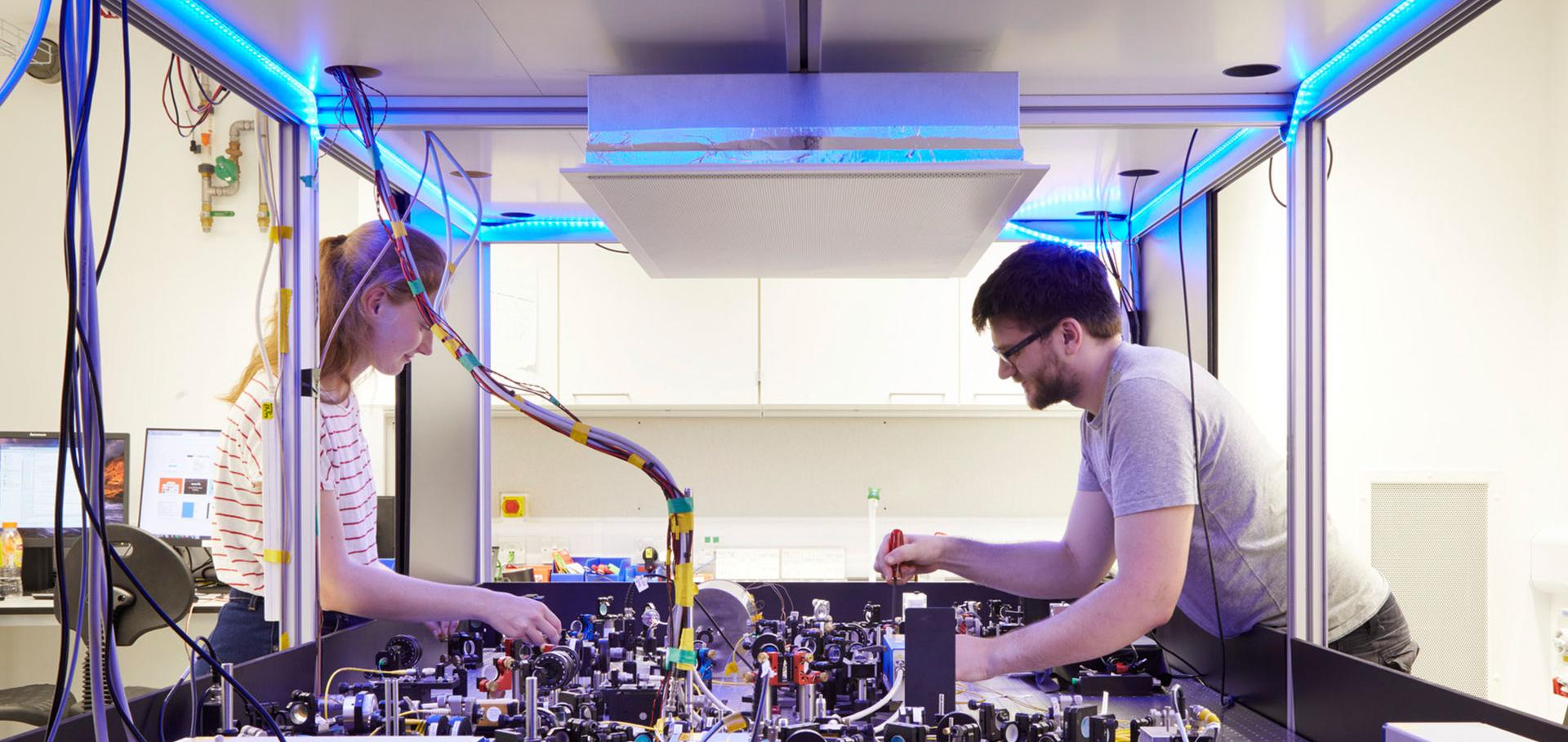
Credit: Jack Hobhouse

Oliver Lunt

Postdoctoral Research Associate

Research theme

  • Fields, strings, and quantum dynamics
  • Quantum information and computation
  • Quantum optics & ultra-cold matter

Sub department

  • Atomic and Laser Physics

Research groups

  • Theory of quantum systems
oliver.lunt@physics.ox.ac.uk
Clarendon Laboratory
Personal webpage
  • About
  • Publications

Probing hydrodynamic crossovers with dissipation-assisted operator evolution

Physical Review B American Physical Society (APS) 113:16 (2026) 165150

Authors:

NS Srivatsa, Oliver Lunt, Tibor Rakovszky, Curt von Keyserlingk

Abstract:

Using artificial dissipation to tame entanglement growth, we chart the emergence of diffusion in a generic interacting lattice model for varying U(1) charge densities. We follow the crossover from ballistic to diffusive transport above a scale set by the scattering length, finding the intuitive result that the diffusion constant scales as D ∝ 1 / ρ at low densities ρ . Our numerical approach generalizes the Dissipation-Assisted Operator Evolution algorithm: in the spirit of the Bogoliubov-Born-Green-Kirkwood-Yvon hierarchy, we effectively approximate nonlocal operators by their ensemble averages, rather than discarding them entirely. This greatly reduces the operator entanglement entropy, while still giving accurate predictions for diffusion constants across all density scales. We further construct a minimal model for the transport crossover, yielding charge correlation functions which agree well with our numerical data. Our results clarify the dominant contributions to hydrodynamic correlation functions of conserved densities, and serve as a guide for generalizations to low-temperature transport.
More details from the publisher
More details

Footer Menu

  • Contact us
  • Giving to the Dept of Physics
  • Work with us
  • Media

User account menu

  • Log in

Follow us

FIND US

Clarendon Laboratory,

Parks Road,

Oxford,

OX1 3PU

CONTACT US

Tel: +44(0)1865272200

University of Oxfrod logo Department Of Physics text logo
IOP Juno Champion logo Athena Swan Silver Award logo

© University of Oxford - Department of Physics

Cookies | Privacy policy | Accessibility statement

Built by: Versantus

  • Home
  • Research
  • Study
  • Engage
  • Our people
  • News & Comment
  • Events
  • Our facilities & services
  • About us
  • Giving to Physics
  • Current students
  • Staff intranet