

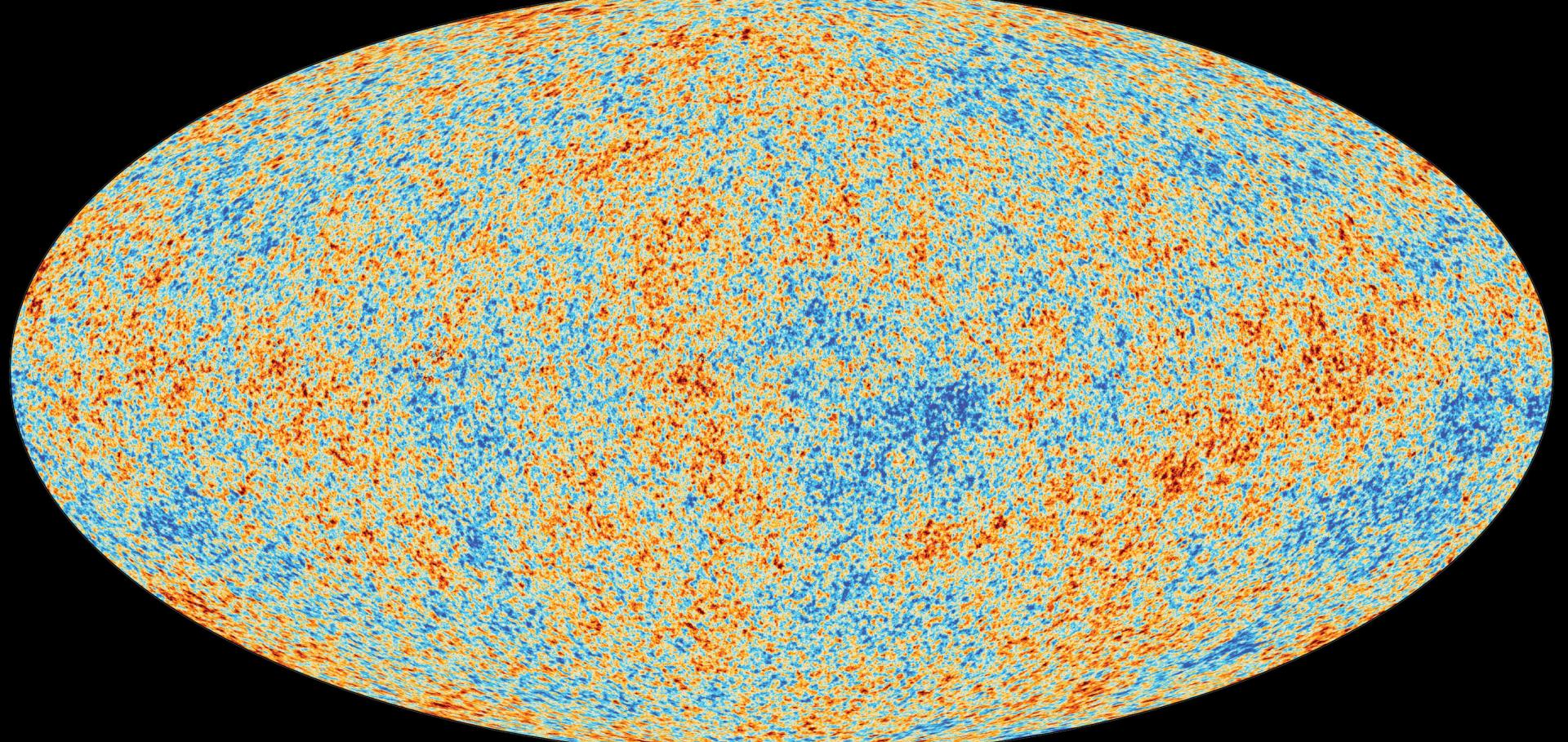
First results from the BOOMERanG experiment
(2001)
Abstract:
We report the first results from the BOOMERanG experiment, which mapped at 90, 150, 240 and 410 GHz a wide (3%) region of the microwave sky with minimal local contamination. From the data of the best 150 GHz detector we find evidence for a well defined peak in the power spectrum of temperature fluctuations of the Cosmic Microwave Background, localized at $\ell = 197 \pm 6$, with an amplitude of $(68 \pm 8) \mu K_{CMB}$. The location, width and amplitude of the peak is suggestive of acoustic oscillations in the primeval plasma. In the framework of inflationary adiabatic cosmological models the measured spectrum allows a Bayesian estimate of the curvature of the Universe and of other cosmological parameters. With reasonable priors we find $\Omega = (1.07 \pm 0.06)$ and $n_s = (1.00 \pm 0.08)$ (68%C.L.) in excellent agreement with the expectations from the simplest inflationary theories. We also discuss the limits on the density of baryons, of cold dark matter and on the cosmological constant.The Quintessential CMB, Past & Future
Mon.Not.Roy.Astron.Soc. (2001)
Abstract:
The past, present and future of cosmic microwave background (CMB) anisotropy research is discussed, with emphasis on the Boomerang and Maxima balloon experiments. These data are combined with large scale structure (LSS) information and high redshift supernova (SN1) observations to explore the inflation-based cosmic structure formation paradigm. Here we primarily focus on a simplified inflation parameter set, {omega_b,omega_{cdm},Omega_{tot}, Omega_Q,w_Q, n_s,tau_C, sigma_8}. After marginalizing over the other cosmic and experimental variables, we find the current CMB+LSS+SN1 data gives Omega_{tot}=1.04\pm 0.05, consistent with (non-baroque) inflation theory. Restricting to Omega_{tot}=1, we find a nearly scale invariant spectrum, n_s =1.03 \pm 0.07. The CDM density, omega_{cdm}=0.17\pm 0.02, is in the expected range, but the baryon density, omega_b=0.030\pm 0.004, is slightly larger than the current nucleosynthesis estimate. Substantial dark energy is inferred, Omega_Q\approx 0.68\pm 0.05, and CMB+LSS Omega_Q values are compatible with the independent SN1 estimates. The dark energy equation of state, parameterized by a quintessence-field pressure-to-density ratio w_Q, is not well determined by CMB+LSS (w_Q<-0.3 at 95%CL), but when combined with SN1 the resulting w_Q<-0.7 limit is quite consistent with the w_Q=-1 cosmological constant case. Though forecasts of statistical errors on parameters for current and future experiments are rosy, rooting out systematic errors will define the true progress.First Results from the 2dF QSO redshift survey
ArXiv astro-ph/0103064 (2001)
Abstract:
We present some initial results from the 2dF QSO redshift survey. The aim of the survey is to produce an optically-selected catalogue of 25000 QSOs over the redshift range 0The 2dF QSO Redshift Survey - 10K@2K!
ArXiv astro-ph/0103056 (2001)