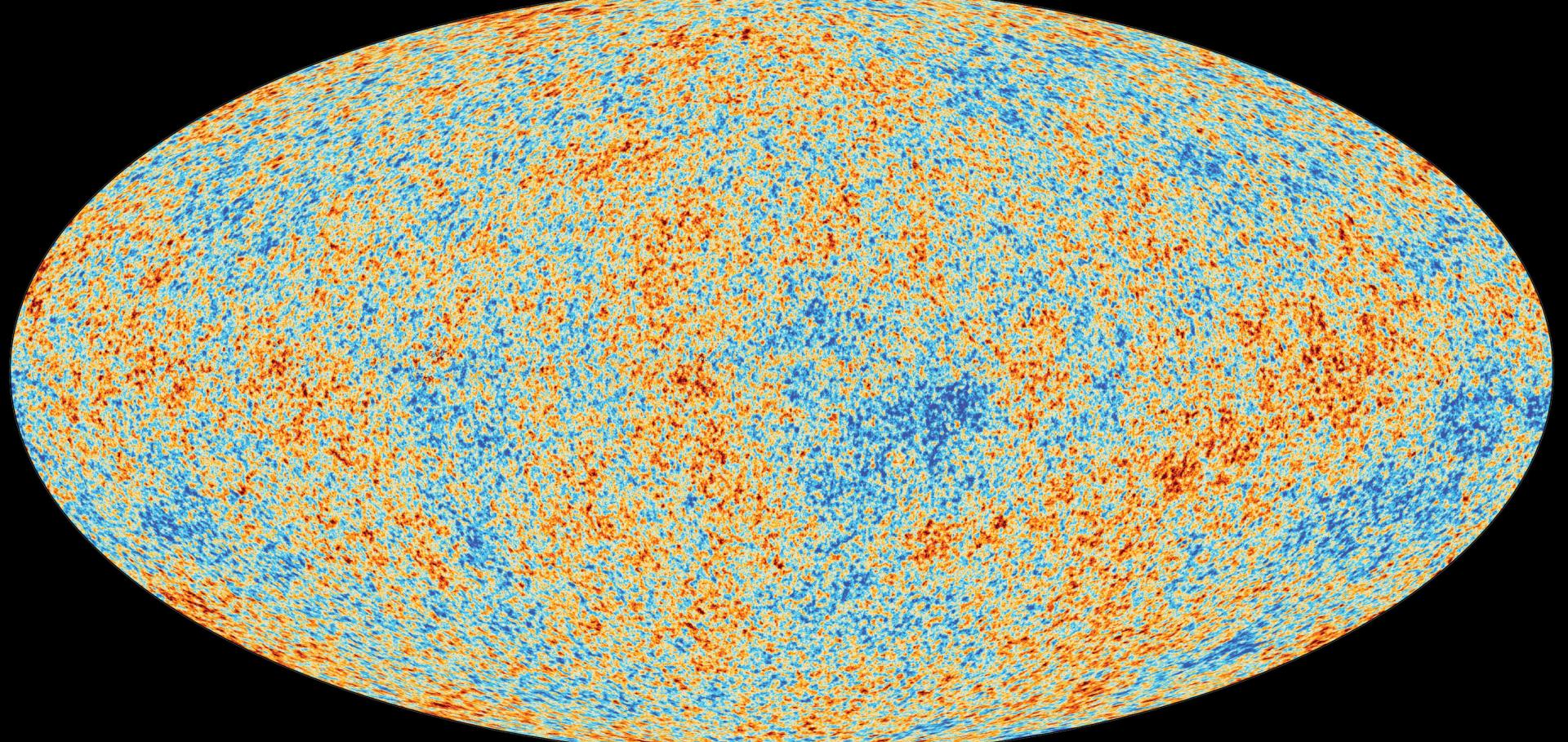
The Quintessential CMB, Past & Future
ArXiv astro-ph/0011379 (2000)
Abstract:
The past, present and future of cosmic microwave background (CMB) anisotropy research is discussed, with emphasis on the Boomerang and Maxima balloon experiments. These data are combined with large scale structure (LSS) information and high redshift supernova (SN1) observations to explore the inflation-based cosmic structure formation paradigm. Here we primarily focus on a simplified inflation parameter set, {omega_b,omega_{cdm},Omega_{tot}, Omega_Q,w_Q, n_s,tau_C, sigma_8}. After marginalizing over the other cosmic and experimental variables, we find the current CMB+LSS+SN1 data gives Omega_{tot}=1.04\pm 0.05, consistent with (non-baroque) inflation theory. Restricting to Omega_{tot}=1, we find a nearly scale invariant spectrum, n_s =1.03 \pm 0.07. The CDM density, omega_{cdm}=0.17\pm 0.02, is in the expected range, but the baryon density, omega_b=0.030\pm 0.004, is slightly larger than the current nucleosynthesis estimate. Substantial dark energy is inferred, Omega_Q\approx 0.68\pm 0.05, and CMB+LSS Omega_Q values are compatible with the independent SN1 estimates. The dark energy equation of state, parameterized by a quintessence-field pressure-to-density ratio w_Q, is not well determined by CMB+LSS (w_Q<-0.3 at 95%CL), but when combined with SN1 the resulting w_Q<-0.7 limit is quite consistent with the w_Q=-1 cosmological constant case. Though forecasts of statistical errors on parameters for current and future experiments are rosy, rooting out systematic errors will define the true progress.Measuring Stellar and Dark Mass Fractions in Spiral Galaxies
ArXiv astro-ph/0011250 (2000)
Abstract:
We explore the relative importance of the stellar mass density as compared to the inner dark halo, for the observed gas kinematics thoughout the disks of spiral galaxies. We perform hydrodynamical simulations of the gas flow in a sequence of potentials with varying the stellar contribution to the total potential. The stellar portion of the potential was derived empirically from K-band photometry. The output of the simulations - namely the gas density and the gas velocity field - are then compared to the observed spiral arm morphology and the H-alpha gas kinematics. We solve for the best matching spiral pattern speed and draw conclusions on how massive the stellar disk can be at most. For the case of the galaxy NGC 4254 (Messier 99) we demonstrate that the prominent spiral arms of the stellar component would overpredict the non-circular gas motions unless an axisymmetric dark halo component adds significantly in the radial range R_exp < R < 3*R_exp.The Impact of Galaxy Formation on the Diffuse Background Radiation
ArXiv astro-ph/0010460 (2000)
Abstract:
The far infrared background is a sink for the hidden aspects of galaxy formation. At optical wavelengths, ellipticals and spheroids are old, even at $z \sim 1.$ Neither the luminous formation phase nor their early evolution is seen in the visible. We infer that ellipticals and, more generally, most spheroids must have formed in dust-shrouded starbursts. In this article, we show how separate tracking of disk and spheroid star formation enables us to infer that disks dominate near the peak in the cosmic star formation rate at $z \lapproxeq 2$ and in the diffuse ultraviolet/optical/infrared background, whereas spheroid formation dominates the submillimetre background.The Impact of Galaxy Formation on the Diffuse Background Radiation
(2000)