

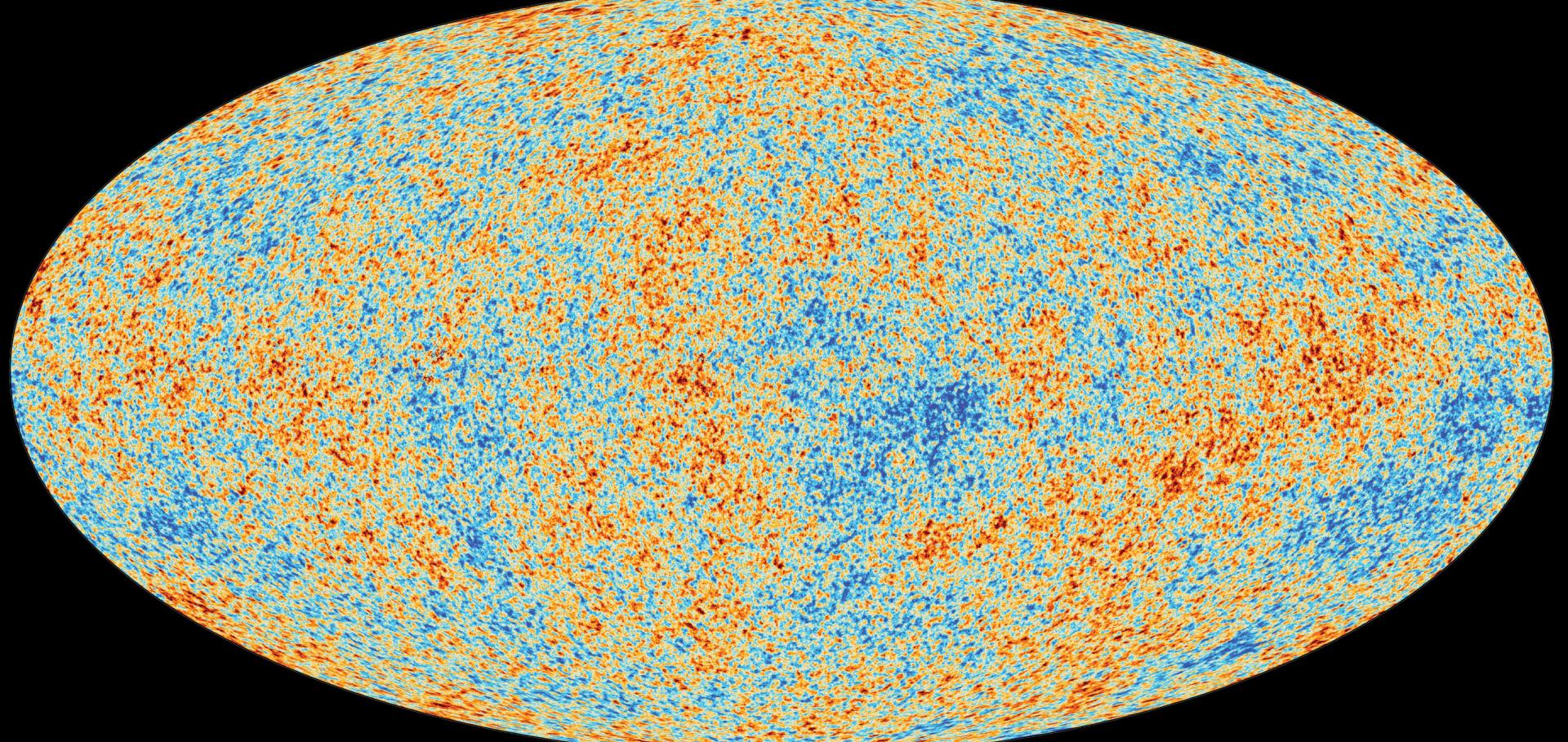
Tests for Gaussianity of the MAXIMA-1 cosmic microwave background map
Physical Review Letters 87:25 (2001)
Abstract:
A series of Gaussianity tests were performed on the MAXIMA-1 CMB map. To optimize both the resolution and the signal-to-noise ratio for these tests, a map with 5972 square pixels of 8' each was used. Using these high-quality data, the Gaussianity of CMB anisotropy on subdegree scales was probed for the first time. It was found that the MAXIMA-1 CMB map is consistent with Gaussianity on angular scales between 10 arcmin and 5 deg.The Trispectrum of the 4 Year COBE-DMR data
Astrophys. J. 563 (2001) L99-L99
Abstract:
We propose an estimator for the trispectrum of a scalar random field on a sphere, discuss its geometrical and statistical properties, and outline its implementation. By estimating the trispectrum of the 4 year COBE-DMR data (in HEALPix pixelization) we find new evidence of a non-Gaussian signal associated with a known systematic effect. We find that by removing data from the sky maps for those periods of time perturbed by this effect, the amplitudes of the trispectrum coefficients become completely consistent with predictions for a Gaussian sky. These results reinforce the importance of statistical methods based in harmonic space for quantifying non-Gaussianity.Have Acoustic Oscillations been Detected in the Current Cosmic Microwave Background Data?
(2001)
Have Acoustic Oscillations been Detected in the Current Cosmic Microwave Background Data?
ArXiv astro-ph/0111400 (2001)
Abstract:
The angular power spectrum of the Cosmic Microwave Background has been measured out to sufficiently small angular scale to encompass a few acoustic oscillations. We use a phenomenological fit to the angular power spectrum to quantify the statistical significance of these oscillations and discuss the cosmological implications of such a finding.Probing for Dark Matter within Spiral Galaxy Disks
The Astrophysical Journal (2001)