

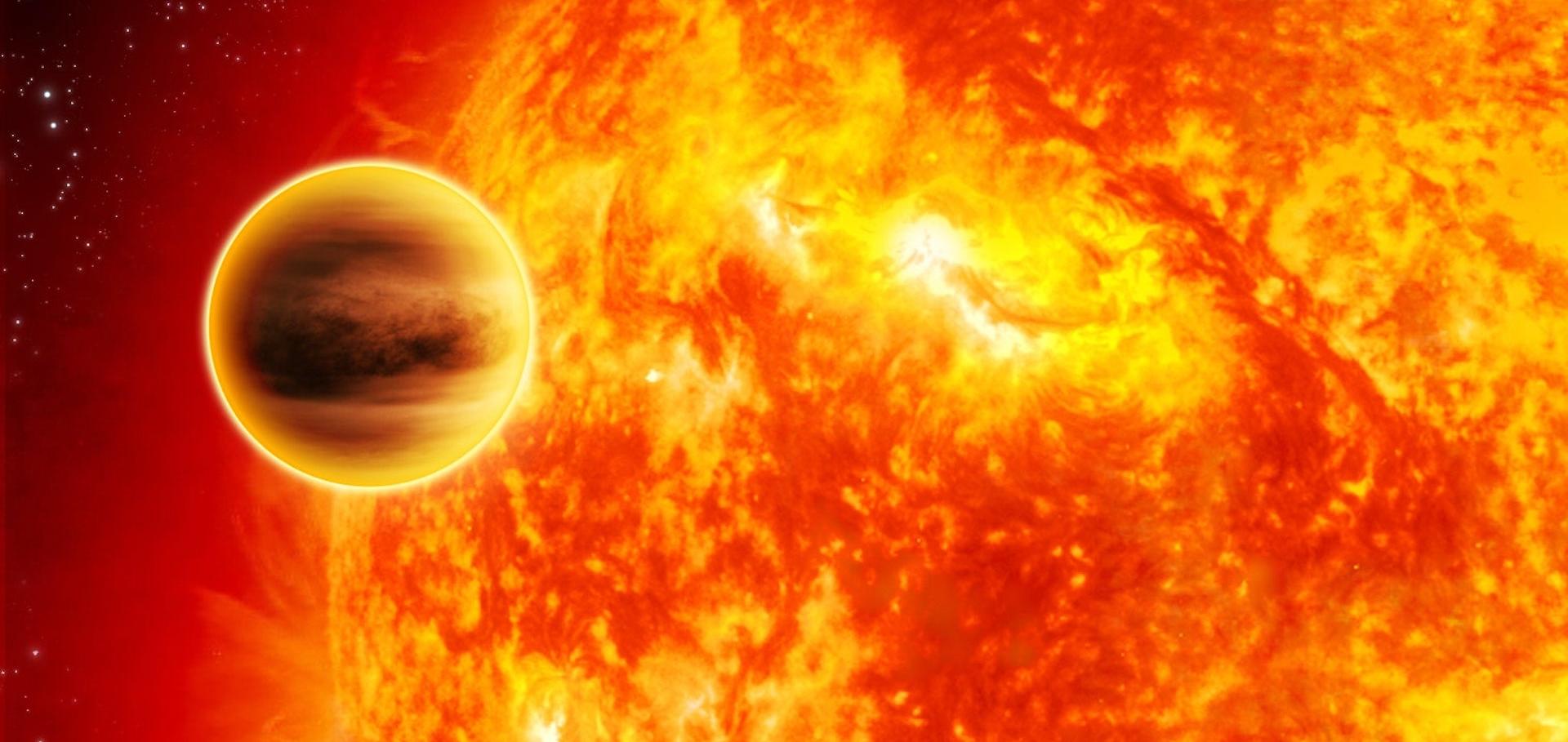
A Comparison of One-dimensional and Three-dimensional Exoplanet Atmosphere Model Grids: ScCHIMERA and the SPARC/MiTgcm
The Astrophysical Journal American Astronomical Society 997:2 (2026) 365
Abstract:
Inferring the properties of transiting exoplanet atmospheres relies on comparing models to spectroscopic observations. Atmosphere models, however, make a range of assumptions, from one-dimensional (1D, varying with altitude) radiative-convective equilibrium (RCE) to three-dimensional (3D) global circulation models (GCMs). The goal of this investigation is to determine the causes of differences in dayside thermal emission spectra resulting from 3D-GCMs (using SPARC/MITgcm) and 1D-RCE models (using ScCHIMERA). We conduct a one-to-one comparison of 1D-RCE models and 3D-GCMs with the same outgoing bolometric thermal flux over a grid of equilibrium temperatures, gravities, metallicities, and rotation periods. Each 1D-RCE model assumes heat redistribution in the planet’s atmosphere consistent with that in the corresponding 3D-GCM’s photosphere. Comparing corresponding models, the dayside average pressure–temperature (or PT) structures can be broken into four vertical regions, each influencing wavelength-dependent differences in their spectra. Furthermore, the dayside average 3D-GCM PTs for planets with Teq = 1400 K exhibit a temperature inversion, whereas corresponding 1D-RCE models do not. We find that spectral differences between 1D-RCE models and 3D-GCMs with the same parameters decrease for hotter planets because the spectral shapes more closely resemble blackbodies. To a lesser extent, spectral differences increase for planets with longer rotation periods because of smaller day–night temperature contrasts in the photosphere. Finally, we compare spectral differences to realistic observational uncertainties from JWST with the NIRISS SOSS, NIRSpec G395H, and MIRI long-resolution spectroscopy instrument modes. We find that 1D-RCE models and 3D-GCMs with the same parameters can produce dayside spectral differences larger than JWST’s uncertainty, potentially biasing data–model inferences.The Supermassive Black Hole in the Nearby Spiral Galaxy M81: A Robust Mass from JWST/NIRSpec Stellar Dynamics
(2026)
Mass estimates of the young TOI-451 transiting planets: multidimensional Gaussian Process on stellar spectroscopic and photometric signals
Monthly Notices of the Royal Astronomical Society Oxford University Press 546:2 (2026) stag087
Abstract:
The young TOI-451 planetary system, aged 125 Myr, provides a unique opportunity to test theories of planetary internal structures and atmospheric mass-loss through examination of its three transiting planets. We present an exhaustive photometric and spectroscopic follow-up to determine the orbital and physical properties of the system. We perform multidimensional Gaussian Process regression with the code pyaneti on spectroscopic time-series and NGTS/LCO light curves to disentangle the stellar and planetary signal in ESPRESSO radial velocities. We show how contemporaneous photometry serves as an activity indicator to inform RV modelling within a multidimensional Gaussian Processes framework. We argue that this can be exploited when spectroscopic observations are adversely affected by low signal-to-noise and/or poor sampling. We estimate the Doppler semi-amplitudes of , , and . This translates in 2 mass estimates for TOI-451 b and d of and ; as well as a mass upper limit for TOI-451 c of . The derived planetary properties suggest that planets c and d contain significant hydrogen-rich envelopes. The inferred parameters of TOI-451 b are consistent with either a rocky world that still retains a small hydrogen envelope or a water world. These insights make the TOI-451 system an ideal laboratory for future follow-up studies aimed at measuring atmospheric compositions, detecting atmospheric mass-loss signatures, and further exploring planetary formation and evolution processes.Mass estimates of the young TOI-451 transiting planets: Multidimensional Gaussian Process on stellar spectroscopic and photometric signals
(2026)
Detecting and characterising exoplanets with HARPS-N
Proceedings of the International Astronomical Union Cambridge University Press 20:S393 (2026) 150-155