

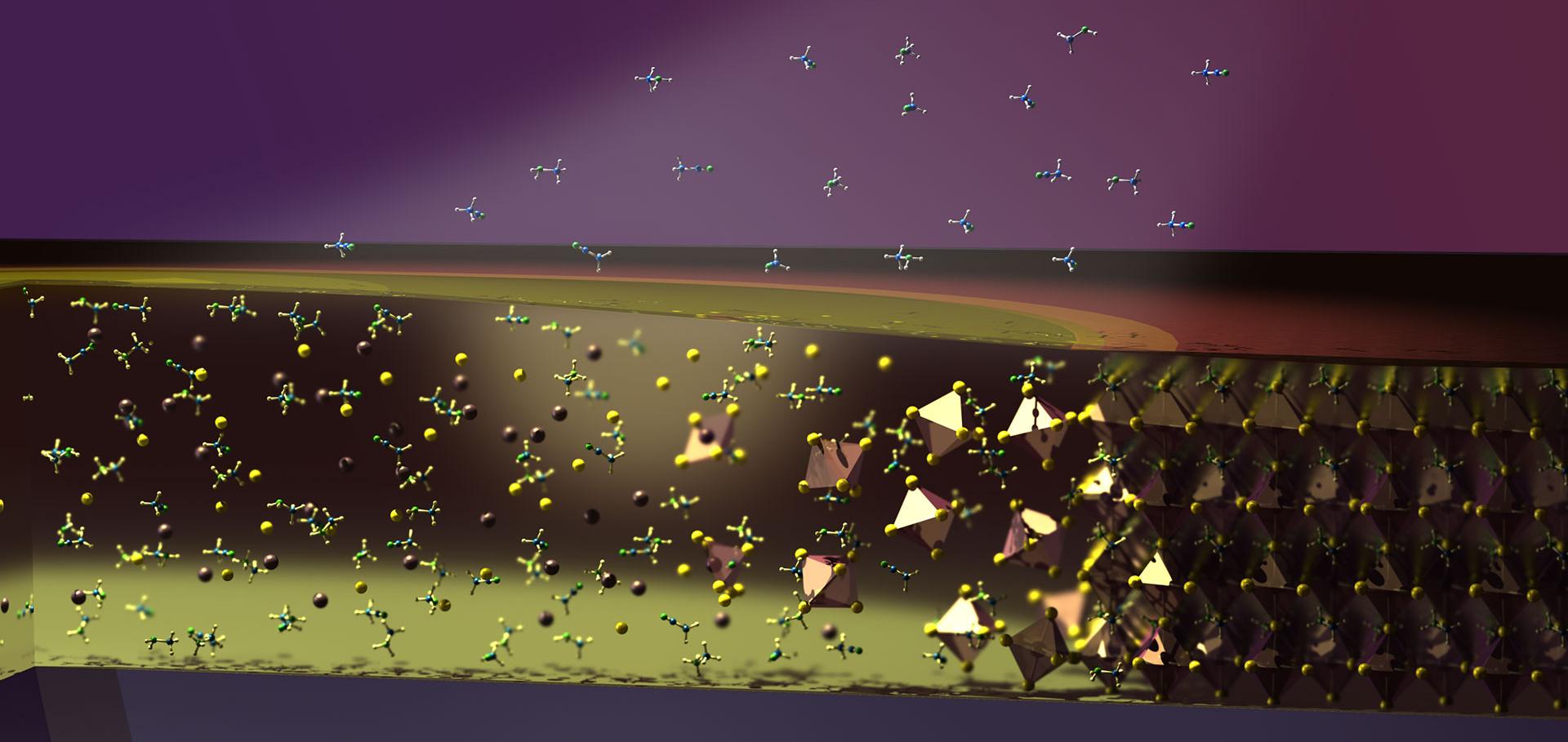
The effects of solution processing methods on halide perovskite nanostructure
BIO Web of Conferences EDP Sciences 129 (2024) 24032
Correction to “A Templating Approach to Controlling the Growth of Coevaporated Halide Perovskites”
ACS Energy Letters American Chemical Society (ACS) 8:11 (2023) 4714-4715
Roadmap on Photovoltaic Absorber Materials for Sustainable Energy Conversion
(2023)
A templating approach to controlling the growth of coevaporated halide perovskites
ACS Energy Letters American Chemical Society 8:10 (2023) 4008-4015
Abstract:
Metal halide perovskite semiconductors have shown significant potential for use in photovoltaic (PV) devices. While fabrication of perovskite thin films can be achieved through a variety of techniques, thermal vapor deposition is particularly promising, allowing for high-throughput fabrication. However, the ability to control the nucleation and growth of these materials, particularly at the charge-transport layer/perovskite interface, is critical to unlocking the full potential of vapor-deposited perovskite PV. In this study, we explore the use of a templating layer to control the growth of coevaporated perovskite films and find that such templating leads to highly oriented films with identical morphology, crystal structure, and optoelectronic properties independent of the underlying layers. Solar cells incorporating templated FA0.9Cs0.1PbI3–xClx show marked improvements with steady-state power conversion efficiency over 19.8%. Our findings provide a straightforward and reproducible method of controlling the charge-transport layer/coevaporated perovskite interface, further clearing the path toward large-scale fabrication of efficient PV devices.Contrasting charge-carrier dynamics across key metal-halide perovskite compositions through in situ simultaneous probes
Advanced Functional Materials Wiley 33:51 (2023) 2305283