Weak low-temperature polarity in a PbZrO3 single crystal

Physical Review B American Physical Society (APS) 107:14 (2023) l140102

Authors:

K Roleder, G Catalan, AM Glazer, JS Baker, J-H Ko, FH Naqvi, SB Junaid, A Majchrowski, Z Trybuła, J Zaręba, I Lazar, D Kajewski, J Koperski, A Soszyński

Erratum: Splitting of the transition to the antiferroelectric state in PbZr0.95Ti0.05O3 into polar and antiferrodistortive components [Phys. Rev. B 88, 094107 (2013)]

Physical Review B American Physical Society (APS) 107:9 (2023) 099901

Authors:

F Cordero, F Craciun, F Trequattrini, C Galassi, PA Thomas, DS Keeble, AM Glazer

Tuning of Polar Domain Boundaries in Nonpolar Perovskite

Advanced Materials Wiley 35:11 (2023) e2207665

Authors:

Zheyi An, Hiroko Yokota, Kyomaru Kurihara, Nozomu Hasegawa, Pavel Marton, Anthony Michael Glazer, Yoshiaki Uesu, Wei Ren, Zuo‐Guang Ye, Marek Paściak, Nan Zhang

Thermally stable perovskite solar cells by all-vacuum deposition

ACS Applied Materials and Interfaces American Chemical Society 15:1 (2022) 772-781

Abstract:

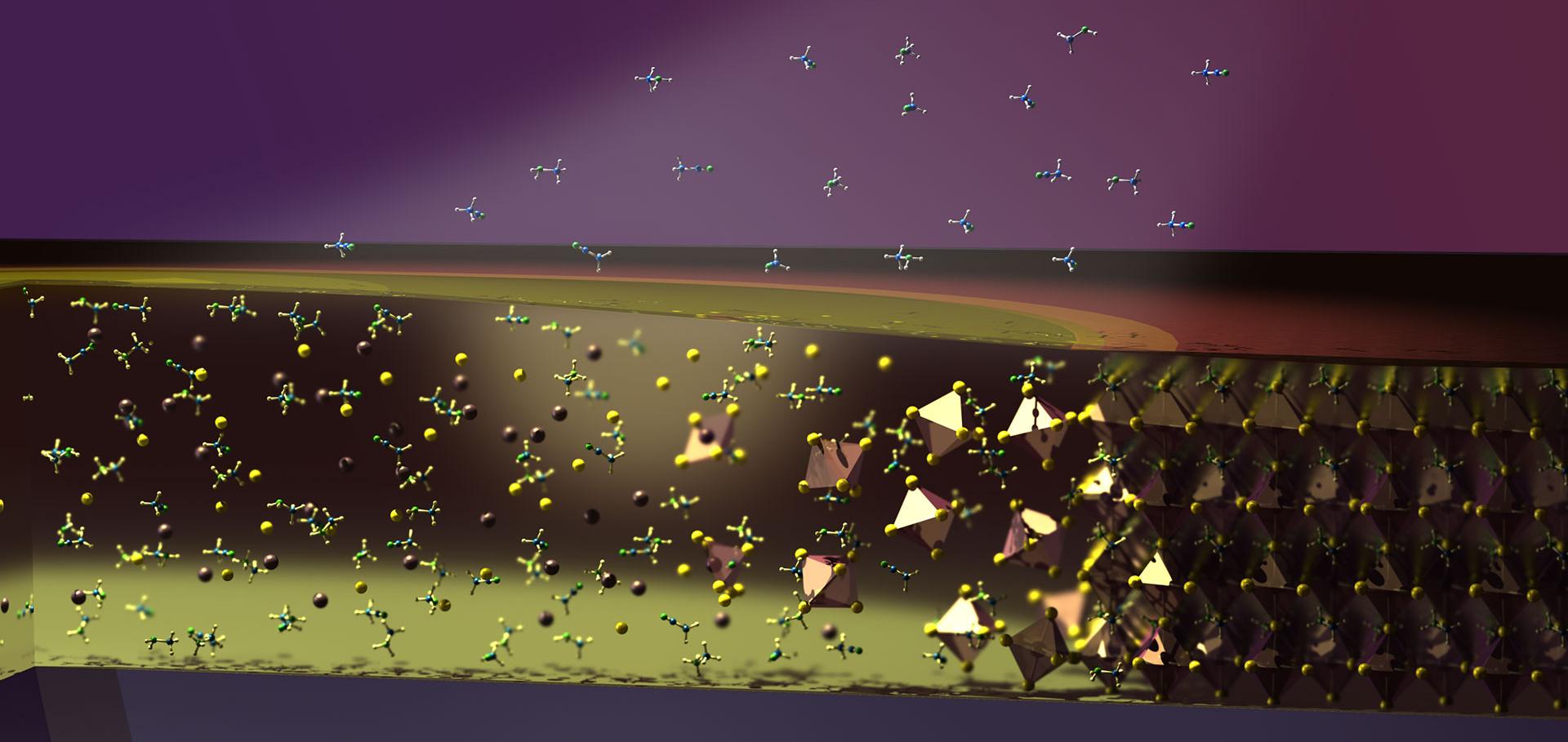
Vacuum deposition is a solvent-free method suitable for growing thin films of metal halide perovskite (MHP) semiconductors. However, most reports of high-efficiency solar cells based on such vacuum-deposited MHP films incorporate solution-processed hole transport layers (HTLs), thereby complicating prospects of industrial upscaling and potentially affecting the overall device stability. In this work, we investigate organometallic copper phthalocyanine (CuPc) and zinc phthalocyanine (ZnPc) as alternative, low-cost, and durable HTLs in all-vacuum-deposited solvent-free formamidinium-cesium lead triodide [CH(NH2)2]0.83Cs0.17PbI3 (FACsPbI3) perovskite solar cells. We elucidate that the CuPc HTL, when employed in an “inverted” p–i–n solar cell configuration, attains a solar-to-electrical power conversion efficiency of up to 13.9%. Importantly, unencapsulated devices as large as 1 cm2 exhibited excellent long-term stability, demonstrating no observable degradation in efficiency after more than 5000 h in storage and 3700 h under 85 °C thermal stressing in N2 atmosphere.

Phase transition hysteresis at the antiferroelectric-ferroelectric boundary in PbZr1−xTixO3

Physical Review B American Physical Society (APS) 106:22 (2022) 224103

Authors:

Zheyi An, Shanshan Xie, Petr Ondrejkovic, Pavel Marton, Esther de Prado, Hiroko Yokota, Wei Ren, Zuo-Guang Ye, AM Glazer, Marek Paściak, Nan Zhang