Home
Department Of Physics text logo
  • Research
    • Our research
    • Our research groups
    • Our research in action
    • Research funding support
    • Summer internships for undergraduates
  • Study
    • Undergraduates
    • Postgraduates
  • Engage
    • For alumni
    • For business
    • For schools
    • For the public
  • Support
Menu
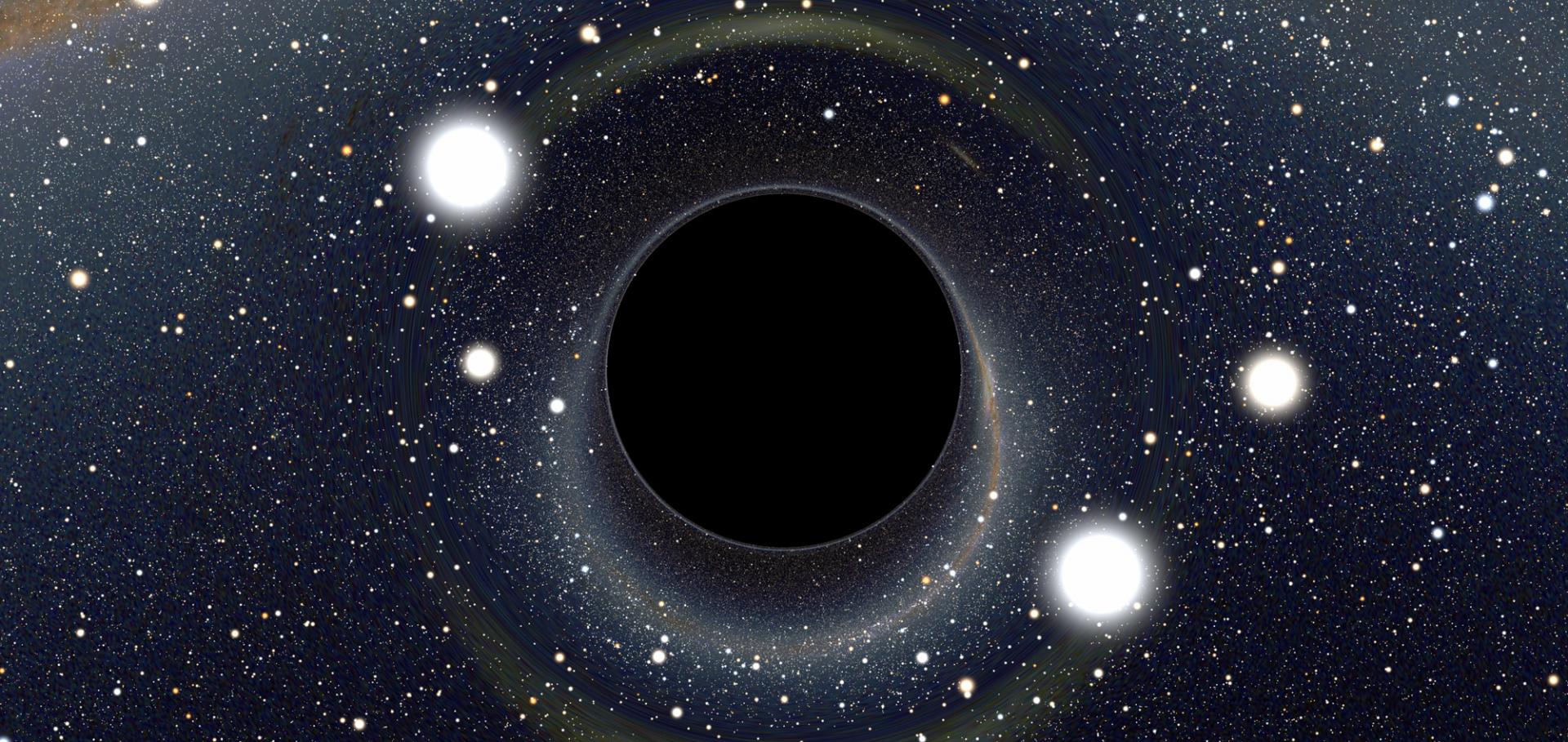
Black Hole

Lensing of space time around a black hole. At Oxford we study black holes observationally and theoretically on all size and time scales - it is some of our core work.

Credit: ALAIN RIAZUELO, IAP/UPMC/CNRS. CLICK HERE TO VIEW MORE IMAGES.

Aprajita Verma

Associate Professor

Research theme

  • Astronomy and astrophysics

Sub department

  • Astrophysics

Research groups

  • Zooniverse
  • Astronomical instrumentation
  • Galaxy formation and evolution
  • Hintze Centre for Astrophysical Surveys
  • MeerKAT
  • Rubin-LSST
  • Extremely Large Telescope
aprajita.verma@physics.ox.ac.uk
Telephone: 01865 (2)73374
Denys Wilkinson Building, room 760
  • About
  • Outreach
  • Teaching
  • Publications

Herschel-ATLAS: Blazars in the science demonstration phase field

Astronomy and Astrophysics 518:3 (2010)

Authors:

J González-Nuevo, G De Zotti, P Andreani, EJ Barton, F Bertoldi, M Birkinshaw, L Bonavera, S Buttiglione, J Cooke, A Cooray, G Danese, L Dunne, S Eales, L Fan, MJ Jarvis, HR Klöckner, E Hatziminaoglou, D Herranz, DH Hughes, A Lapi, A Lawrence, L Leeuw, M Lopez-Caniego, M Massardi, T Mauch, MJ Michałowski, M Negrello, S Rawlings, G Rodighiero, S Samui, S Serjeant, JD Vieira, G White, A Amblard, R Auld, M Baes, DG Bonfield, D Burgarella, A Cava, DL Clements, A Dariush, S Dye, D Frayer, J Fritz, E Ibar, RJ Ivison, G Lagache, S Maddox, E Pascale, M Pohlen, E Rigby, B Sibthorpe, DJB Smith, P Temi, M Thompson, I Valtchanov, A Verma

Abstract:

To investigate the poorly constrained sub-mm counts and spectral properties of blazars we searched for these in the Herschel-ATLAS (H-ATLAS) science demonstration phase (SDP) survey catalog. We cross-matched 500 μm sources brighter than 50 mJy with the FIRST radio catalogue. We found two blazars, both previously known. Our study is among the first blind blazar searches at sub-mm wavelengths, i.e., in the spectral regime where little is still known about the blazar SEDs, but where the synchrotron peak of the most luminous blazars is expected to occur. Our early results are consistent with educated extrapolations of lower frequency counts and question indications of substantial spectral curvature downwards and of spectral upturns at mm wavelengths. One of the two blazars is identified with a Fermi/LAT γ-ray source and a WMAP source. The physical parameters of the two blazars are briefly discussed. These observations demonstrate that the H-ATLAS survey will provide key information about the physics of blazars and their contribution to sub-mm counts. © 2010 ESO.
More details from the publisher

Herschel-ATLAS: Dust temperature and redshift distribution of SPIRE and PACS detected sources using submillimetre colours

Astronomy and Astrophysics 518:1 (2010)

Authors:

A Amblard, A Cooray, P Serra, P Temi, E Barton, M Negrello, R Auld, M Baes, IK Baldry, S Bamford, A Blain, J Bock, D Bonfield, D Burgarella, S Buttiglione, E Cameron, A Cava, D Clements, S Croom, A Dariush, G De Zotti, S Driver, J Dunlop, L Dunne, S Dye, S Eales, D Frayer, J Fritz, JP Gardner, J Gonzalez-Nuevo, D Herranz, D Hill, A Hopkins, DH Hughes, E Ibar, RJ Ivison, M Jarvis, DH Jones, L Kelvin, G Lagache, L Leeuw, J Liske, M Lopez-Caniego, J Loveday, S Maddox, M Michałowski, P Norberg, H Parkinson, JA Peacock, C Pearson, E Pascale, M Pohlen, C Popescu, M Prescott, A Robotham, E Rigby, G Rodighiero, S Samui, A Sansom, D Scott, S Serjeant, R Sharp, B Sibthorpe, DJB Smith, MA Thompson, R Tuffs, I Valtchanov, E Van Kampen, P Van Der Werf, A Verma, J Vieira, C Vlahakis

Abstract:

We present colour-colour diagrams of detected sources in the Herschel-ATLAS science demonstration field from 100 to 500 μm using both PACS and SPIRE. We fit isothermal modified black bodies to the spectral energy distribution (SED) to extract the dust temperature of sources with counterparts in Galaxy And Mass Assembly (GAMA) or SDSS surveys with either a spectroscopic or a photometric redshift. For a subsample of 330 sources detected in at least three FIR bands with a significance greater than 3σ, we find an average dust temperature of (28±8) K. For sources with no known redshift, we populate the colour-colour diagram with a large number of SEDs generated with a broad range of dust temperatures and emissivity parameters, and compare to colours of observed sources to establish the redshift distribution of this sample. For another subsample of 1686 sources with fluxes above 35 mJy at 350 μm and detected at 250 and 500 μm with a significance greater than 3σ, we find an average redshift of 2.2±0.6. © 2010 ESO.
More details from the publisher
More details
Details from ArXiV

Herschel-ATLAS: Dust temperature and redshift distribution of SPIRE and PACS detected sources using submillimetre colours

Astronomy and Astrophysics 518:1 (2010)

Authors:

A Amblard, A Cooray, P Serra, P Temi, E Barton, M Negrello, R Auld, M Baes, IK Baldry, S Bamford, A Blain, J Bock, D Bonfield, D Burgarella, S Buttiglione, E Cameron, A Cava, D Clements, S Croom, A Dariush, G De Zotti, S Driver, J Dunlop, L Dunne, S Dye, S Eales, D Frayer, J Fritz, JP Gardner, J Gonzalez-Nuevo, D Herranz, D Hill, A Hopkins, DH Hughes, E Ibar, RJ Ivison, M Jarvis, DH Jones, L Kelvin, G Lagache, L Leeuw, J Liske, M Lopez-Caniego, J Loveday, S Maddox, M Michałowski, P Norberg, H Parkinson, JA Peacock, C Pearson, E Pascale, M Pohlen, C Popescu, M Prescott, A Robotham, E Rigby, G Rodighiero, S Samui, A Sansom, D Scott, S Serjeant, R Sharp, B Sibthorpe, DJB Smith, MA Thompson, R Tuffs, I Valtchanov, E Van Kampen, P Van Der Werf, A Verma, J Vieira, C Vlahakis

Abstract:

We present colour-colour diagrams of detected sources in the Herschel-ATLAS science demonstration field from 100 to 500 μm using both PACS and SPIRE. We fit isothermal modified black bodies to the spectral energy distribution (SED) to extract the dust temperature of sources with counterparts in Galaxy And Mass Assembly (GAMA) or SDSS surveys with either a spectroscopic or a photometric redshift. For a subsample of 330 sources detected in at least three FIR bands with a significance greater than 3σ, we find an average dust temperature of (28±8) K. For sources with no known redshift, we populate the colour-colour diagram with a large number of SEDs generated with a broad range of dust temperatures and emissivity parameters, and compare to colours of observed sources to establish the redshift distribution of this sample. For another subsample of 1686 sources with fluxes above 35 mJy at 350 μm and detected at 250 and 500 μm with a significance greater than 3σ, we find an average redshift of 2.2±0.6. © 2010 ESO.
More details from the publisher

Herschel-ATLAS: Evolution of the 250 μm luminosity function out to z = 0.5

Astronomy and Astrophysics 518:1 (2010)

Authors:

S Dye, L Dunne, S Eales, DJB Smith, A Amblard, R Auld, M Baes, IK Baldry, S Bamford, AW Blain, DG Bonfield, M Bremer, D Burgarella, S Buttiglione, E Cameron, A Cava, DL Clements, A Cooray, S Croom, A Dariush, G De Zotti, S Driver, JS Dunlop, D Frayer, J Fritz, JP Gardner, HL Gomez, J Gonzalez-Nuevo, D Herranz, D Hill, A Hopkins, E Ibar, RJ Ivison, MJ Jarvis, DH Jones, L Kelvin, G Lagache, L Leeuw, J Liske, M Lopez-Caniego, J Loveday, S Maddox, MJ Michałowski, M Negrello, P Norberg, MJ Page, H Parkinson, E Pascale, JA Peacock, M Pohlen, C Popescu, M Prescott, D Rigopoulou, A Robotham, E Rigby, G Rodighiero, S Samui, D Scott, S Serjeant, R Sharp, B Sibthorpe, P Temi, MA Thompson, R Tuffs, I Valtchanov, PP Van Der Werf, E Van Kampen, A Verma

Abstract:

We have determined the luminosity function of 250 μm-selected galaxies detected in the ∼14 deg2science demonstration region of the Herschel-ATLAS project out to a redshift of z = 0.5. Our findings very clearly show that the luminosity function evolves steadily out to this redshift. By selecting a sub-group of sources within a fixed luminosity interval where incompleteness effects are minimal, we have measured a smooth increase in the comoving 250 μm luminosity density out to z = 0.2 where it is 3.6+1.4-0.9times higher than the local value. © 2010 ESO.
More details from the publisher

Herschel-ATLAS: Extragalactic number counts from 250 to 500 microns

Astronomy and Astrophysics 518:1 (2010)

Authors:

DL Clements, E Rigby, S Maddox, L Dunne, A Mortier, C Pearson, A Amblard, R Auld, M Baes, D Bonfield, D Burgarella, S Buttiglione, A Cava, A Cooray, A Dariush, G De Zotti, S Dye, S Eales, D Frayer, J Fritz, JP Gardner, J Gonzalez-Nuevo, D Herranz, E Ibar, R Ivison, MJ Jarvis, G Lagache, L Leeuw, M Lopez-Caniego, M Negrello, E Pascale, M Pohlen, G Rodighiero, S Samui, S Serjeant, B Sibthorpe, D Scott, DJB Smith, P Temi, M Thompson, I Valtchanov, P Van Der Werf, A Verma

Abstract:

Aims. The Herschel-ATLAS survey (H-ATLAS) will be the largest area survey to be undertaken by the Herschel Space Observatory. It will cover 550 sq. deg. of extragalactic sky at wavelengths of 100, 160, 250, 350 and 500 μm when completed, reaching flux limits (5σ) from 32 to 145 mJy. We here present galaxy number counts obtained for SPIRE observations of the first ∼14 sq. deg. observed at 250, 350 and 500 μm. Methods. Number counts are a fundamental tool in constraining models of galaxy evolution. We use source catalogs extracted from the H-ATLAS maps as the basis for such an analysis. Correction factors for completeness and flux boosting are derived by applying our extraction method to model catalogs and then applied to the raw observational counts. Results. We find a steep rise in the number counts at flux levels of 100-200 mJy in all three SPIRE bands, consistent with results from BLAST. The counts are compared to a range of galaxy evolution models. None of the current models is an ideal fit to the data but all ascribe the steep rise to a population of luminous, rapidly evolving dusty galaxies at moderate to high redshift. © 2010 ESO.
More details from the publisher
More details
Details from ArXiV

Pagination

  • First page First
  • Previous page Prev
  • …
  • Page 22
  • Page 23
  • Page 24
  • Page 25
  • Current page 26
  • Page 27
  • Page 28
  • Page 29
  • Page 30
  • …
  • Next page Next
  • Last page Last

Footer Menu

  • Contact us
  • Giving to the Dept of Physics
  • Work with us
  • Media

User account menu

  • Log in

Follow us

FIND US

Clarendon Laboratory,

Parks Road,

Oxford,

OX1 3PU

CONTACT US

Tel: +44(0)1865272200

University of Oxfrod logo Department Of Physics text logo
IOP Juno Champion logo Athena Swan Silver Award logo

© University of Oxford - Department of Physics

Cookies | Privacy policy | Accessibility statement

Built by: Versantus

  • Home
  • Research
  • Study
  • Engage
  • Our people
  • News & Comment
  • Events
  • Our facilities & services
  • About us
  • Giving to Physics
  • Current students
  • Staff intranet