

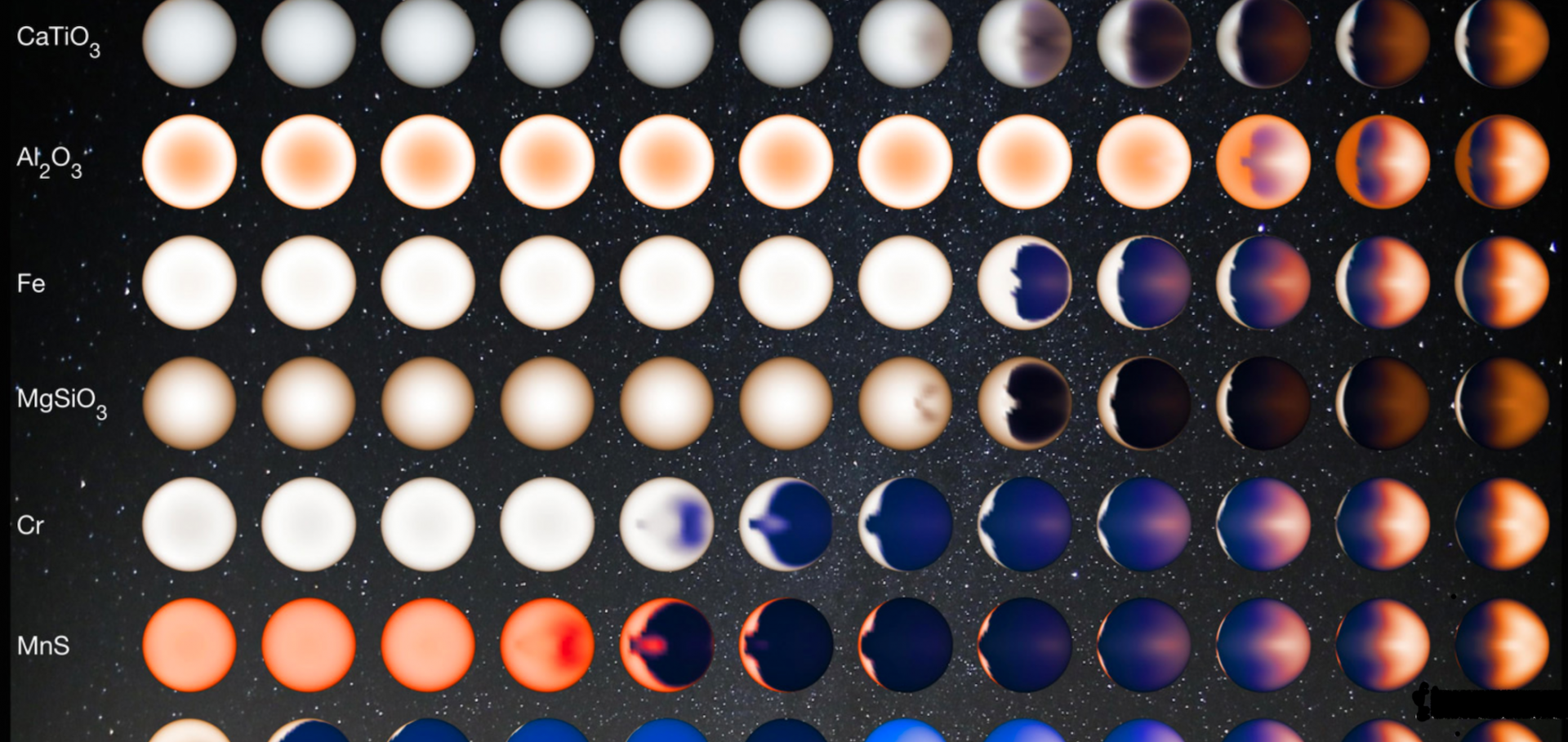
The Dark World: A Tale of WASP-43b in Reflected Light with HST WFC3/UVIS
The Astronomical Journal American Astronomical Society 161:6 (2021) 269
3D Convection-resolving Model of Temperate, Tidally Locked Exoplanets
ASTROPHYSICAL JOURNAL 913:2 (2021) ARTN 101
3D convection-resolving model of temperate, tidally locked exoplanets
Astrophysical Journal American Astronomical Society 913:2 (2021) 101
Abstract:
A large fraction of known terrestrial-size exoplanets located in the habitable zone of M-dwarfs are expected to be tidally locked. Numerous efforts have been conducted to study the climate of such planets, using in particular 3D global climate models (GCMs). One of the biggest challenges in simulating such an extreme environment is to properly represent the effects of sub-grid convection. Most GCMs use either a simplistic convective-adjustment parameterization or sophisticated (e.g., mass flux scheme) Earth-tuned parameterizations. One way to improve the representation of convection is to study convection using numerical convection-resolving models (CRMs), with a fine spatial resolution. In this study, we developed a CRM coupling the non-hydrostatic dynamical core Advanced Research Weather-Weather Research and Forecast model with the radiative transfer and cloud/precipitation models of the Laboratoire de Météorologie Dynamique generic climate model to study convection and clouds on tidally locked planets, with a focus on Proxima b. Simulations were performed for a set of three surface temperatures (corresponding to three different incident fluxes) and two rotation rates, assuming an Earth-like atmosphere. The main result of our study is that while we recover the prediction of GCMs that (low-altitude) cloud albedo increases with increasing stellar flux, the cloud feedback is much weaker due to transient aggregation of convection leading to low partial cloud cover.Original Research by Young Twinkle Students (ORBYTS): ephemeris refinement of transiting exoplanets
Monthly Notices of the Royal Astronomical Society Oxford University Press (OUP) 504:4 (2021) 5671-5684
Characterising atmospheric gravity waves on the nightside lower clouds of Venus: a systematic analysis
ArXiv 2105.04931 (2021)