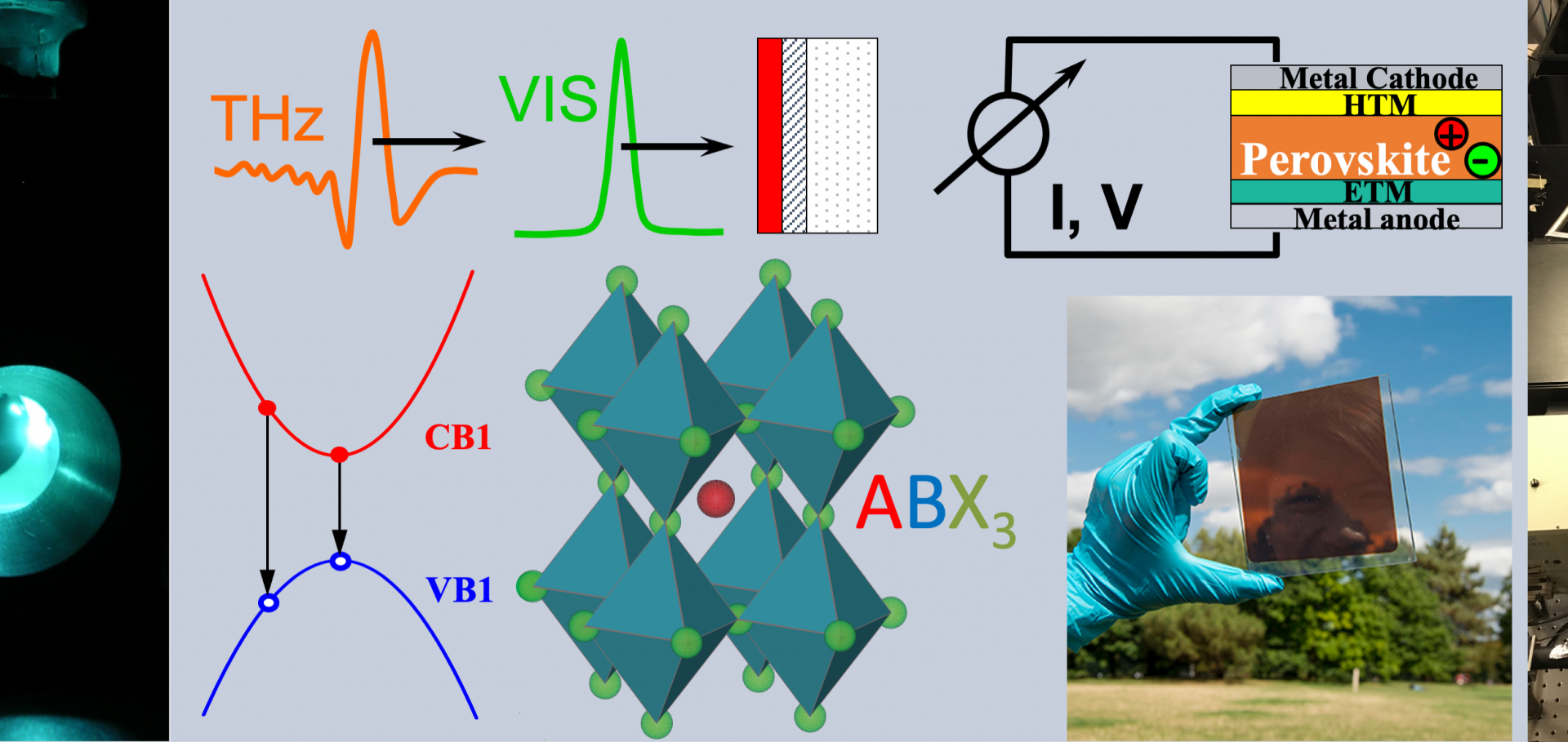
Heterogeneous photon recycling and charge diffusion enhance charge transport in quasi-2D lead-halide perovskite films

Nano Letters American Chemical Society 19:6 (2019) 3953-3960

Authors:

Silvia Motti, Timothy Crothers, R Yang, Y Cao, R Li, Michael Johnston, J Wang, Laura Herz

Abstract:

The addition of large hydrophobic cations to lead halide perovskites has significantly enhanced the environmental stability of photovoltaic cells based on these materials. However, the associated formation of two-dimensional structures inside the material can lead to dielectric confinement, higher exciton binding energies, wider bandgaps and limited charge-carrier mobilities. Here we show that such effects are not detrimental to the charge transport for carefully processed films comprising a self-assembled thin layer of quasi-two-dimensional (2D) perovskite interfaced with a 3D MAPbI3 perovskite layer. We apply a combination of time-resolved photoluminescence and photoconductivity spectroscopy to reveal the charge-carrier recombination and transport through the film profile, when either the quasi-2D or the 3D layers are selectively excited. Through modeling of the recorded dynamics, we demonstrate that while the charge-carrier mobility is lower within the quasi-2D region, charge-carrier diffusion to the 3D phase leads to a rapid recovery in photoconductivity even when the quasi-2D region is initially photoexcited. In addition, the blue-shifted emission originating from quasi-2D regions overlaps significantly with the absorption spectrum of the 3D perovskite, allowing for highly effective “heterogeneous photon recycling”. We show that this combination fully compensates for the adverse effects of electronic confinement, yielding quasi-2D perovskites with highly efficient charge transporting properties.

Tuning the Circumference of Six-Porphyrin Nanorings

Journal of the American Chemical Society American Chemical Society (ACS) (2019) jacs.9b02965

Authors:

Renee Haver, Lara Tejerina, Hua-Wei Jiang, Michel Rickhaus, Michael Jirasek, Isabell Gruebner, Hannah J Eggimann, Laura M Herz, Harry L Anderson

Aromaticity and Antiaromaticity in the Excited States of Porphyrin Nanorings.

The journal of physical chemistry letters (2019) 2017-2022

Authors:

Martin D Peeks, Juliane Q Gong, Kirstie McLoughlin, Takayuki Kobatake, Renée Haver, Laura M Herz, Harry L Anderson

Abstract:

Aromaticity can be a useful concept for predicting the behavior of excited states. Here we show that π-conjugated porphyrin nanorings exhibit size-dependent excited-state global aromaticity and antiaromaticity for rings containing up to eight porphyrin subunits, although they have no significant global aromaticity in their neutral singlet ground states. Applying Baird's rule, even rings ([4 n] π-electrons) are aromatic in their lowest excited states, whereas the lowest excited states of odd rings ([4 n + 2] π-electrons) are antiaromatic. These predictions are borne out by density functional theory (DFT) studies of the nucleus-independent chemical shift (NICS) in the T1 triplet state of each ring, which reveal the critical importance of the triplet delocalization to the emergence of excited-state aromaticity. The singlet excited states (S1) are explored by measurements of the radiative rate and fluorescence peak wavelength, revealing a subtle odd-even alternation as a function of ring size, consistent with symmetry breaking in antiaromatic excited states.

Self-Trapped Excitons in All-Inorganic Halide Perovskites: Fundamentals, Status, and Potential Applications.

The journal of physical chemistry letters 10:8 (2019) 1999-2007

Authors:

Shunran Li, Jiajun Luo, Jing Liu, Jiang Tang

Abstract:

Photoluminescence is a radiative recombination process of electron-hole pairs. Self-trapped excitons (STEs), occurring in a material with soft lattice and strong electron-phonon coupling, emit photons with broad spectrum and large Stokes shift. Recently, series halide perovskites with efficient STE emission have been reported and showed promise for solid-state lighting. In this Perspective, we present an overview of various photoluminescence phenomena with the emphasis on the mechanism and characteristics of emission derived from STEs. This is followed by the introduction of STE emission in hybrid halide perovskites. We then introduce all-inorganic STE emitters and focus in particular on the mechanism of STEs in double-perovskite Cs2AgInCl6 and strategies for efficiency improvement. Finally, we summarize the current photoluminescence and electroluminescence applications of STE emitters as well as the potential in luminescent solar concentrators and provide an overview of future research opportunities.

How β-Phase Content Moderates Chain Conjugation and Energy Transfer in Polyfluorene Films

Journal of Physical Chemistry Letters American Chemical Society 10:8 (2019) 1729-1736

Authors:

HJ Eggimann, F Le Roux, Laura Herz