

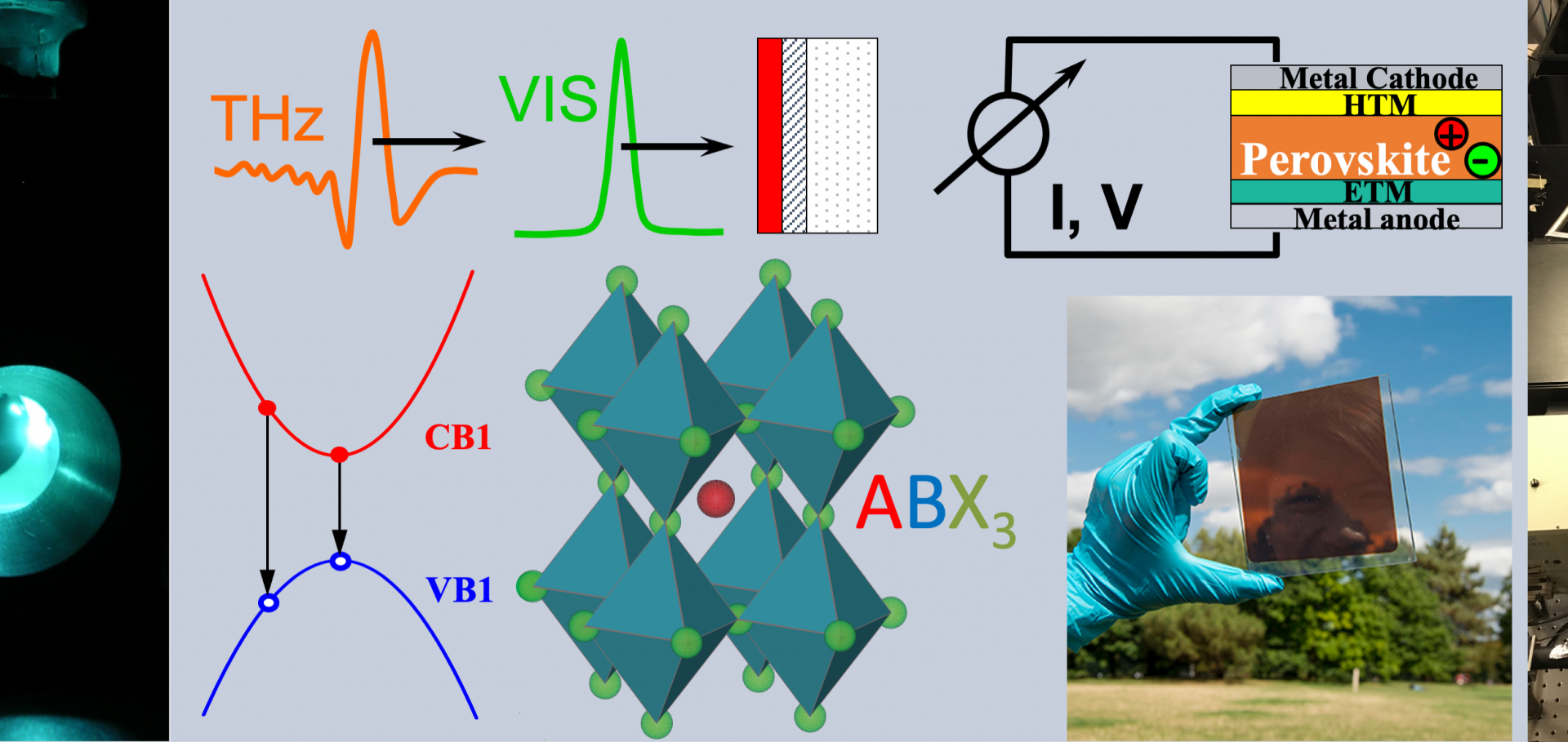
Electronic Traps and Phase Segregation in Lead Mixed-Halide Perovskite
ACS Energy Letters (2018) 75-84
Abstract:
© 2018 American Chemical Society. An understanding of the factors driving halide segregation in lead mixed-halide perovskites is required for their implementation in tandem solar cells with existing silicon technology. Here we report that the halide segregation dynamics observed in the photoluminescence from CH3NH3Pb(Br0.5I0.5)3 is strongly influenced by the atmospheric environment, and that encapsulation of films with a layer of poly(methyl methacrylate) allows for halide segregation dynamics to be fully reversible and repeatable. We further establish an empirical model directly linking the amount of halide segregation observed in the photoluminescence to the fraction of charge carriers recombining through trap-mediated channels, and the photon flux absorbed. From such quantitative analysis we show that under pulsed illumination, the frequency of the modulation alone has no influence on the segregation dynamics. Additionally, we extrapolate that working CH3NH3Pb(Br0.5I0.5)3 perovskite cells would require a reduction of the trap-related charge carrier recombination rate to ≲105s-1 in order for halide segregation to be sufficiently suppressed.How lattice dynamics moderate the electronic properties of metal-halide perovskites
Journal of Physical Chemistry Letters American Chemical Society 9:23 (2018) 6853-6863
Abstract:
Metal-halide perovskites have emerged as highly promising semiconductors with excellent optoelectronic properties. This Perspective outlines how the dynamic response of the ionic lattice affects key electronic properties such as exciton binding energies and charge-carrier mobilities in hybrid perovskites. Such links are shown to derive from the frequency-dependence of the dielectric function, which is governed by contributions from electronic interband transitions, polar vibrations of the metal-halide sublattice, organic cation collective reorientations, and ionic movement. The influence of each of these contributions to charge-carrier screening and carrier–lattice interactions is discussed, which allows for general trends with material composition to be revealed. Overall, this Perspective highlights the challenges and questions arising from the peculiar combination of a soft polar metal-halide sublattice interspersed with rotationally mobile dipolar molecules that is encountered in hybrid metal-halide perovskites.Efficient and stable emission of warm-white light from lead-free halide double perovskites.
Nature 563:7732 (2018) 541-545
Abstract:
Lighting accounts for one-fifth of global electricity consumption1. Single materials with efficient and stable white-light emission are ideal for lighting applications, but photon emission covering the entire visible spectrum is difficult to achieve using a single material. Metal halide perovskites have outstanding emission properties2,3; however, the best-performing materials of this type contain lead and have unsatisfactory stability. Here we report a lead-free double perovskite that exhibits efficient and stable white-light emission via self-trapped excitons that originate from the Jahn-Teller distortion of the AgCl6 octahedron in the excited state. By alloying sodium cations into Cs2AgInCl6, we break the dark transition (the inversion-symmetry-induced parity-forbidden transition) by manipulating the parity of the wavefunction of the self-trapped exciton and reduce the electronic dimensionality of the semiconductor4. This leads to an increase in photoluminescence efficiency by three orders of magnitude compared to pure Cs2AgInCl6. The optimally alloyed Cs2(Ag0.60Na0.40)InCl6 with 0.04 per cent bismuth doping emits warm-white light with 86 ± 5 per cent quantum efficiency and works for over 1,000 hours. We anticipate that these results will stimulate research on single-emitter-based white-light-emitting phosphors and diodes for next-generation lighting and display technologies.Raman Spectrum of the Organic-Inorganic Halide Perovskite CH3NH3PbI3 from First Principles and High-Resolution Low-Temperature Raman Measurements
JOURNAL OF PHYSICAL CHEMISTRY C 122:38 (2018) 21703-21717
The effects of doping density and temperature on the optoelectronic properties of formamidinium tin triiodide thin films
Advanced Materials Wiley 30:44 (2018) 1804506