How lattice dynamics moderate the electronic properties of metal-halide perovskites

Journal of Physical Chemistry Letters American Chemical Society 9:23 (2018) 6853-6863

Abstract:

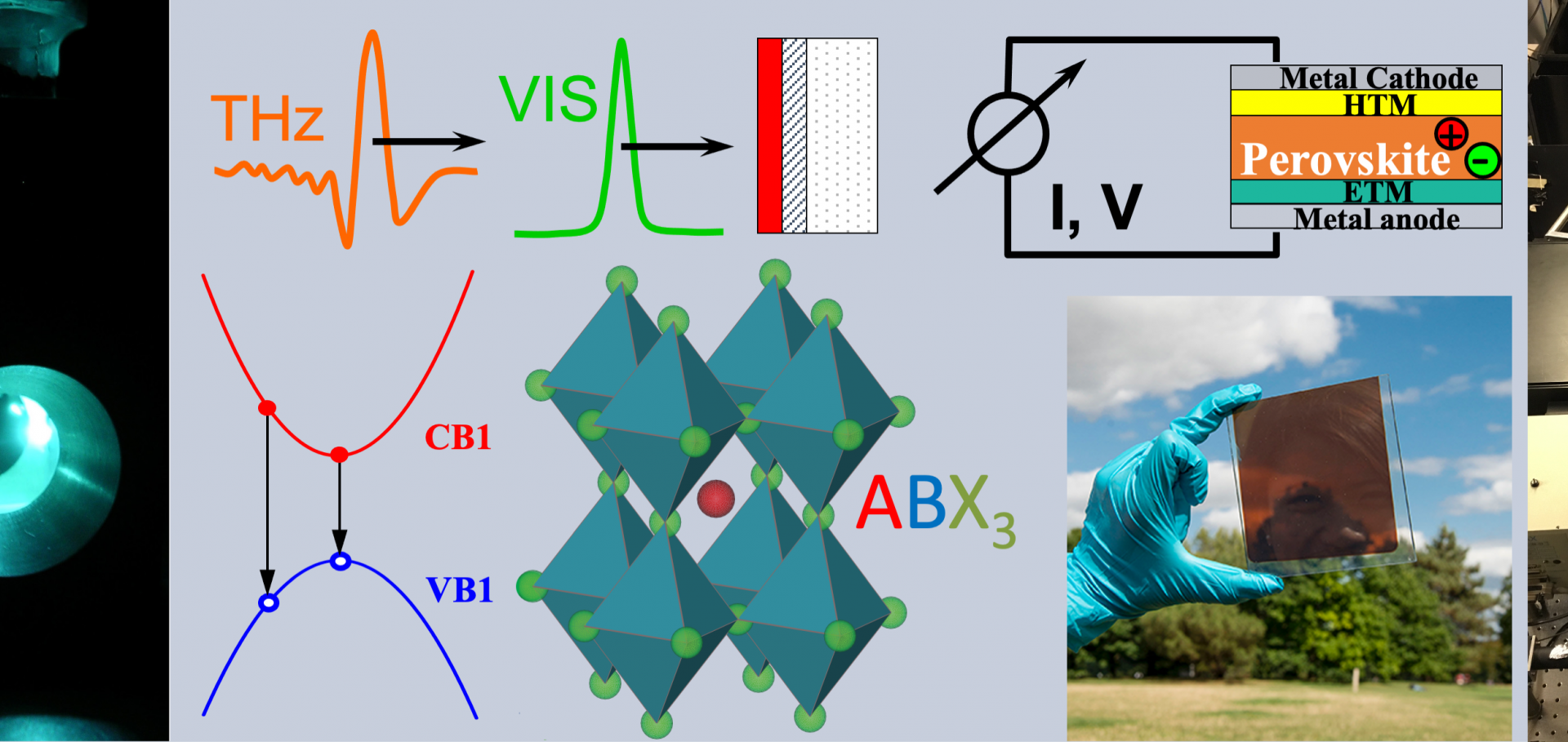
Metal-halide perovskites have emerged as highly promising semiconductors with excellent optoelectronic properties. This Perspective outlines how the dynamic response of the ionic lattice affects key electronic properties such as exciton binding energies and charge-carrier mobilities in hybrid perovskites. Such links are shown to derive from the frequency-dependence of the dielectric function, which is governed by contributions from electronic interband transitions, polar vibrations of the metal-halide sublattice, organic cation collective reorientations, and ionic movement. The influence of each of these contributions to charge-carrier screening and carrier–lattice interactions is discussed, which allows for general trends with material composition to be revealed. Overall, this Perspective highlights the challenges and questions arising from the peculiar combination of a soft polar metal-halide sublattice interspersed with rotationally mobile dipolar molecules that is encountered in hybrid metal-halide perovskites.

Publisher Correction: High irradiance performance of metal halide perovskites for concentrator photovoltaics

Nature Energy Springer Nature America, Inc (2018)

Authors:

Z Wang, Q Lin, B Wenger, Mark Christoforo, Y-H Lin, MT Klug, MICHAEL Johnston, LAURA Herz, HJ Snaith

Abstract:

© 2018, Springer Nature Limited. When this Article was originally published, an old version of the associated Supplementary Information file was uploaded. This has now been replaced.

Efficient and stable emission of warm-white light from lead-free halide double perovskites.

Nature 563:7732 (2018) 541-545

Authors:

Jiajun Luo, Xiaoming Wang, Shunran Li, Jing Liu, Yueming Guo, Guangda Niu, Li Yao, Yuhao Fu, Liang Gao, Qingshun Dong, Chunyi Zhao, Meiying Leng, Fusheng Ma, Wenxi Liang, Liduo Wang, Shengye Jin, Junbo Han, Lijun Zhang, Joanne Etheridge, Jianbo Wang, Yanfa Yan, Edward H Sargent, Jiang Tang

Abstract:

Lighting accounts for one-fifth of global electricity consumption1. Single materials with efficient and stable white-light emission are ideal for lighting applications, but photon emission covering the entire visible spectrum is difficult to achieve using a single material. Metal halide perovskites have outstanding emission properties2,3; however, the best-performing materials of this type contain lead and have unsatisfactory stability. Here we report a lead-free double perovskite that exhibits efficient and stable white-light emission via self-trapped excitons that originate from the Jahn-Teller distortion of the AgCl6 octahedron in the excited state. By alloying sodium cations into Cs2AgInCl6, we break the dark transition (the inversion-symmetry-induced parity-forbidden transition) by manipulating the parity of the wavefunction of the self-trapped exciton and reduce the electronic dimensionality of the semiconductor4. This leads to an increase in photoluminescence efficiency by three orders of magnitude compared to pure Cs2AgInCl6. The optimally alloyed Cs2(Ag0.60Na0.40)InCl6 with 0.04 per cent bismuth doping emits warm-white light with 86 ± 5 per cent quantum efficiency and works for over 1,000 hours. We anticipate that these results will stimulate research on single-emitter-based white-light-emitting phosphors and diodes for next-generation lighting and display technologies.

The effects of doping density and temperature on the optoelectronic properties of formamidinium tin triiodide thin films

Advanced Materials Wiley 30:44 (2018) 1804506

Authors:

Rebecca L Milot, Matthew T Klug, Christopher Davies, Zhiping Wang, Hans AP Kraus, Henry J Snaith, Michael B Johnston, Laura M Herz

Abstract:

Intrinsic and extrinsic optoelectronic properties are unraveled for formamidinium tin triiodide (FASnI3) thin films, whose background hole doping density was varied through SnF2 addition during film fabrication. Monomolecular charge-carrier recombination exhibits both a dopant-mediated part that grows linearly with hole doping density and remnant contributions that remain under tin-enriched processing conditions. At hole densities near 1020 cm-3, a strong Burstein-Moss effect increases absorption onset energies by ~300meV beyond the band gap energy of undoped FASnI3 (shown to be 1.2 eV at 5 K and 1.35 eV at room temperature). At very high doping densities (1020 cm-3), temperature-dependent measurements indicate that the effective charge-carrier mobility is suppressed through scattering with ionized dopants. Once the background hole concentration is nearer 1019 cm-3 and below, the charge-carrier mobility increases with decreasing temperature according to ~T-1.2, suggesting it is limited mostly by intrinsic interactions with lattice vibrations. For the lowest doping concentration of 7.2´1018 cm^-3, charge-carrier mobilities reach a value of 67 cm2V-1s-1at room temperature and 470 cm2V-1s-1 at 50 K. Intra-excitonic transitions observed in the THz-frequency photoconductivity spectra at 5K reveal an exciton binding energy of only 3.1 meV for FASnI3, in agreement with the low bandgap energy exhibited by this perovskite.

Temperature-dependent refractive index of quartz at terahertz frequencies

Journal of Infrared, Millimeter and Terahertz Waves Springer Verlag 39:12 (2018) 1236-1248

Authors:

Christopher L Davies, Jay B Patel, Chelsea Q Xia, Laura M Herz, Michael Johnston

Abstract:

Characterisation of materials often requires the use of a substrate to support the sample being investigated. For optical characterisation at terahertz frequencies, quartz is commonly used owing to its high transmission and low absorption at these frequencies. Knowledge of the complex refractive index of quartz is required for analysis of time-domain terahertz spectroscopy and optical pump terahertz probe spectroscopy for samples on a quartz substrate. Here, we present the refractive index and extinction coefficient for α-quartz between 0.5 THz and 5.5 THz (17–183 cm^−1) taken at 10, 40, 80, 120, 160, 200 and 300 K. Quartz shows excellent transmission and is thus an ideal optical substrate over the THz band, apart from the region 3.9 ± 0.1 THz owing to a spectral feature originating from the lowest energy optical phonon modes. We also present the experimentally measured polariton dispersion of α-quartz over this frequency range.