

Crystallization Kinetics and Morphology Control of Formamidinium-Cesium Mixed-Cation Lead Mixed-Halide Perovskite via Tunability of the Colloidal Precursor Solution.
Advanced materials (Deerfield Beach, Fla.) 29:29 (2017)
Abstract:
The meteoric rise of the field of perovskite solar cells has been fueled by the ease with which a wide range of high-quality materials can be fabricated via simple solution processing methods. However, to date, little effort has been devoted to understanding the precursor solutions, and the role of additives such as hydrohalic acids upon film crystallization and final optoelectronic quality. Here, a direct link between the colloids concentration present in the [HC(NH2 )2 ]0.83 Cs0.17 Pb(Br0.2 I0.8 )3 precursor solution and the nucleation and growth stages of the thin film formation is established. Using dynamic light scattering analysis, the dissolution of colloids over a time span triggered by the addition of hydrohalic acids is monitored. These colloids appear to provide nucleation sites for the perovskite crystallization, which critically impacts morphology, crystal quality, and optoelectronic properties. Via 2D X-ray diffraction, highly ordered and textured crystals for films prepared from solutions with lower colloidal concentrations are observed. This increase in material quality allows for a reduction in microstrain along with a twofold increase in charge-carrier mobilities leading to values exceeding 20 cm2 V-1 s-1 . Using a solution with an optimized colloidal concentration, devices that reach current-voltage measured power conversion efficiency of 18.8% and stabilized efficiency of 17.9% are fabricated.Large-Scale Statistics for Threshold Optimization of Optically Pumped Nanowire Lasers.
Nano letters 17:8 (2017) 4860-4865
Abstract:
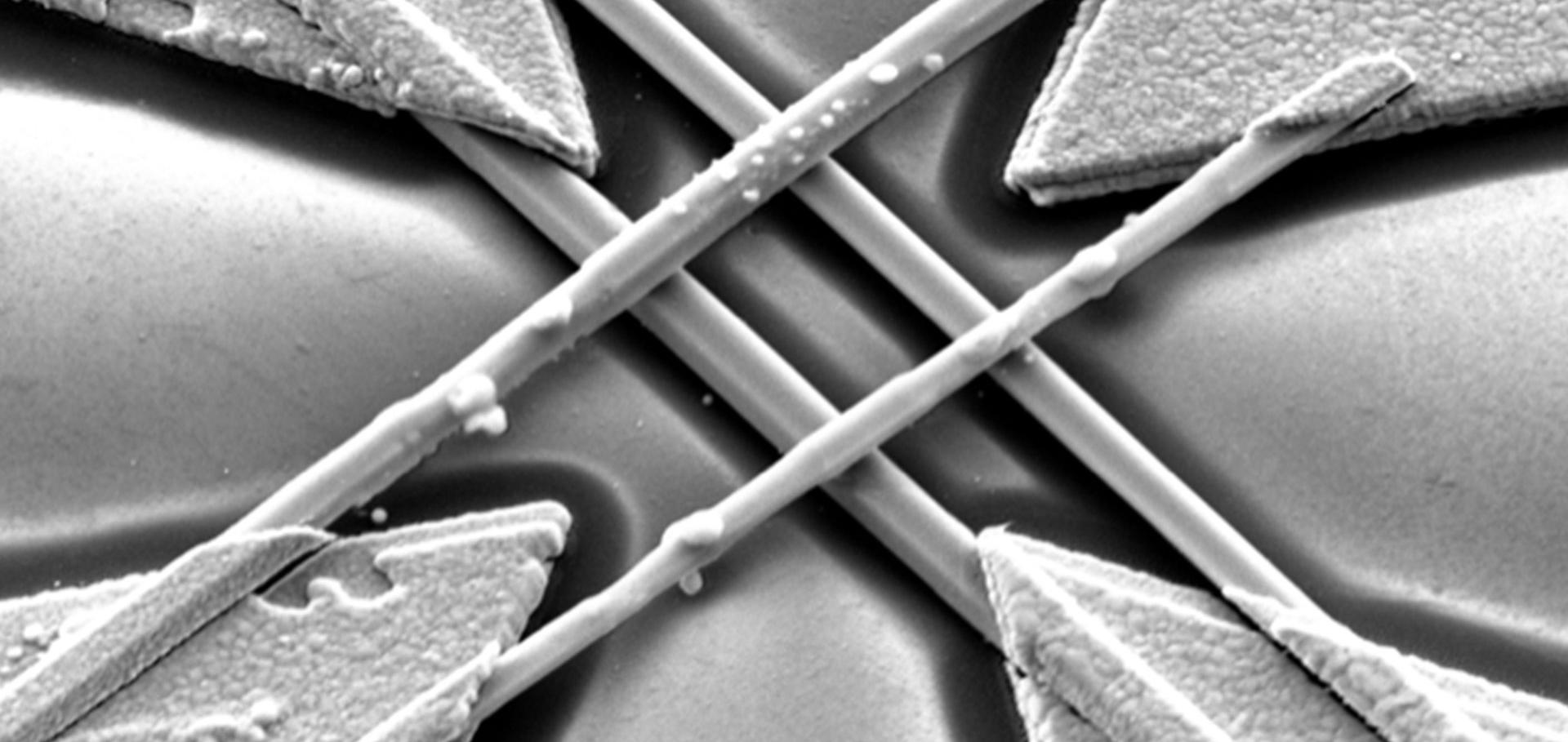
Single nanowire lasers based on bottom-up III-V materials have been shown to exhibit room-temperature near-infrared lasing, making them highly promising for use as nanoscale, silicon-integrable, and coherent light sources. While lasing behavior is reproducible, small variations in growth conditions across a substrate arising from the use of bottom-up growth techniques can introduce interwire disorder, either through geometric or material inhomogeneity. Nanolasers critically depend on both high material quality and tight dimensional tolerances, and as such, lasing threshold is both sensitive to and a sensitive probe of such inhomogeneity. We present an all-optical characterization technique coupled to statistical analysis to correlate geometrical and material parameters with lasing threshold. For these multiple-quantum-well nanolasers, it is found that low threshold is closely linked to longer lasing wavelength caused by losses in the core, providing a route to optimized future low-threshold devices. A best-in-group room temperature lasing threshold of ∼43 μJ cm-2 under pulsed excitation was found, and overall device yields in excess of 50% are measured, demonstrating a promising future for the nanolaser architecture.Choice of Polymer Matrix for a Fast Switchable III-V Nanowire Terahertz Modulator
MRS Advances Springer Nature 2:28 (2017) 1475-1480
Broadband Single-Nanowire Photoconductive Terahertz Detectors
2017 CONFERENCE ON LASERS AND ELECTRO-OPTICS (CLEO) (2017)
Towards higher electron mobility in modulation doped GaAs/AlGaAs core shell nanowires
Nanoscale Royal Society of Chemistry 9 (2017) 7839-7846