

Extracting the key electrical properties of semiconductors using optical pump terahertz probe spectroscopy
41st International Conference on Infrared, Millimeter, and Terahertz waves (IRMMW-THz), 2016 IEEE 2016-November (2016)
Abstract:
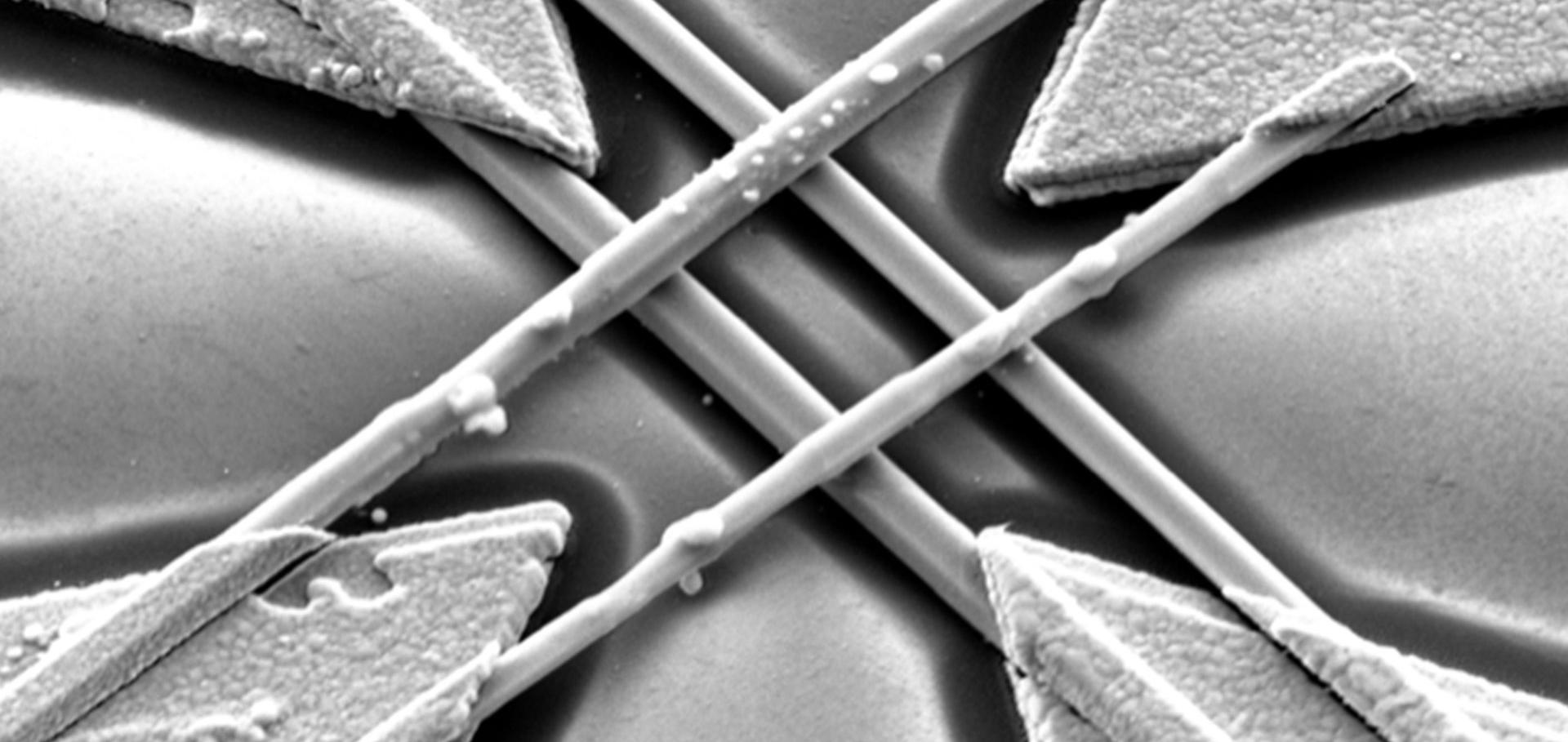
We have used optical-pump-terahertz-probe spectroscopy (OPTPS) to study a range of novel of semiconductors including III-V nanowires and metal halide perovskites. We show that OPTPs allows key figures of merit to be extracted in a non-contact manner, including charge mobility, surface recombination velocity, and doping density. Furthermore, the technique allows charge recombination dynamics to be followed on a picosecond time-scale. This knowledge is useful in the design of new optoelectronic devices from lasers to solar cells as well as for the development and optimisation of new semiconductors.Increased photoconductivity lifetimes in GaAs nanowires via n-type and p-type shell doping
41st International Conference on Infrared, Millimeter, and Terahertz waves (IRMMW-THz), 2016 IEEE 2016-November (2016)
Abstract:
Reliable doping in GaAs nanowires is essential for the development of novel optoelectronic devices. Previously, GaAs nanowires have been shown to exhibit extremely short photoconductivity lifetimes of a few picoseconds due to their high surface recombination velocity, which is detrimental for nanowire devices, such as solar cells and nanowire lasers. Here, we show that, by exploiting engineered band-bending via selective doping, this parasitic surface recombination can be reduced. We utilise non-contact time-resolved terahertz spectroscopy to characterise the doping efficiency in n-type and p-type doped GaAs nanowire8 and show high carrier concentrations of the order of 1018 cm-3. The carrier lifetimes were increased by an order of magnitude from 0.13ns for undoped to 3.8ns and 2.5ns for n-doped and p-doped GaAs nanowires respectively; showing that surface recombination is greatly suppressed as a result of shell doping. We also present a novel effect of p-doping in GaAs nanowires: a rapid decay in photoconductivity within 25ps after photoexcitation. This fast decay is attributed to rapid electron trapping at the nanowire surface due to doping related band bending. Thus, we demonstrate the advantages of selective doping for enhancement of desirable transport properties in GaAs nanowires, as well as highlighting terahertz spectroscopy as a reliable technique for characterising doped GaAs nanowires1.Perovskite-perovskite tandem photovoltaics with optimized band gaps.
Science 354:6314 (2016) 861-865
Abstract:
We demonstrate four- and two-terminal perovskite-perovskite tandem solar cells with ideally matched band gaps. We develop an infrared-absorbing 1.2-electron volt band-gap perovskite, FA0.75Cs0.25Sn0.5Pb0.5I3, that can deliver 14.8% efficiency. By combining this material with a wider-band gap FA0.83Cs0.17Pb(I0.5Br0.5)3 material, we achieve monolithic two-terminal tandem efficiencies of 17.0% with >1.65-volt open-circuit voltage. We also make mechanically stacked four-terminal tandem cells and obtain 20.3% efficiency. Notably, we find that our infrared-absorbing perovskite cells exhibit excellent thermal and atmospheric stability, not previously achieved for Sn-based perovskites. This device architecture and materials set will enable "all-perovskite" thin-film solar cells to reach the highest efficiencies in the long term at the lowest costs.Cs$_2$InAgCl$_6$: A new lead-free halide double perovskite with direct band gap
(2016)
Charge-Carrier Dynamics in 2D Hybrid Metal-Halide Perovskites.
Nano letters 16:11 (2016) 7001-7007