

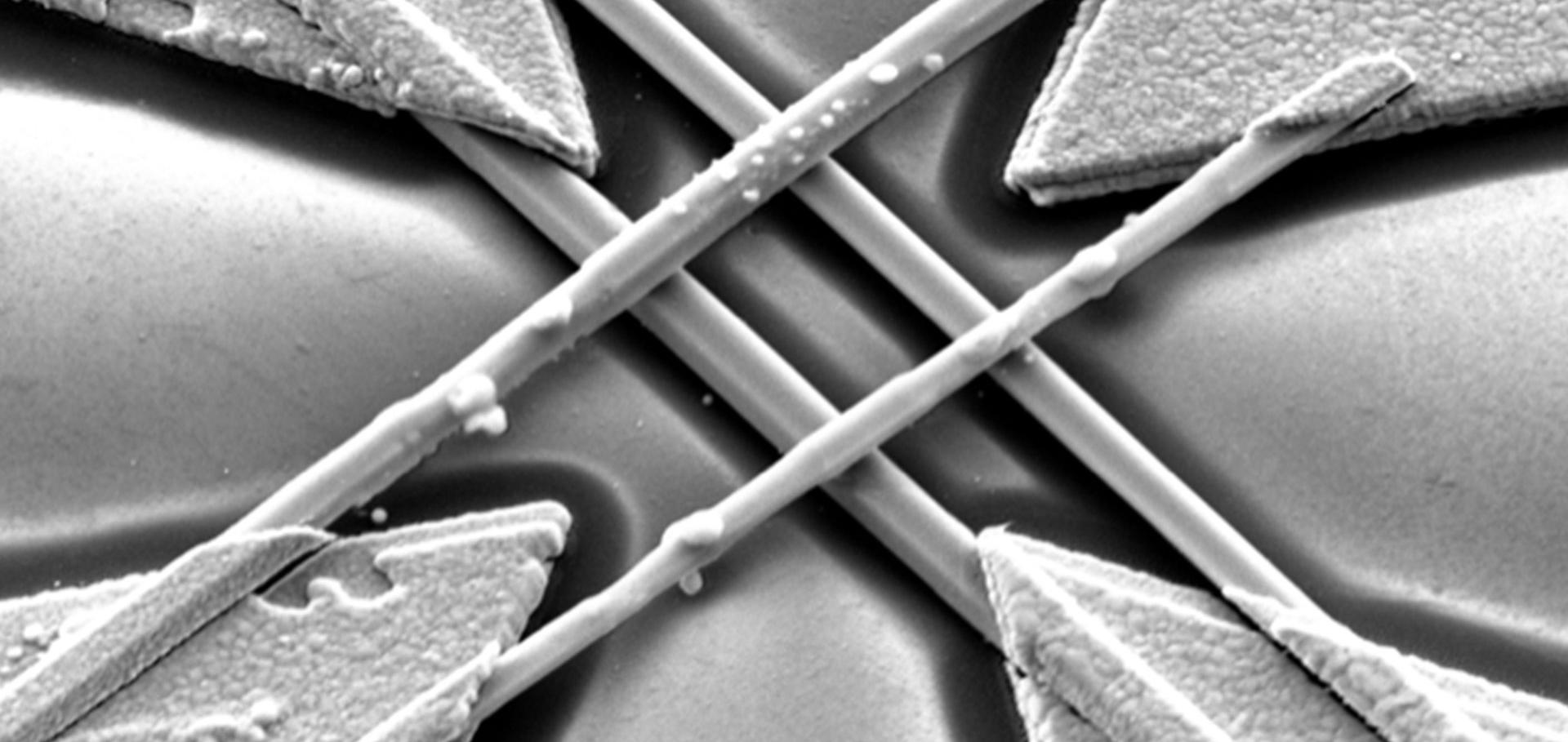
Broadband Phase-Sensitive Single InP Nanowire Photoconductive Terahertz Detectors.
Nano letters 16:8 (2016) 4925-4931
Abstract:
Terahertz time-domain spectroscopy (THz-TDS) has emerged as a powerful tool for materials characterization and imaging. A trend toward size reduction, higher component integration, and performance improvement for advanced THz-TDS systems is of increasing interest. The use of single semiconducting nanowires for terahertz (THz) detection is a nascent field that has great potential to realize future highly integrated THz systems. In order to develop such components, optimized material optoelectronic properties and careful device design are necessary. Here, we present antenna-optimized photoconductive detectors based on single InP nanowires with superior properties of high carrier mobility (∼1260 cm(2) V(-1) s(-1)) and low dark current (∼10 pA), which exhibit excellent sensitivity and broadband performance. We demonstrate that these nanowire THz detectors can provide high quality time-domain spectra for materials characterization in a THz-TDS system, a critical step toward future application in advanced THz-TDS system with high spectral and spatial resolution.Efficient perovskite solar cells by metal ion doping
ENERGY & ENVIRONMENTAL SCIENCE 9:9 (2016) 2892-2901
Electron–phonon coupling in hybrid lead halide perovskites
Nature Communications Nature Publishing Group: Nature Communications 7 (2016)
Abstract:
Phonon scattering limits charge-carrier mobilities and governs emission line broadening in hybrid metal halide perovskites. Establishing how charge carriers interact with phonons in these materials is therefore essential for the development of high-efficiency perovskite photovoltaics and low-cost lasers. Here we investigate the temperature dependence of emission line broadening in the four commonly studied formamidinium and methylammonium perovskites, HC(NH2)2PbI3, HC(NH2)2PbBr3,CH3NH3PbI3 and CH3NH3PbBr3, and discover that scattering from longitudinal optical phonons via the Fröhlich interaction is the dominant source of electron–phonon coupling near room temperature, with scattering off acoustic phonons negligible. We determine energies for the interacting longitudinal optical phonon modes to be 11.5 and 15.3 meV, and Fro¨hlich coupling constants ofB40 and 60 meV for the lead iodide and bromide perovskites, respectively. Our findings correlate well with first-principles calculations based on many-body perturbation theory, which underlines the suitability of an electronic band-structure picture for describing charge carriers in hybrid perovskites.Bandgap-Tunable Cesium Lead Halide Perovskites with High Thermal Stability for Efficient Solar Cells
ADVANCED ENERGY MATERIALS 6:8 (2016) ARTN 1502458
Effect of Structural Phase Transition on Charge-Carrier Lifetimes and Defects in CH3NH3SnI3 Perovskite.
The journal of physical chemistry letters 7:7 (2016) 1321-1326