Home
Department Of Physics text logo
  • Research
    • Our research
    • Our research groups
    • Our research in action
    • Research funding support
    • Summer internships for undergraduates
  • Study
    • Undergraduates
    • Postgraduates
  • Engage
    • For alumni
    • For business
    • For schools
    • For the public
  • Support
Menu
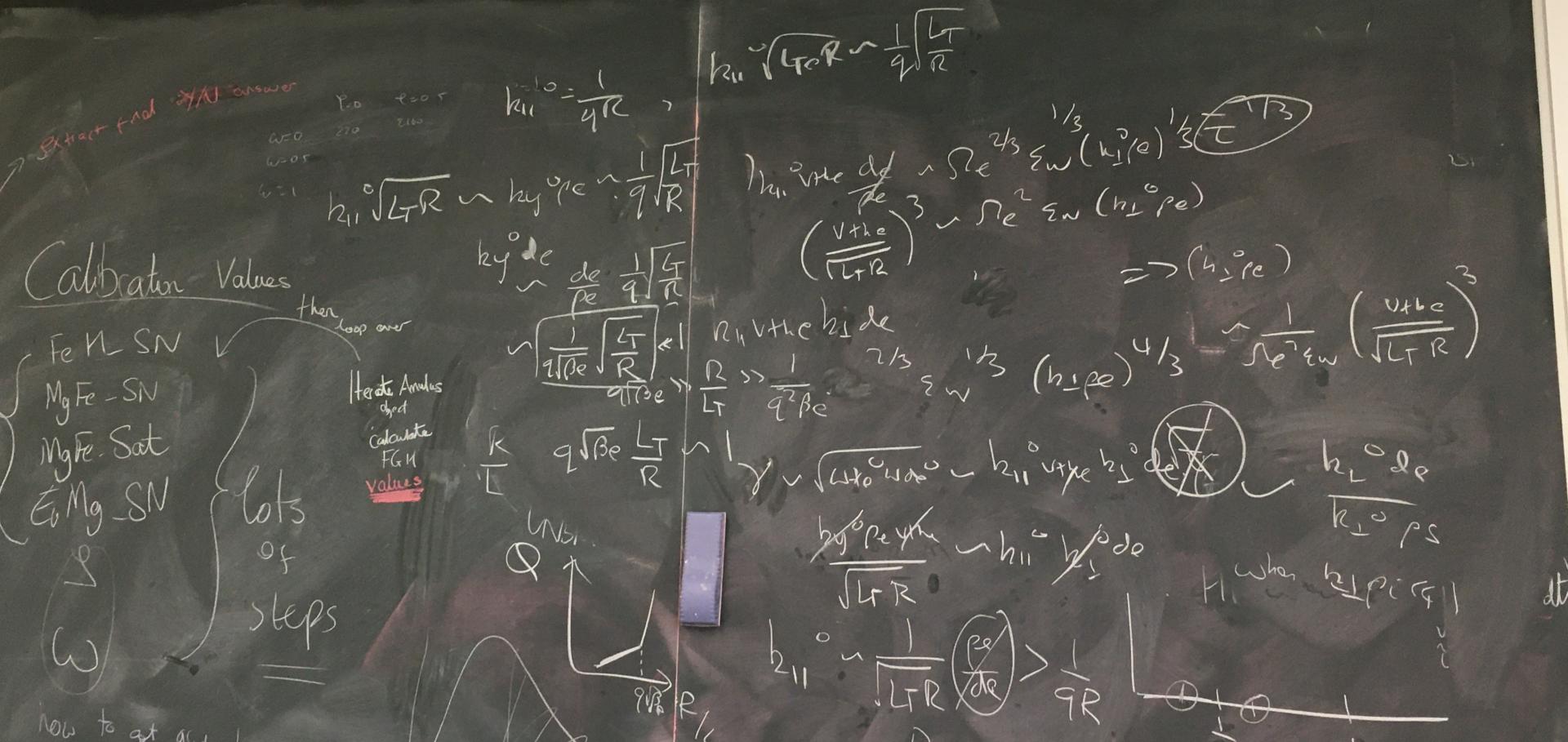
Blackboard displaying turbulence scaling calculations

Dr Toby Adkins

Visitor

Research theme

  • Plasma physics

Sub department

  • Rudolf Peierls Centre for Theoretical Physics

Research groups

  • Theoretical astrophysics and plasma physics at RPC
toby.adkins1@gmail.com
  • About
  • Publications

Scale invariance and critical balance in electrostatic drift-kinetic turbulence

Journal of Plasma Physics Cambridge University Press 89:4 (2023) 905890406

Authors:

Toby Adkins, Plamen G Ivanov, Alexander A Schekochihin

Abstract:

The equations of electrostatic drift kinetics are observed to possess a symmetry associated with their intrinsic scale invariance. Under the assumptions of spatial periodicity, stationarity, and locality, this symmetry implies a particular scaling of the turbulent heat flux with the system's parallel size, from which its scaling with the equilibrium temperature gradient can be deduced under some additional assumptions. This macroscopic transport prediction is then confirmed numerically for a reduced model of electron-temperature-gradient-driven turbulence in slab geometry. The system realises this scaling through a turbulent cascade from large to small perpendicular spatial scales. The route of this cascade through wavenumber space (i.e. the relationship between parallel and perpendicular scales in the inertial range) is shown to be determined by a balance between nonlinear-decorrelation and parallel-dissipation timescales. This type of ‘critically balanced’ cascade, which maintains a constant energy flux despite the presence of parallel dissipation throughout the inertial range (as well as order-unity dissipative losses at the outer scale) is expected to be a generic feature of plasma turbulence. The outer scale of the turbulence, on which the turbulent heat flux depends, is determined by the breaking of drift-kinetic scale invariance due to the existence of large-scale parallel inhomogeneity (the parallel system size).
More details from the publisher
Details from ORA
More details

An analytical form of the dispersion function for local linear gyrokinetics in a curved magnetic field

Journal of Plasma Physics Cambridge University Press 89:2 (2023) 905890213

Authors:

Plamen G Ivanov, Toby Adkins

Abstract:

Starting from the equations of collisionless linear gyrokinetics for magnetised plasmas with an imposed inhomogeneous magnetic field, we present the first known analytical, closed-form solution for the resulting velocity-space integrals in the presence of resonances due to both parallel streaming and constant magnetic drifts. These integrals are written in terms of the well-known plasma dispersion function (Faddeeva & Terent'ev, Tables of Values of the Function w(z)=exp(−z2)(1+2i/ √ π ∫ z 0 exp(t2)dt) for Complex Argument, 1954. Gostekhizdat. English translation: Pergamon Press, 1961; Fried & Conte, The Plasma Dispersion Function, 1961. Academic Press), rendering the subsequent expressions simpler to treat analytically and more efficient to compute numerically. We demonstrate that our results converge to the well-known ones in the straight-magnetic-field and two-dimensional limits, and show good agreement with the numerical solver by Gürcan (J. Comput. Phys., vol. 269, 2014, p. 156). By way of example, we calculate the exact dispersion relation for a simple electrostatic, ion-temperature-gradient-driven instability, and compare it with approximate kinetic and fluid models.
More details from the publisher
Details from ORA
More details

Collisionless relaxation of a Lynden-Bell plasma

Journal of Plasma Physics Cambridge University Press 88:5 (2022) 925880501

Authors:

Rj Ewart, A Brown, T Adkins, Aa Schekochihin

Abstract:

Plasmas whose Coulomb-collision rates are very small may relax on shorter timescales to non-Maxwellian quasi-equilibria, which, nevertheless, have a universal form, with dependence on initial conditions retained only via an infinite set of Casimir invariants enforcing phase-volume conservation. These are distributions derived by Lynden-Bell (Mon. Not. R. Astron. Soc., vol. 136, 1967, p. 101) via a statistical-mechanical entropy-maximisation procedure, assuming perfect mixing of phase-space elements. To show that these equilibria are reached dynamically, one must derive an effective 'collisionless collision integral' for which they are fixed points - unique and inevitable provided the integral has an appropriate H-theorem. We describe how such collision integrals are derived and what assumptions are required for them to have a closed form, how to prove the H-theorems for them, and why, for a system carrying sufficiently large electric-fluctuation energy, collisionless relaxation should be fast. It is suggested that collisionless dynamics may favour maximising entropy locally in phase space before converging to global maximum-entropy states. Relaxation due to interspecies interaction is examined, leading, inter alia, to spontaneous transient generation of electron currents. The formalism also allows efficient recovery of 'true' collision integrals for both classical and quantum plasmas.
More details from the publisher
Details from ORA
More details
More details

Electromagnetic instabilities and plasma turbulence driven by electron-temperature gradient

Journal of Plasma Physics Cambridge University Press 88:4 (2022) 905880410

Authors:

T Adkins, AA Schekochihin, Pg Ivanov, Cm Roach

Abstract:

Electromagnetic (EM) instabilities and turbulence driven by the electron-temperature gradient (ETG) are considered in a local slab model of a tokamak-like plasma. Derived in a low-beta asymptotic limit of gyrokinetics, the model describes perturbations at scales both larger and smaller than the electron inertial length de, but below the ion Larmor scale ρi, capturing both electrostatic and EM regimes of turbulence. The well-known electrostatic instabilities – slab and curvature-mediated ETG – are recovered, and a new instability is found in the EM regime, called the thermo-Alfvénic instability (TAI). It exists in both a slab version (sTAI, destabilising kinetic Alfvén waves) and a curvature-mediated version (cTAI), which is a cousin of the (electron-scale) kinetic ballooning mode. The cTAI turns out to be dominant at the largest scales covered by the model (greater than de but smaller than ρi), its physical mechanism hinging on the fast equalisation of the total temperature along perturbed magnetic field lines (in contrast to kinetic ballooning mode, which is pressure balanced). A turbulent cascade theory is then constructed, with two energy-injection scales: de, where the drivers are slab ETG and sTAI, and a larger (parallel system size dependent) scale, where the driver is cTAI. The latter dominates the turbulent transport if the temperature gradient is greater than a certain critical value, which scales inversely with the electron beta. The resulting heat flux scales more steeply with the temperature gradient than that due to electrostatic ETG turbulence, giving rise to stiffer transport. This can be viewed as a physical argument in favour of near-marginal steady-state in electron-transport-controlled plasmas (e.g. the pedestal). While the model is simplistic, the new physics that is revealed by it should be of interest to those attempting to model the effect of EM turbulence in tokamak-relevant configurations with high beta and large ETGs.
More details from the publisher
Details from ORA
More details
More details
Details from ArXiV

Extended electron tails in electrostatic microinstabilities and the nonadiabatic response of passing electrons

Plasma Physics and Controlled Fusion IOP Publishing 64:5 (2022) 055004-055004

Authors:

MR Hardman, FI Parra, C Chong, T Adkins, MS Anastopoulos-Tzanis, M Barnes, D Dickinson, JF Parisi, H Wilson

Abstract:

Abstract Ion-gyroradius-scale microinstabilities typically have a frequency comparable to the ion transit frequency. Due to the small electron-to-ion mass ratio and the large electron transit frequency, it is conventionally assumed that passing electrons respond adiabatically in ion-gyroradius-scale modes. However, in gyrokinetic simulations of ion-gyroradius-scale modes in axisymmetric toroidal magnetic fields, the nonadiabatic response of passing electrons can drive the mode, and generate fluctuations in narrow radial layers, which may have consequences for turbulent transport in a variety of circumstances. In flux tube simulations, in the ballooning representation, these instabilities reveal themselves as modes with extended tails. The small electron-to-ion mass ratio limit of linear gyrokinetics for electrostatic instabilities is presented, in axisymmetric toroidal magnetic geometry, including the nonadiabatic response of passing electrons and associated narrow radial layers. This theory reveals the existence of ion-gyroradius-scale modes driven solely by the nonadiabatic passing electron response, and recovers the usual ion-gyroradius-scale modes driven by the response of ions and trapped electrons, where the nonadiabatic response of passing electrons is small. The collisionless and collisional limits of the theory are considered, demonstrating parallels in structure and physical processes to neoclassical transport theory. By examining initial-value simulations of the fastest-growing eigenmodes, the predictions for mass-ratio scaling are tested and verified numerically for a range of collision frequencies. Insight from the small electron-to-ion mass ratio theory may lead to a computationally efficient treatment of extended modes.
More details from the publisher

Pagination

  • Current page 1
  • Page 2
  • Next page Next
  • Last page Last

Footer Menu

  • Contact us
  • Giving to the Dept of Physics
  • Work with us
  • Media

User account menu

  • Log in

Follow us

FIND US

Clarendon Laboratory,

Parks Road,

Oxford,

OX1 3PU

CONTACT US

Tel: +44(0)1865272200

University of Oxfrod logo Department Of Physics text logo
IOP Juno Champion logo Athena Swan Silver Award logo

© University of Oxford - Department of Physics

Cookies | Privacy policy | Accessibility statement

Built by: Versantus

  • Home
  • Research
  • Study
  • Engage
  • Our people
  • News & Comment
  • Events
  • Our facilities & services
  • About us
  • Giving to Physics
  • Current students
  • Staff intranet