Home
Department Of Physics text logo
  • Research
    • Our research
    • Our research groups
    • Our research in action
    • Research funding support
    • Summer internships for undergraduates
  • Study
    • Undergraduates
    • Postgraduates
  • Engage
    • For alumni
    • For business
    • For schools
    • For the public
  • Support
Menu
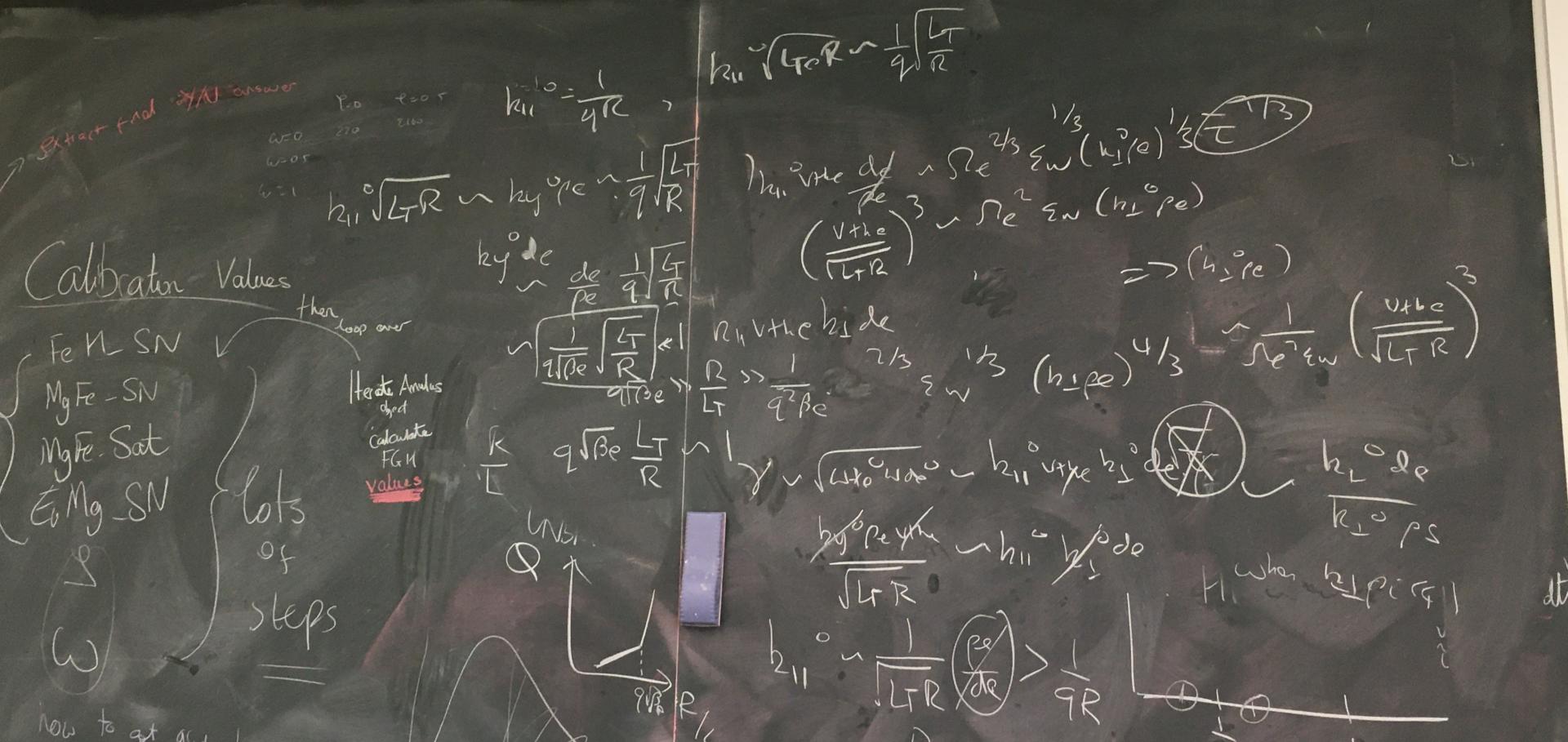
Blackboard displaying turbulence scaling calculations

Dr Toby Adkins

Visitor

Research theme

  • Plasma physics

Sub department

  • Rudolf Peierls Centre for Theoretical Physics

Research groups

  • Theoretical astrophysics and plasma physics at RPC
toby.adkins1@gmail.com
  • About
  • Publications

Extended electron tails in electrostatic microinstabilities and the nonadiabatic response of passing electrons

Plasma Physics and Controlled Fusion IOP Publishing 64:5 (2022) 055004

Authors:

Mr Hardman, Fi Parra, C Chong, T Adkins, Ms Anastopoulos-Tzanis, M Barnes, D Dickinson, Jf Parisi, H Wilson

Abstract:

Ion-gyroradius-scale microinstabilities typically have a frequency comparable to the ion transit frequency. Due to the small electron-to-ion mass ratio and the large electron transit frequency, it is conventionally assumed that passing electrons respond adiabatically in ion-gyroradius-scale modes. However, in gyrokinetic simulations of ion-gyroradius-scale modes in axisymmetric toroidal magnetic fields, the nonadiabatic response of passing electrons can drive the mode, and generate fluctuations in narrow radial layers, which may have consequences for turbulent transport in a variety of circumstances. In flux tube simulations, in the ballooning representation, these instabilities reveal themselves as modes with extended tails. The small electron-to-ion mass ratio limit of linear gyrokinetics for electrostatic instabilities is presented, in axisymmetric toroidal magnetic geometry, including the nonadiabatic response of passing electrons and associated narrow radial layers. This theory reveals the existence of ion-gyroradius-scale modes driven solely by the nonadiabatic passing electron response, and recovers the usual ion-gyroradius-scale modes driven by the response of ions and trapped electrons, where the nonadiabatic response of passing electrons is small. The collisionless and collisional limits of the theory are considered, demonstrating parallels in structure and physical processes to neoclassical transport theory. By examining initial-value simulations of the fastest-growing eigenmodes, the predictions for mass-ratio scaling are tested and verified numerically for a range of collision frequencies. Insight from the small electron-to-ion mass ratio theory may lead to a computationally efficient treatment of extended modes.
More details from the publisher
Details from ORA
More details
Details from ArXiV

A solvable model of Vlasov-kinetic plasma turbulence in Fourier-Hermite phase space

Journal of Plasma Physics Cambridge University Press 84:1 (2018) 905840107

Authors:

Toby Adkins, Alexander Schekochihin

Abstract:

A class of simple kinetic systems is considered, described by the 1D Vlasov--Landau equation with Poisson or Boltzmann electrostatic response and an energy source. Assuming a stochastic electric field, a solvable model is constructed for the phase-space turbulence of the particle distribution. The model is a kinetic analog of the Kraichnan--Batchelor model of chaotic advection. The solution of the model is found in Fourier--Hermite space and shows that the free-energy flux from low to high Hermite moments is suppressed, with phase mixing cancelled on average by anti-phase-mixing (stochastic plasma echo). This implies that Landau damping is an ineffective dissipation channel at wave numbers below a certain cut off (analog of Kolmogorov scale), which increases with the amplitude of the stochastic electric field and scales as inverse square of the collision rate. The full Fourier--Hermite spectrum is derived. Its asymptotics are $m^{-3/2}$ at low wave numbers and high Hermite moments ($m$) and $m^{-1/2}k^{-2}$ at low Hermite moments and high wave numbers ($k$). The energy distribution and flows in phase space are a simple and, therefore, useful example of competition between phase mixing and nonlinear dynamics in kinetic turbulence, reminiscent of more realistic but more complicated multi-dimensional systems that have not so far been amenable to complete analytical solution.
More details from the publisher
Details from ORA
More details
More details
Details from ArXiV

Pagination

  • First page First
  • Previous page Prev
  • Page 1
  • Current page 2

Footer Menu

  • Contact us
  • Giving to the Dept of Physics
  • Work with us
  • Media

User account menu

  • Log in

Follow us

FIND US

Clarendon Laboratory,

Parks Road,

Oxford,

OX1 3PU

CONTACT US

Tel: +44(0)1865272200

University of Oxfrod logo Department Of Physics text logo
IOP Juno Champion logo Athena Swan Silver Award logo

© University of Oxford - Department of Physics

Cookies | Privacy policy | Accessibility statement

Built by: Versantus

  • Home
  • Research
  • Study
  • Engage
  • Our people
  • News & Comment
  • Events
  • Our facilities & services
  • About us
  • Giving to Physics
  • Current students
  • Staff intranet