

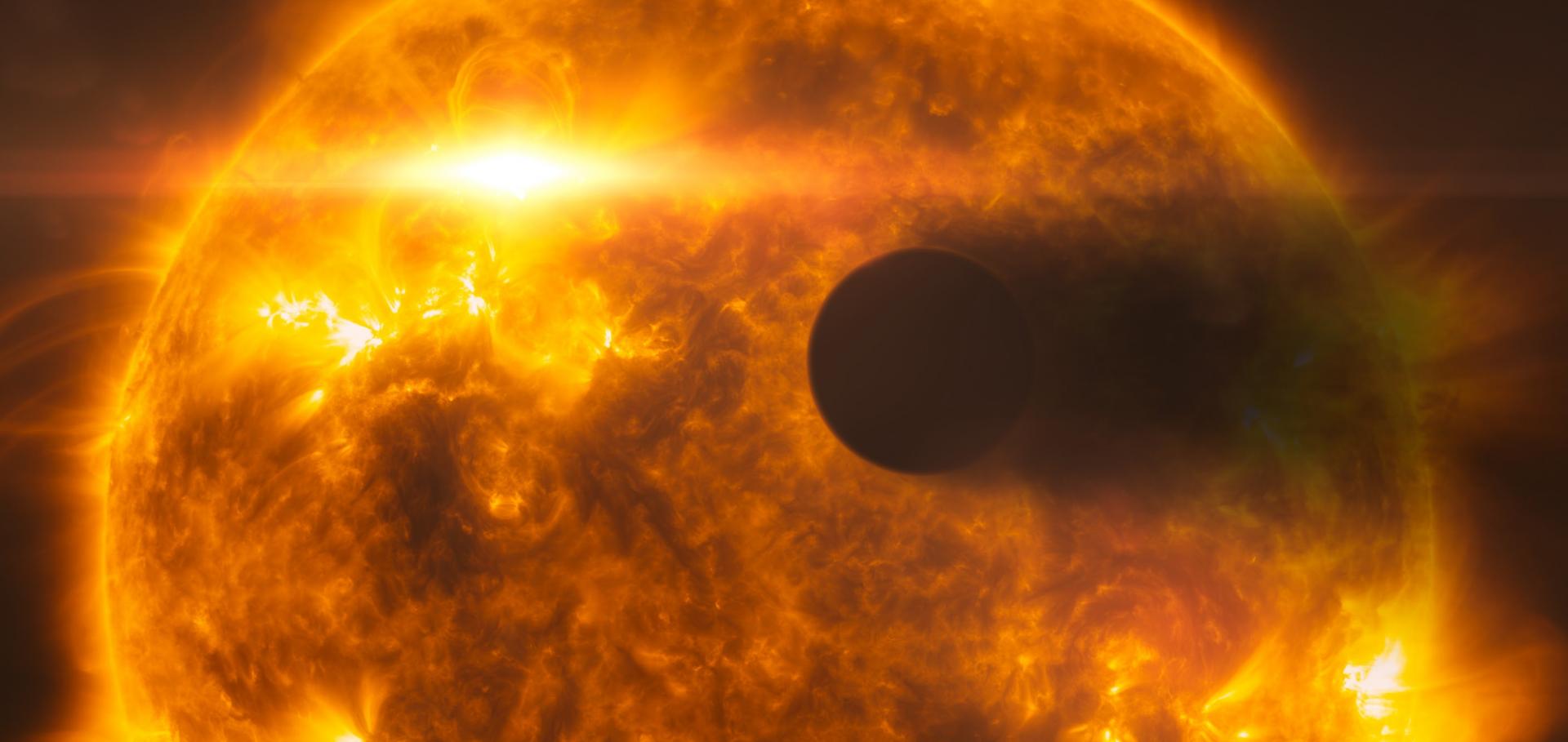

A Neptune Sized Planet Candidate Orbiting K-dwarf TIC 392664683 from TESS Data
Research Notes of the AAS American Astronomical Society 10:10 (2026) 284
Abstract:
This research note presents a new planet candidate orbiting the K-dwarf TIC 392664683, which was discovered by citizen scientists as part of the Planet Hunter TESS (PHT) project. Three transit-like events were observed in Sectors 38, 65 and 102; the available data imply that the orbital period must be either 23 or 46 days. The transit depth of 1964−212+433 ppm and duration of 5.4−0.2+0.4 hr are consistent across the three sectors spanning almost five years of TESS data. Using a stellar radius of 0.7740 ± 0.0168R⊙ we derive a planetary radius between 3.5 and 4.2 R⊕, approximately the same as Neptune. Comprehensive vetting mitigates the risk that this is a false positive and supports the candidate’s likely planetary nature.Measuring masses of transiting Earth-like planets: first insights from the PLATO RV Data Challenge
Monthly Notices of the Royal Astronomical Society Oxford University Press (OUP) (2026) stag1543
Abstract:
Abstract The PLATO Stellar Variability Mitigation Working Group designed a radial-velocity (RV) data challenge to assess the precision and accuracy achievable on RV semi-amplitudes in the context of the future PLATO follow-up. Using Sun-as-a-star observations obtained with HARPS-N, we generated three multi-planet systems with realistic sampling, an effective signal-to-noise ratio of S/N ~ 450, an exposure time of Texp = 15 minutes, and a total of N ~ 1000 observations. The resulting data set is publicly available and can serve as a benchmark for the community to test and compare RV analysis methods. Eight independent teams participated in the challenge, aiming to recover the semi-amplitudes of both transiting and non-transiting planets. A meta-analysis of the submitted results shows that, with current data analysis methods, HARPS-N-like stability and the observing strategy studied in this paper, achieving a precision on semi-amplitudes better than 10% for habitable-zone signals around a solar-type star is challenging, and is typically limited to planets with masses of ~8–10 $\rm{$\mathrm{M}_{\oplus }$}$. This performance is expected to improve for K dwarfs, where planets down to ~2–5 $\rm{$\mathrm{M}_{\oplus }$}$ may be characterized at a similar level of precision. Finally, based on the results of this challenge and the occurrence of false positives, we derive an empirical detection threshold for RV surveys, which can be used to distinguish robust planetary detections from candidates.Spin–Orbit Geometry of AU Mic b and c from Back-to-back Transits Observed Contemporaneously with Magellan PFS, LCOGT, and CHEOPS
The Astrophysical Journal Letters American Astronomical Society 1005:1 (2026) l25
Abstract:
Young planets offer a unique window into the early stages of planetary evolution. AU Mic is one of the nearest (9.8 pc) pre-main-sequence stars (∼20 Myr), hosting two transiting Neptune-sized planets and a debris disk. Previous studies have shown that the rotations of the central star, the debris disk, and the inner planet b are all aligned, suggesting that the system has not undergone violent evolution. Here we report new Rossiter–McLaughlin measurements for both AU Mic b and c, which happened to transit back-to-back on 2024 August 24 and 25, using the Magellan Planet Finder Spectrograph, together with contemporaneous photometry from LCOGT and CHEOPS. We confirm the aligned orbit of AU Mic b (λb = 1∘ ± 12∘) and find two possible solutions for AU Mic c: we slightly favor an aligned solution (λc = −10∘ ± 16∘) but cannot rule out a polar solution ( λc=87∘−29∘+36∘ ). Broader considerations, including dynamical stability and transit possibility, also support the mutually aligned scenario. An unexpected stellar signal during ingress and the poor transit-timing variation predictions of AU Mic c prevent a precise constraint on its obliquity, and various attempts using chromatic spectral analyses fail to outperform simple data exclusion in mitigating stellar contamination. Our observation highlights the importance of understanding stellar activity across multiple timescales and channels when characterizing young, active systems. A robust solution for the AU Mic architecture will require either a better understanding of stellar activity or future observations fortuitously free from strong stellar contamination.Atmospheric characterisation of HIP 67522 b with VLT/CRIRES+
Astronomy & Astrophysics EDP Sciences 710 (2026) a85
Abstract:
Context . Young transiting exoplanets provide unique opportunities to probe planetary atmospheres during critical early phases of evolution when atmospheric escape and contraction are most active. HIP 67522 b, a 17 Myr old hot Jupiter with an extraordinarily low bulk density (<0.20 g cm −3 ), represents an ideal target for high-resolution transmission spectroscopy. Aims . We aim to constrain the mass and characterise the atmospheric composition, thermal structure, and dynamics of HIP 67522 b using ground-based high-resolution near-infrared spectroscopy with VLT/CRIRES+, complementing recent JWST observations. Methods . We obtained 92 high-resolution spectra ( R ≈ 10 5 ) with VLT/CRIRES+ in the K2166 band during a transit on 30 January 2025. We applied cross-correlation techniques and Bayesian nested sampling retrievals to constrain molecular abundances, temperature structure, and atmospheric dynamics. Results . We detected H 2 O at 20σ and CO at 5σ, confirming the extremely extended atmosphere of this low-mass giant. A velocity offset of −2.9 ± 0.2 km s −1 indicates day-to-night winds. The rotation velocity has been constrained to <1.8 km s −1 at 3σ, consistent with tidal locking. The retrieval analysis suggests a planetary mass of 27.7 −5.5 +5.9 Earth masses and statistically favours a two-temperature atmospheric structure with a discrete change at mbar pressures over an isothermal profile. This mass is twice as high as the mass estimated from JWST atmospheric observations and inconsistent at 3 σ , casting doubt on the actual planetary density of the planet. No matter the choice of atmospheric model, we derived a supersolar C/O ratio that is about 1.5 times solar, along with a supersolar metallicity that might further increase if the atmosphere is cloudy, which is a degeneracy that our data alone cannot resolve. We report a tentative 2 σ detection of HDO with an extreme enrichment factor of ∼1000 relative to the protosolar D/H ratio. If confirmed, this would be the first detection of deuterium in an exoplanet atmosphere and would require an intense escape rate to confirm its presence.Assessment of PLATO Science Performance
(2026)