Home
Department Of Physics text logo
  • Research
    • Our research
    • Our research groups
    • Our research in action
    • Research funding support
    • Summer internships for undergraduates
  • Study
    • Undergraduates
    • Postgraduates
  • Engage
    • For young people
    • For teachers
    • For the public
    • For alumni
    • For business
  • Support
Menu
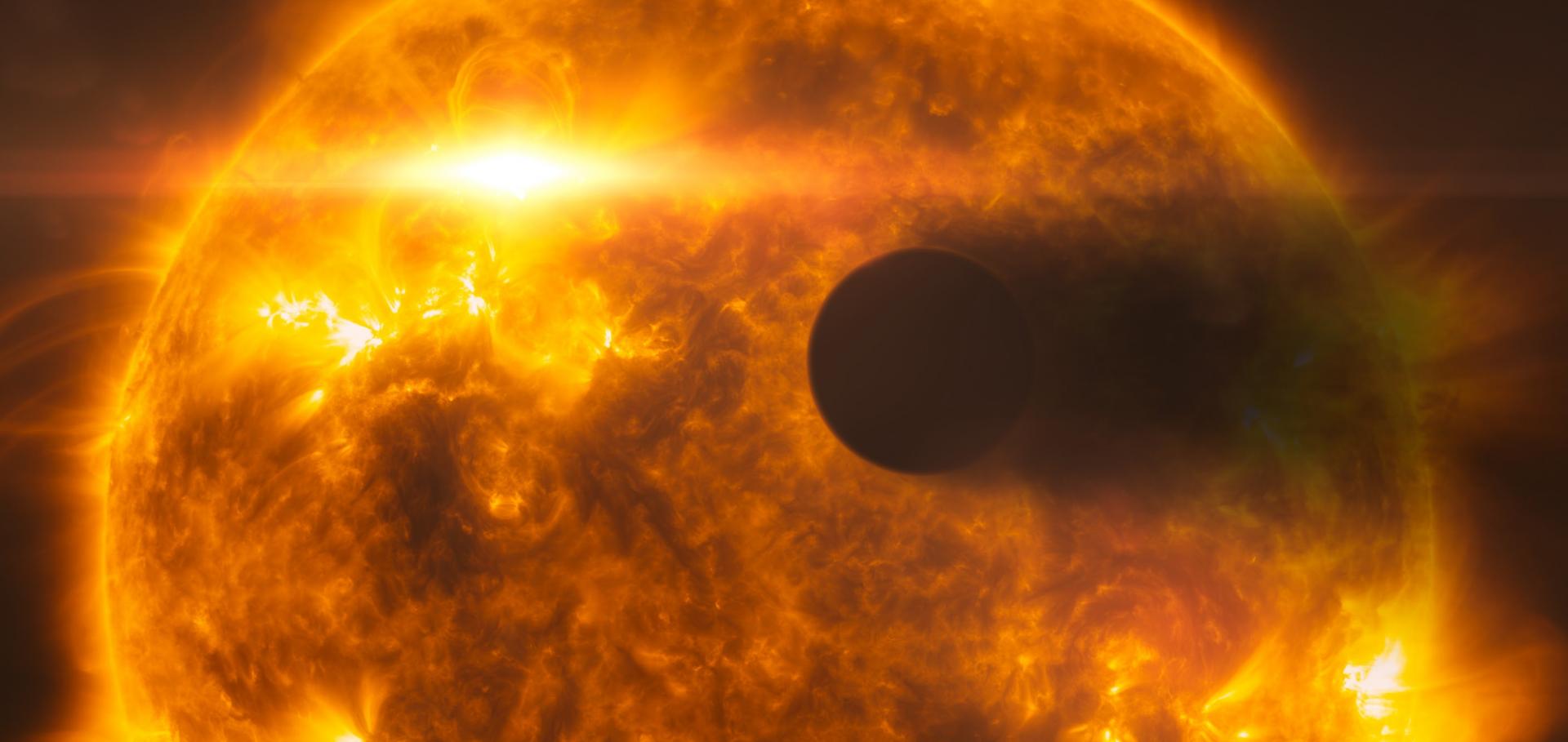
Stellar_flare_hits_HD_189733_b_(artist's_impression)

This artist's impression shows the hot Jupiter HD 189733b, as it passes in front of its parent star, as the latter is flaring, driving material away from the planet. The escaping atmosphere is seen silhouetted against the starlight. The surface of the star, which is around 80% the mass of the Sun, is based on observations of the Sun from NASA's Solar Dynamics Observatory.

Credit: NASA, ESA, L. Calçada, Solar Dynamics Observatory

Prof Suzanne Aigrain

Professor of Astrophysics

Research theme

  • Astronomy and astrophysics
  • Exoplanets and planetary physics

Sub department

  • Astrophysics

Research groups

  • Exoplanets and Stellar Physics
Suzanne.Aigrain@physics.ox.ac.uk
Telephone: 01865 (2)73339
Denys Wilkinson Building, room 762
Stars & Planets @ Oxford research group website
  • About
  • Publications

Gas-depleted planet formation occurred in the four-planet system around the red dwarf LHS 1903

Science American Association for the Advancement of Science 392:6795 (2026) eadl2348

Authors:

Thomas G Wilson, Anna M Simpson, Andrew Collier Cameron, Ryan Cloutier, Vardan Adibekyan, Ancy Anna John, Yann Alibert, Manu Stalport, Jo Ann Egger, Andrea Bonfanti, Nicolas Billot, Pascal Guterman, Pierre FL Maxted, Attila E Simon, Sérgio G Sousa, Malcolm Fridlund, Mathias Beck, Anja Bekkelien, Sébastien Salmon, Valérie Van Grootel, Luca Fossati, Alexander James Mustill, Hugh P Osborn, Tiziano Zingales, Matthew J Hooton, Laura Affer, Suzanne Aigrain, Roi Alonso, Guillem Anglada, Alexandros Antoniadis-Karnavas, Tamas Bárczy, David Barrado Navascues, Susana CC Barros, Wolfgang Baumjohann, Thomas Beck, Willy Benz, Federico Biondi, Xavier Bonfils, Luca Borsato, Alexis Brandeker, Christopher Broeg, Lars A Buchhave, Maximilian Buder, Juan Cabrera, Sebastian Carrazco Gaxiola, David Charbonneau, Sébastien Charnoz, David R Ciardi, Karen A Collins, Kevin I Collins

Abstract:

The radii of small exoplanets form two populations, super-Earths and sub-Neptunes, separated by a gap known as the radius valley. This could be produced by the removal of some atmospheres by stellar or internal heating, or the lack of an initial envelope. We use transit photometry and radial velocity measurements to detect and characterize four exoplanets orbiting LHS 1903, a red dwarf star in the Milky Way's thick disk. The planets have orbital periods from 2.2 to 29.3 days, and span the radius valley within a single planetary system. The derived densities indicate that LHS 1903 b is rocky, while LHS 1903 c and LHS 1903 d have extended atmospheres. The most distant planet from the host star, LHS 1903 e, has no gaseous envelope, indicating it formed from gas-depleted material.
More details from the publisher
Details from ORA
More details
More details

Gas-depleted planet formation occurred in the four-planet system around the red dwarf LHS 1903

(2026)

Authors:

Thomas G Wilson, Anna M Simpson, Andrew Collier Cameron, Ryan Cloutier, Vardan Adibekyan, Ancy Anna John, Yann Alibert, Manu Stalport, Jo Ann Egger, Andrea Bonfanti, Nicolas Billot, Pascal Guterman, Pierre FL Maxted, Attila E Simon, Sergio G Sousa, Malcolm Fridlund, Mathias Beck, Anja Bekkelien, Sebastien Salmon, Valerie Van Grootel, Luca Fossati, Alexander James Mustill, Hugh P Osborn, Tiziano Zingales, Matthew J Hooton, Laura Affer, Suzanne Aigrain, Roi Alonso, Guillem Anglada, Alexandros Antoniadis-Karnavas, Tamas Barczy, David Barrado Navascues, Susana CC Barros, Wolfgang Baumjohann, Thomas Beck, Willy Benz, Federico Biondi, Xavier Bonfils, Luca Borsato, Alexis Brandeker, Christopher Broeg, Lars A Buchhave, Maximilian Buder, Juan Cabrera, Sebastian Carrazco Gaxiola, David Charbonneau, Sebastien Charnoz, David R Ciardi, Karen A Collins, Kevin I Collins, Rosario Cosentino, Szilard Csizmadia, Patricio E Cubillos, Shweta Dalal, Mario Damasso, James RA Davenport, Melvyn B Davies, Magali Deleuil, Laetitia Delrez, Olivier DS Demangeon, Brice-Olivier Demory, Victoria DiTomasso, Diana Dragomir, Courtney D Dressing, Xavier Dumusque, David Ehrenreich, Anders Erikson, Emma Esparza-Borges, Andrea Fortier, Izuru Fukuda, Akihiko Fukui, Davide Gandolfi, Adriano Ghedina, Steven Giacalone, Holden Gill, Michael Gillon, Yilen Gomez Maqueo Chew, Manuel Gudel, Pere Guerra, Maximilian N Gunther, Nathan Hara, Avet Harutyunyan, Yuya Hayashi, Raphaelle D Haywood, Rae Holcomb, Keith Horne, Sergio Hoyer, Chelsea X Huang, Masahiro Ikoma, Kate G Isaak, James AG Jackman, Jon M Jenkins, Eric LN Jensen, Daniel Jontof-Hutter, Yugo Kawai, Laszlo L Kiss, Ben S Lakeland, Jacques Laskar, David W Latham, Alain Lecavelier des Etangs, Adrien Leleu, Monika Lendl, Jerome de Leon, Florian Lienhard, Mercedes Lopez-Morales, Christophe Lovis, Michael B Lund, Rafael Luque, Demetrio Magrin, Luca Malavolta, Aldo F Martınez Fiorenzano, Andrew W Mayo, Michel Mayor, Christoph Mordasini, Annelies Mortier, Felipe Murgas, Norio Narita, Valerio Nascimbeni, Belinda A Nicholson, Goran Olofsson, Roland Ottensamer, Isabella Pagano, Larissa Palethorpe, Enric Palle, Hannu Parviainen, Marco Pedani, Francesco A Pepe, Gisbert Peter, Matteo Pinamonti, Giampaolo Piotto, Don Pollacco, Ennio Poretti, Didier Queloz, Samuel N Quinn, Roberto Ragazzoni, Nicola Rando, David Rapetti, Francesco Ratti, Heike Rauer, Federica Rescigno, Ignasi Ribas, Ken Rice, George R Ricker, Paul Robertson, Thierry de Roche, Laurence Sabin, Nuno C Santos, Dimitar D Sasselov, Arjun B Savel, Gaetano Scandariato, Nicole Schanche, Urs Schroffenegger, Richard P Schwarz, Sara Seager, Ramotholo Sefako, Damien Segransan, Avi Shporer, Andre M Silva, Alexis MS Smith, Alessandro Sozzetti, Manfred Steller, Gyula M Szabo, Motohide Tamura, Nicolas Thomas, Amy Tuson, Stephane Udry, Andrew Vanderburg, Roland K Vanderspek, Julia Venturini, Francesco Verrecchia, Nicholas A Walton, Christopher A Watson, Robert D Wells, Joshua N Winn, Roberto Zambelli, Carl Ziegler

Atmospheric characterization of HIP 67522 b with VLT/CRIRES+. VLT/CRIRES+ suggests a heavier planet and hints at deuterium fractionation

(2026)

Authors:

A Lavail, F Debras, B Klein, E Chabrol, S Vinatier, T Hood, A Masson, JV Seidel, C Moutou, S Aigrain, A Meech, O Barragán
Details from ArXiV

Mass estimates of the young TOI-451 transiting planets: multidimensional Gaussian Process on stellar spectroscopic and photometric signals

Monthly Notices of the Royal Astronomical Society Oxford University Press 546:2 (2026) stag087

Authors:

Oscar Barragán, Manuel Mallorquín, Jorge Fernández-Fernández, Faith Hawthorn, Alix V Freckelton, Marina Lafarga, Michael Cretignier, Yoshi NE Eschen, Samuel Gill, Víctor JS Béjar, Nicolas Lodieu, Haochuan Yu, Thomas G Wilson, David Anderson, Ioannis Apergis, Matthew Battley, Edward M Bryant, Pía Cortés-Zuleta, Edward Gillen, James S Jenkins, Baptiste Klein, James McCormac, Annabella Meech, Erik Meier-Valdés, Suzanne Aigrain

Abstract:

The young TOI-451 planetary system, aged 125 Myr, provides a unique opportunity to test theories of planetary internal structures and atmospheric mass-loss through examination of its three transiting planets. We present an exhaustive photometric and spectroscopic follow-up to determine the orbital and physical properties of the system. We perform multidimensional Gaussian Process regression with the code pyaneti on spectroscopic time-series and NGTS/LCO light curves to disentangle the stellar and planetary signal in ESPRESSO radial velocities. We show how contemporaneous photometry serves as an activity indicator to inform RV modelling within a multidimensional Gaussian Processes framework. We argue that this can be exploited when spectroscopic observations are adversely affected by low signal-to-noise and/or poor sampling. We estimate the Doppler semi-amplitudes of , , and . This translates in 2 mass estimates for TOI-451 b and d of and ; as well as a mass upper limit for TOI-451 c of . The derived planetary properties suggest that planets c and d contain significant hydrogen-rich envelopes. The inferred parameters of TOI-451 b are consistent with either a rocky world that still retains a small hydrogen envelope or a water world. These insights make the TOI-451 system an ideal laboratory for future follow-up studies aimed at measuring atmospheric compositions, detecting atmospheric mass-loss signatures, and further exploring planetary formation and evolution processes.
More details from the publisher
Details from ORA
More details

Mass estimates of the young TOI-451 transiting planets: Multidimensional Gaussian Process on stellar spectroscopic and photometric signals

(2026)

Authors:

Oscar Barragán, Manuel Mallorquín, Jorge Fernández-Fernández, Faith Hawthorn, Alix V Freckelton, Marina Lafarga, Michael Cretignier, Yoshi NE Eschen, Samuel Gill, Víctor JS Béjar, Nicolas Lodieu, Haochuan Yu, Thomas G Wilson, David Anderson, Ioannis Apergis, Matthew Battley, Edward M Bryant, Pía Cortés-Zuleta, Edward Gillen, James S Jenkins, Baptiste Klein, James McCormac, Annabella Meech, Erik Meier-Valdés, Maximiliano Moyano, Annelies Mortier, Felipe Murgas, Louise D Nielsen, Suman Saha, Josà I Vines, Richard West, Peter J Wheatley, Suzanne Aigrain
More details from the publisher
Details from ArXiV

Pagination

  • First page First
  • Previous page Prev
  • Page 1
  • Current page 2
  • Page 3
  • Page 4
  • Page 5
  • Page 6
  • Page 7
  • Page 8
  • Page 9
  • …
  • Next page Next
  • Last page Last

Footer Menu

  • Contact us
  • Giving to the Dept of Physics
  • Work with us
  • Media

User account menu

  • Log in

Follow us

FIND US

Clarendon Laboratory,

Parks Road,

Oxford,

OX1 3PU

CONTACT US

Tel: +44(0)1865272200

University of Oxfrod logo Department Of Physics text logo
IOP Juno Champion logo Athena Swan Silver Award logo

© University of Oxford - Department of Physics

Cookies | Privacy policy | Accessibility statement

Built by: Versantus

  • Home
  • Research
  • Study
  • Engage
  • Our people
  • News & Comment
  • Events
  • Our facilities & services
  • About us
  • Giving to Physics
  • Current students
  • Staff intranet