Home
Department Of Physics text logo
  • Research
    • Our research
    • Our research groups
    • Our research in action
    • Research funding support
    • Summer internships for undergraduates
  • Study
    • Undergraduates
    • Postgraduates
  • Engage
    • For young people
    • For teachers
    • For the public
    • For alumni
    • For business
  • Support
Menu
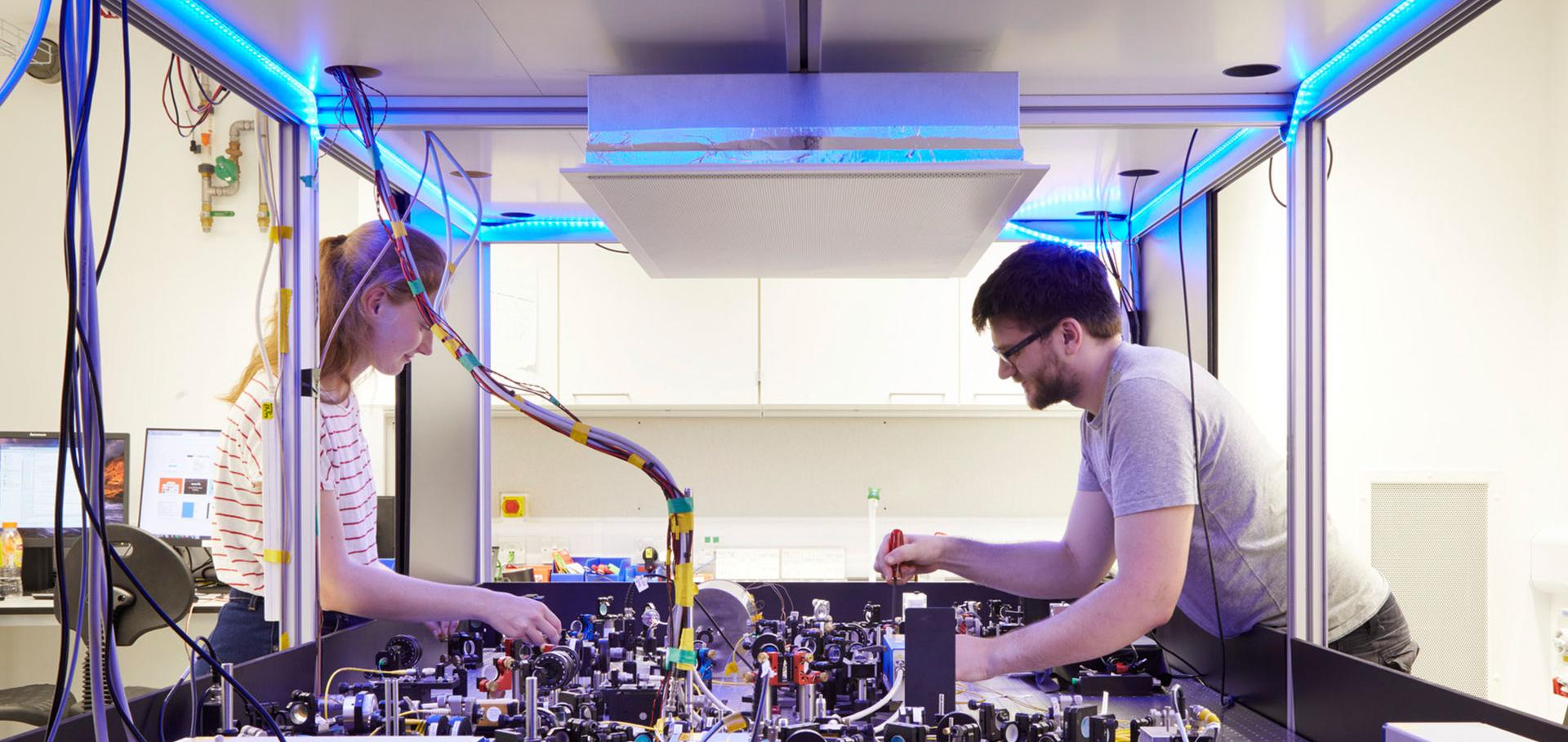
Atomic and Laser Physics
Credit: Jack Hobhouse

Charles Heaton

Graduate Student

Research theme

  • Lasers and high energy density science
  • Plasma physics

Sub department

  • Atomic and Laser Physics

Research groups

  • Laboratory astroparticle physics
  • Oxford Centre for High Energy Density Science (OxCHEDS)
charles.heaton@physics.ox.ac.uk
Clarendon Laboratory
  • About
  • Publications

Bounds on heavy axions with an X-ray free electron laser

Physical Review Letters American Physical Society 134:5 (2025) 55001

Authors:

Jack WD Halliday, Giacomo Marocco, Konstantin A Beyer, Charles Heaton, Motoaki Nakatsutsumi, Thomas R Preston, Charles Arrowsmith, Carsten Baehtz, Sebastian Goede, Oliver Humphries, Alejandro Laso Garcia, Richard Plackett, Pontus Svensson, Georgios Vacalis, Justin Wark, Daniel Wood, Ulf Zastrau, Robert Bingham, Ian Shipsey, Subir Sarkar, Gianluca Gregori

Abstract:

We present new exclusion bounds obtained at the European X-Ray Free Electron Laser facility (EuXFEL) on axionlike particles in the mass range $10^{-3}\,\mathrm{eV} \lesssim m_a \lesssim 10^{4}\,\mathrm{eV}$. Our experiment exploits the Primakoff effect via which photons can, in the presence of a strong external electric field, decay into axions, which then convert back into photons after passing through an opaque wall. While similar searches have been performed previously at a third-generation synchrotron [Yamaji et al., Phys.\ Lett.\ B 782, 523 (2018)], our work demonstrates improved sensitivity, exploiting the higher brightness of x-rays at EuXFEL.
More details from the publisher
Details from ORA
More details
More details

Theory of x-ray photon correlation spectroscopy for multiscale flows

Physical Review Research American Physical Society 7 (2025) 023202

Authors:

Yin, Charles Heaton, Gianluca Gregori

Abstract:

Complex multiscale flows associated with instabilities and turbulence are commonly induced under High Energy Density (HED) conditions, but accurate measurement of their transport properties has been challenging. X-ray Photon Correlation Spectroscopy (XPCS) with coherent X-ray sources can, in principle, probe material dynamics to infer transport properties using time autocorrelation of density fluctuations. Here we develop a theoretical framework for utilizing XPCS to study material diffusivity in multiscale flows. We extend single-scale shear flow theories to broadband flows using a multiscale analysis that captures shear and diffusion dynamics. Our theory is validated with simulated XPCS for Brownian particles advected in multiscale flows. We demonstrate the versatility of the method over several orders of magnitude in timescale using sequential-pulse XPCS, single-pulse X-ray Speckle Visibility Spectroscopy (XSVS), and double-pulse XSVS.
More details from the publisher
Details from ORA

Probing keV mass QCD axions with the SACLA X-ray free electron laser

(2026)

Authors:

Charles Heaton, Jack WD Halliday, Taito Osaka, Ichiro Inoue, Sifei Zhang, Ahmed Alsulami, Joshua TY Chu, Mila Fitzgerald, Takaki Hatsui, Motoaki Nakatsutsumi, Haruki Nishino, Atsushi O Tokiyasu, Robert Bingham, Subir Sarkar, Gianluca Gregori
Details from ArXiV

Measurement of ion acceleration and diffusion in a laser-driven magnetized plasma

Nature Communications Nature Research (2026)

Authors:

JTY Chu, JWD Halliday, C Heaton, K Moczulski, A Blazevic, D Schumacher, M Metternich, H Nazary, CD Arrowsmith, AR Bell, KA Beyer, AFA Bott, T Campbell, E Hansen, DQ Lamb, F Miniati, P Neumayer, CAJ Palmer, B Reville, A Reyes, S Sarkar, A Scopatz, C Spindloe, CB Stuart, H Wen, P Tzeferacos, R Bingham, G Gregori

Abstract:

Here we present results from an experiment performed at the GSI Helmholtz Center for Heavy Ion Research. A mono-energetic beam of chromium ions with initial energies of  ~ 450 MeV was fired through a magnetized interaction region formed by the collision of two counter-propagating laser-ablated plasma jets. While laser interferometry revealed the absence of strong fluid-scale turbulence, acceleration and diffusion of the beam ions was driven by wave-particle interactions. A possible mechanism is particle acceleration by electrostatic, short scale length kinetic turbulence, such as the lower-hybrid drift instability.
More details from the publisher
Details from ORA
More details
More details

Time-embedded convolutional neural networks for modeling plasma heat transport

Physical Review E American Physical Society (APS) 113:3 (2026) 035303

Authors:

Mufei Luo, Charles Heaton, Yizhen Wang, Daniel Plummer, Mila Fitzgerald, Francesco Miniati, Sam M Vinko, Gianluca Gregori

Abstract:

We introduce a time-embedded convolutional neural network (TCNN) for modeling spatiotemporal heat transport in plasmas, particularly under strongly nonlocal conditions. In our earlier work, the Luciani-Mora-Virmont (LMV) Informed Neural Network (LINN) (Luo , ) combined prior knowledge from the LMV model with kinetic Particle-in-Cell (PIC) data to improve kernel-based heat-flux predictions. While effective under moderately nonlocal conditions, LINN produced physically inconsistent kernels in strongly time-dependent regimes due to its reliance on the quasistationary LMV formulation. To overcome this limitation, TCNN is designed to capture the coupled evolution of both the normalized heat flux and the characteristic nonlocality parameter using a unified neural architecture informed by underlying physical principles. Trained on fully kinetic PIC simulations, TCNN accurately reproduces nonlocal dynamics across a broad range of collisionalities. Our results demonstrate that the combination of time modulation, coupled prediction, and convolutional depth significantly enhances predictive performance, offering a data-driven yet physically consistent framework for multiscale plasma transport problems.
More details from the publisher
More details
More details

Pagination

  • Current page 1
  • Page 2
  • Page 3
  • Next page Next
  • Last page Last

Footer Menu

  • Contact us
  • Giving to the Dept of Physics
  • Work with us
  • Media

User account menu

  • Log in

Follow us

FIND US

Clarendon Laboratory,

Parks Road,

Oxford,

OX1 3PU

CONTACT US

Tel: +44(0)1865272200

University of Oxfrod logo Department Of Physics text logo
IOP Juno Champion logo Athena Swan Silver Award logo

© University of Oxford - Department of Physics

Cookies | Privacy policy | Accessibility statement

Built by: Versantus

  • Home
  • Research
  • Study
  • Engage
  • Our people
  • News & Comment
  • Events
  • Our facilities & services
  • About us
  • Giving to Physics
  • Current students
  • Staff intranet