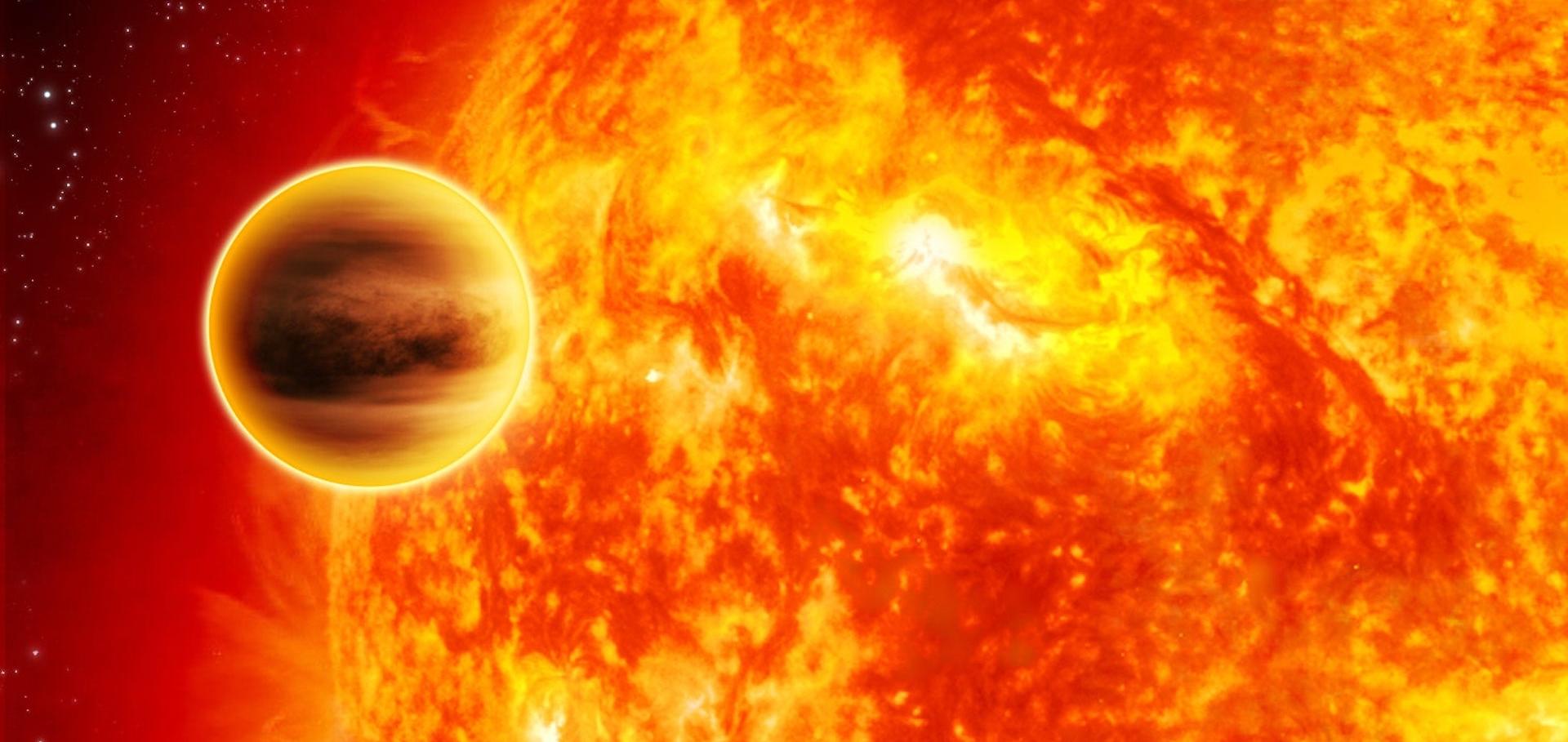
The impact of mixing treatments on cloud modelling in 3D simulations of hot Jupiters

Monthly Notices of the Royal Astronomical Society Oxford University Press (OUP) 506:3 (2021) 4500-4515

Authors:

DA Christie, NJ Mayne, S Lines, V Parmentier, J Manners, I Boutle, B Drummond, T Mikal-Evans, DK Sing, K Kohary

Abstract:

ABSTRACT We present results of 3D hydrodynamical simulations of HD209458b including a coupled, radiatively active cloud model (eddysed). We investigate the role of the mixing by replacing the default convective treatment used in previous works with a more physically relevant mixing treatment (Kzz) based on global circulation. We find that uncertainty in the efficiency of sedimentation through the sedimentation factor fsed plays a larger role in shaping cloud thickness and its radiative feedback on the local gas temperatures – e.g. hotspot shift and day-to-night side temperature gradient – than the switch in mixing treatment. We demonstrate using our new mixing treatments that simulations with cloud scales that are a fraction of the pressure scale height improve agreement with the observed transmission spectra, the emission spectra, and the Spitzer 4.5 µm phase curve, although our models are still unable to reproduce the optical and ultraviolet transmission spectra. We also find that the inclusion of cloud increases the transit asymmetry in the optical between the east and west limbs, although the difference remains small ($\lesssim 1{{\ \rm per\ cent}}$).

Erratum: “Vertical Tracer Mixing in Hot Jupiter Atmospheres” (2019, ApJ, 881, 152)

The Astrophysical Journal American Astronomical Society 917:2 (2021) 112

Authors:

Thaddeus D Komacek, Adam P Showman, Vivien Parmentier

The Air Over There: Exploring Exoplanet Atmospheres

Elements Mineralogical Society of America 17:4 (2021) 257-263

Authors:

Laura K Schaefer, Vivien Parmentier

A HARPS-N mass for the elusive Kepler-37d: a case study in disentangling stellar activity and planetary signals

(2021)

Authors:

VM Rajpaul, LA Buchhave, G Lacedelli, K Rice, A Mortier, L Malavolta, S Aigrain, L Borsato, AW Mayo, D Charbonneau, M Damasso, X Dumusque, A Ghedina, DW Latham, M López-Morales, A Magazzù, G Micela, E Molinari, F Pepe, G Piotto, E Poretti, S Rowther, A Sozzetti, S Udry, CA Watson

Geophysical constraints on the properties of a subglacial lake in northwest Greenland

The Cryosphere Copernicus GmbH 15:7 (2021) 3279-3291

Authors:

Ross Maguire, Nicholas Schmerr, Erin Pettit, Kiya Riverman, Christyna Gardner, Daniella N DellaGiustina, Brad Avenson, Natalie Wagner, Angela G Marusiak, Namrah Habib, Juliette I Broadbeck, Veronica J Bray, Samuel H Bailey

Abstract:

In this study, we report the results of an active-source seismology and ground-penetrating radar survey performed in northwestern Greenland at a site where the presence of a subglacial lake beneath the accumulation area has previously been proposed. Both seismic and radar results show a flat reflector approximately 830–845 m below the surface, with a seismic reflection coefficient of −0.43 ± 0.17, which is consistent with the acoustic impedance contrast between a layer of water and glacial ice. Additionally, in the seismic data we observe an intermittent lake bottom reflection arriving between 14–20 ms after the lake top reflection, corresponding to a lake depth of approximately 10–15 m. A strong coda following the lake top and lake bottom reflections is consistent with a package of lake bottom sediments although its thickness and material properties are uncertain. Finally, we use these results to conduct a first-order assessment of the lake origins using a one-dimensional thermal model and hydropotential modeling based on published surface and bed topography. Using these analyses, we narrow the lake origin hypotheses to either anomalously high geothermal flux or hypersalinity due to local ancient evaporite. Because the origins are still unclear, this site provides an intriguing opportunity for the first in situ sampling of a subglacial lake in Greenland, which could better constrain mechanisms of subglacial lake formation, evolution, and relative importance to glacial hydrology.