Home
Department Of Physics text logo
  • Research
    • Our research
    • Our research groups
    • Our research in action
    • Research funding support
    • Summer internships for undergraduates
  • Study
    • Undergraduates
    • Postgraduates
  • Engage
    • For alumni
    • For business
    • For schools
    • For the public
  • Support
Menu
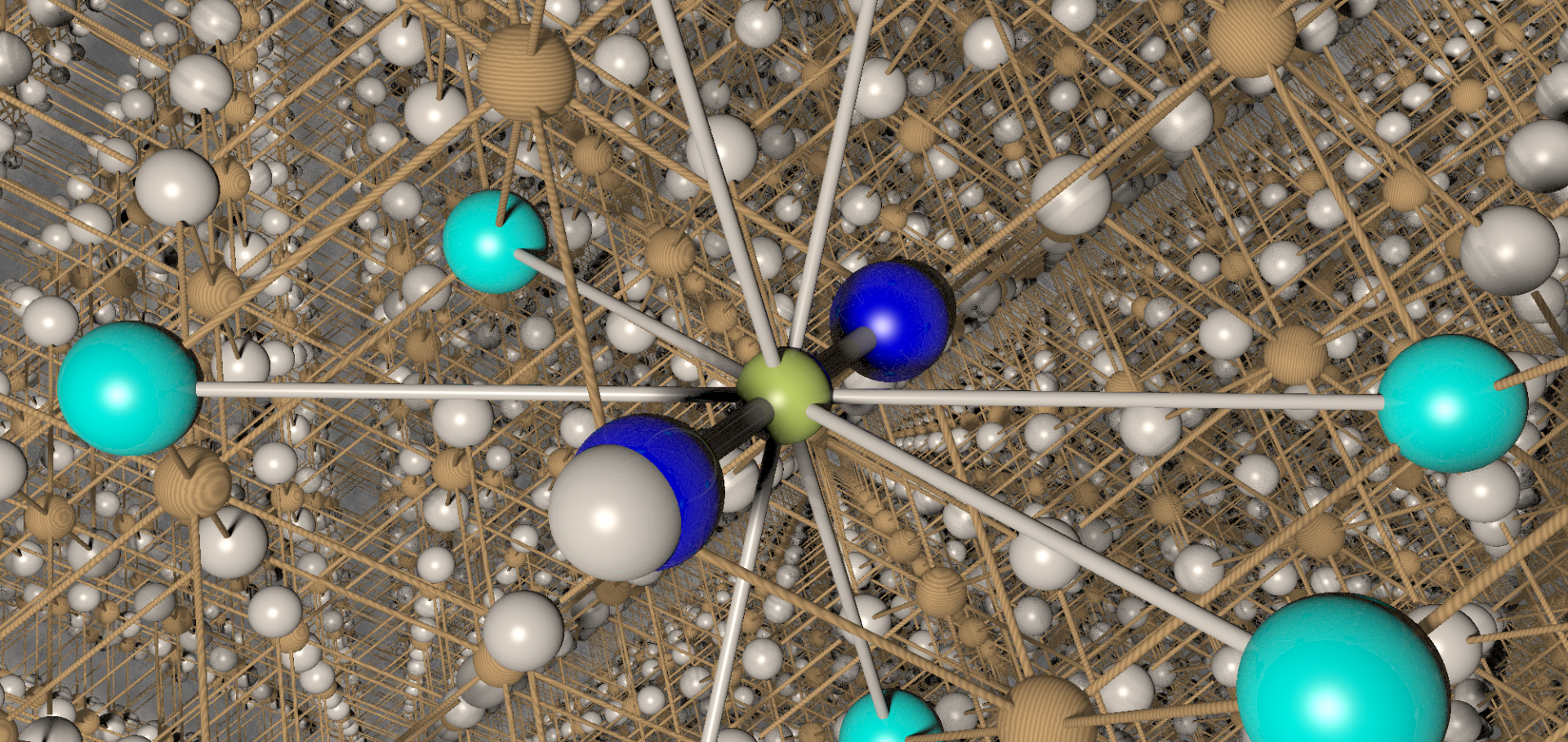
Crystal structure inside calcium fluoride with an implanted muon
Credit: SJB

Professor Stephen Blundell

Professor of Physics

Research theme

  • Quantum materials

Sub department

  • Condensed Matter Physics

Research groups

  • Muons and magnets
Stephen.Blundell@physics.ox.ac.uk
Telephone: 01865 (2)72347
Clarendon Laboratory, room 108
  • About
  • Books
  • Teaching
  • Research
  • Publications

Muon-spin relaxation studies of the low-dimensional molecular compounds Mn(dca)(2)(pyz) and Fe(NCS)(2)(pyz)(2)

PHYSICA B 374 (2006) 118-121

Authors:

T Lancaster, SJ Blundell, ML Brooks, FL Pratt, JL Manson

Abstract:

We present the results of zero field muon-spin relaxation (mu+SR) studies of the molecular magnets Mn(dca)(2)(pyz) and Fe(NCS)(2)(pyz)(2) (where dca = [N(CN)(2)](-) and pyz = pyrazine). Both of these materials possess low-dimensional structural motifs resulting in magnetic behaviour consistent with this reduced dimensionality. Mn(dca)(2)(pyz) is formed from Mn-pyz-Mn chains, linked with dca anions to form two interpenetrating three-dimensional (3D) networks. Antiferromagnetic ordering in this compound is seen as a rapid change in the measured asymmetry around T-N = 2.5 K. Fe(NCS)(2)(pyz)(2) is a two-dimensional (2D) sheet-like polymer with the sheets consisting of Fe atoms bridged by pyz ligands. mu+SR measurements display both the 3D and 2D nature of the material in the measured relaxation spectra. We observe the transition into the LRO state below T-N along with an excitation of E = 1.09(5) meV above T-N associated with fluctuations within the correlated 2D layers. (c) 2005 Elsevier B.V. All rights reserved.
More details from the publisher

Physica B: Condensed Matter: Preface

Physica B: Condensed Matter 374-375 (2006)

Authors:

SJ Blundell, PJC King, FL Pratt
More details from the publisher

Thermodynamic and magnetic properties of the layered triangular magnet NaNiO2

PHYSICA B 374 (2006) 47-50

Authors:

PJ Baker, T Lancaster, SJ Blundell, ML Brooks, W Hayes, D Prabhakaran, FL Pratt

Abstract:

We report muon-spin rotation, heat capacity, magnetization, and AC magnetic susceptibility measurements of the magnetic properties of the layered spin-1/2 antiferromagnet NaNiO2. These show the onset of long-range magnetic order below T-N = 19.5K. The temperature dependence of the muon precession frequency suggests 2D XY magnetic ordering. Rapid muon depolarization persisting to about 5 K above TN is consistent with the presence of short-range magnetic order. Our AC susceptibility measurements suggest that magnetic clusters persist above 25 K, with their volume fraction decreasing with increasing temperature, and that there is a slowing of spin fluctuations at T-sf = 3 K. A partial magnetic phase diagram has been deduced. (c) 2006 Elsevier B.V. All rights reserved.
More details from the publisher

Thermodynamic and magnetic properties of the layered triangular magnet NaNiO2

Physica B Condensed Matter 374-375 (2006) 47-50

Authors:

PJ Baker, T Lancaster, SJ Blundell, ML Brooks, W Hayes, D Prabhakaran, FL Pratt

Abstract:

We report muon-spin rotation, heat capacity, magnetization, and AC magnetic susceptibility measurements of the magnetic properties of the layered spin-1/2 antiferromagnet NaNiO2. These show the onset of long-range magnetic order below TN=19.5K. The temperature dependence of the muon precession frequency suggests 2D XY magnetic ordering. Rapid muon depolarization persisting to about 5K above TN is consistent with the presence of short-range magnetic order. Our AC susceptibility measurements suggest that magnetic clusters persist above 25K, with their volume fraction decreasing with increasing temperature, and that there is a slowing of spin fluctuations at Tsf=3K. A partial magnetic phase diagram has been deduced. © 2006 Elsevier B.V. All rights reserved.
More details from the publisher
More details

mu SR studies of the hexaboride system EuxCa1-xB6

PHYSICA B 374 (2006) 26-29

Authors:

ML Brooks, T Lancaster, SJ Blundell, FL Pratt, LD Pham, Z Fisk

Abstract:

We report the results of transverse field (TF) and zero-field (ZF) mu SR measurements on the hexaboride system EuxCa1-xB6. EuB6 is a semimetallic ferromagnet that magnetically orders via two transitions at T-m approximate to 15 K and T-c approximate to 12 K, with colossal magnetoresistance accompanying the higher temperature transition. New TF mu SR measurements on EuB6 allow us to follow the temperature evolution of the local magnetic field distribution through the two magnetic transitions. Substitution of Ca for Eu dilutes the magnetic sublattice, causing a substantial suppression of the transition temperature, with the transition completely removed when the doping level approaches the three-dimensional site percolation limit, x(p) = 0.31. ZF experiments on doped samples, 0.35 <= x <= 1, enable a sensitive local-probe exploration of the order and dynamics across the phase diagram. (c) 2005 Elsevier B.V. All rights reserved.
More details from the publisher

Pagination

  • First page First
  • Previous page Prev
  • …
  • Page 129
  • Page 130
  • Page 131
  • Page 132
  • Current page 133
  • Page 134
  • Page 135
  • Page 136
  • Page 137
  • …
  • Next page Next
  • Last page Last

Footer Menu

  • Contact us
  • Giving to the Dept of Physics
  • Work with us
  • Media

User account menu

  • Log in

Follow us

FIND US

Clarendon Laboratory,

Parks Road,

Oxford,

OX1 3PU

CONTACT US

Tel: +44(0)1865272200

University of Oxfrod logo Department Of Physics text logo
IOP Juno Champion logo Athena Swan Silver Award logo

© University of Oxford - Department of Physics

Cookies | Privacy policy | Accessibility statement

Built by: Versantus

  • Home
  • Research
  • Study
  • Engage
  • Our people
  • News & Comment
  • Events
  • Our facilities & services
  • About us
  • Giving to Physics
  • Current students
  • Staff intranet