



2nd-order Fermi acceleration as the origin of the Fermi bubbles
Proceedings of the 32nd International Cosmic Ray Conference, ICRC 2011 7 (2011) 36-39
Abstract:
Gamma-ray data from Fermi-LAT show a bi-lobular structure extending up to 50 degrees above and below the Galactic centre, coincident with a possibly related structure in the ROSAT X-ray map which presumably originated in some energy release close to the centre a few million years ago. It has been argued that the gamma-rays arise due to inverse Compton scattering of relativistic electrons accelerated at plasma shocks present in the bubbles. We explore the alternative possibility that the relativistic electrons undergo stochastic 2nd-order Fermi acceleration in the entire volume of the bubbles by plasma wave turbulence. This turbulence is generated behind the outer shock and propagates into the bubble volume, leading to a non-trivial spatial variation of the electron spectral index. Rather than a constant volume emissivity as predicted in other models we find an almost constant surface brightness in gamma-rays and also reproduce the observed sharp edges of the bubbles. We comment on possible cross-checks in other channels.Anisotropies and chemical composition of ultra-high energy cosmic rays using arrival directions measured by the Pierre Auger Observatory
Proceedings of the 32nd International Cosmic Ray Conference Icrc 2011 2 (2011) 137-140
Abstract:
The Pierre Auger Collaboration has reported evidence for anisotropy in the distribution of arrival directions of the cosmic rays with energies E > EConstraints on high-energy neutrino emission from SN 2008D
Astronomy and Astrophysics 527:4 (2011)
Abstract:
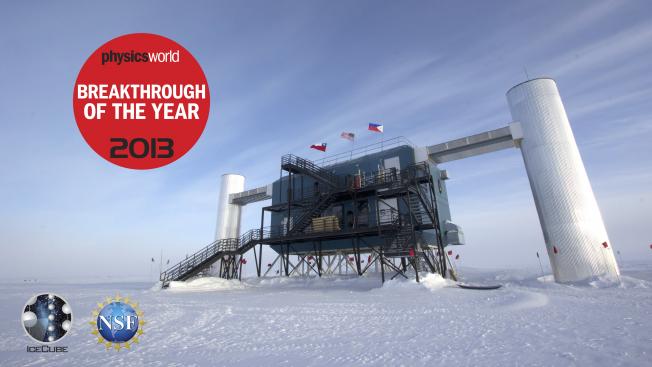
SN 2008D, a core collapse supernova at a distance of 27 Mpc, was serendipitously discovered by the Swift satellite through an associated X-ray flash. Core collapse supernovae have been observed in association with long gamma-ray bursts and X-ray flashes and a physical connection is widely assumed. This connection could imply that some core collapse supernovae possess mildly relativistic jets in which high-energy neutrinos are produced through proton-proton collisions. The predicted neutrino spectra would be detectable by Cherenkov neutrino detectors like IceCube. A search for a neutrino signal in temporal and spatial correlation with the observed X-ray flash of SN 2008D was conducted using data taken in 2007-2008 with 22 strings of the IceCube detector. Events were selected based on a boosted decision tree classifier trained with simulated signal and experimental background data. The classifier was optimized to the position and a "soft jet" neutrino spectrum assumed for SN 2008D. Using three search windows placed around the X-ray peak, emission time scales from 100-10-000 s were probed. No events passing the cuts were observed in agreement with the signal expectation of 0.13 events. Upper limits on the muon neutrino flux from core collapse supernovae were derived for different emission time scales and the principal model parameters were constrained. While no meaningful limits can be given in the case of an isotropic neutrino emission, the parameter space for a jetted emission can be constrained. Future analyses with the full 86 string IceCube detector could detect up to ∼100 events for a core-collapse supernova at 10 Mpc according to the soft jet model. © 2011 ESO.Cosmogenic photons as a test of ultra-high energy cosmic ray composition
Astroparticle Physics 34:6 (2011) 340-343
Abstract:
Although recent measurements of the shower profiles of ultra-high energy cosmic rays suggest that they are largely initiated by heavy nuclei, such conclusions rely on hadronic interaction models which have large uncertainties. We investigate an alternative test of cosmic ray composition which is based on the observation of ultra-high energy photons produced through cosmic ray interactions with diffuse low energy photon backgrounds during intergalactic propagation. We show that if the ultra-high energy cosmic rays are dominated by heavy nuclei, the flux of these photons is suppressed by approximately an order of magnitude relative to the proton-dominated case. Future observations by the Pierre Auger Observatory may be able to use this observable to constrain the composition of the primaries, thus providing an important cross-check of hadronic interaction models. © 2010 Elsevier B.V. All rights reserved.Design concepts for the Cherenkov Telescope Array CTA: An advanced facility for ground-based high-energy gamma-ray astronomy
Experimental Astronomy 32:3 (2011) 193-316